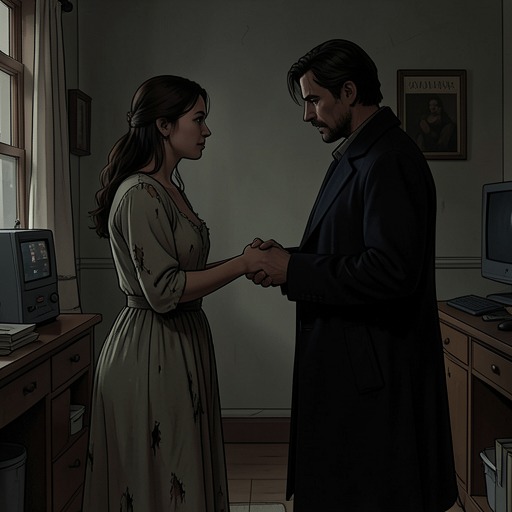
Therese's escape from Gernande château
JustineTherese's escape from Gernande château is a failed rescue attempt that becomes an escape from imprisonment. She and Madame de Gernande plan to send the Countess's mother a letter exposing the Count's abuses, but the supposed way out proves to be an inner park enclosed by a higher, fortified wall. The Count discovers the letter and imprisons Therese; only when news of the Countess's collapse draws him away does Therese find an opening to flee. She reaches Lyon, but the escape brings neither justice for the Countess nor relief from the pattern of hardship that defines Therese's life.
A Plan to Reach the Countess's Mother
After a year in the household, Therese believes that Madame de Gernande understands her wish to help. The two women agree to expose the Count's conduct to the Countess's mother, whom Madame de Gernande expects to come quickly to her daughter's aid. Their difficulty is practical as well as political: they are closely watched and confined to the Countess's apartment, and cannot simply leave the château to seek help.
Therese studies the ramparts around the terrace and estimates that they are scarcely thirty feet high. From what she can see, she assumes that descending them would bring her directly to the road through the forest. Madame de Gernande cannot confirm this impression: she was brought to the apartment at night and has not left it since. Therese therefore takes responsibility for testing the route, while the Countess writes a letter designed to persuade her mother to rescue her.
The Descent and the Hidden Enclosure
After nightfall, Therese uses the bed linen to lower herself to the ground outside the terrace. The descent does not carry her beyond the château's outer boundary, as she had expected. She has entered only a park, itself enclosed by walls that the dense trees had concealed from view. These walls rise more than forty feet and are topped with broken glass. The apparent route to freedom thus leads into another enclosure, more formidable than the one she had tried to cross.
With dawn approaching, Therese recognizes that returning to the apartment would expose the attempt. She fears the Count's response, especially because he has spoken of making a woman suffer through repeated bloodletting. She waits beside a tree, uncertain what will happen, until the Count himself enters the park in the morning. Startled to find her there, he asks what she is doing; Therese admits fault and begs him to punish her. But the letter she has forgotten to destroy is visible above her kerchief. The Count takes it, reads it, and orders her to follow him.
Imprisonment and the Count's Threat
The Count leads Therese through a concealed stairway into the château's vaults and locks her in a dungeon. He declares that her attempted escape is punishable by death and says he will carry out the sentence after dinner the following day. Before leaving, he roughly drags and throws her across the cell, then renews his threat to make her death more terrible by delaying it. Therese spends the night in fear, unable to know what punishment awaits her.
After thirty-six hours, the Count returns alone and announces that he intends to bleed her three times a day as an experiment. He draws two bowls of blood from her arm. The threat has moved from words to action: Therese's attempt to carry the Countess's appeal to the outside world has resulted in her own confinement and an immediate assault on her health.
The Opening and Flight to Lyon
The Count is interrupted by a servant who reports that Madame de Gernande is dying and wants to speak with him. He leaves in alarm and fails to secure the dungeon door. Despite fasting and the blood she has lost, Therese escapes her cell, crosses the courtyard and park, and reaches the forest without being seen. Her release therefore follows not from the successful execution of the women's plan, but from a lapse caused by the crisis inside the château.
Therese walks until she reaches a cottage four leagues away, where she rests and has her needs attended to. At daybreak she sets out again, asks directions to Lyon, and arrives there on the eighth day, weak and suffering but no longer pursued. She chooses not to make another complaint to the authorities and concentrates first on recovering. The failed attempt to secure help for the Countess has become a narrow escape for Therese herself; the evidence does not establish what happens to Madame de Gernande after the servant's announcement.
Narrative Significance and Aftermath
The episode turns on a repeated reversal: a route Therese believes leads out of captivity brings her into a more tightly enclosed space, and a plan to obtain help instead exposes her to the Count's punishment. Her eventual escape depends on an unforeseen interruption rather than on the strength of the plan. The Count's departure, prompted by news that the Countess is dying, creates the opening through which Therese survives.
The escape is also recounted within Therese's testimony to Madame de Lorsange and Monsieur de Corville. At Montargis, the guards have brought Therese toward Paris for confirmation of a sentence handed down in Lyon; moved by the account of her troubles, the listeners give her the opportunity to speak. Her recollection of the château thus forms part of a larger appeal to be understood as innocent rather than criminal. Its aftermath preserves the novel's stark contrast between virtue under pressure and wrongdoing apparently rewarded: in Lyon, Therese reads that Rodin has been appointed First Surgeon to the Empress of Russia, even as she continues her journey toward Grenoble.