Therese's escape from Saint Mary-in-the-Wood
JustineTherese's escape from Saint Mary-in-the-Wood is both a practical flight from confinement and a revelation of the institution's hidden violence. After two months of preparation, she slips out through a window, encounters evidence of other imprisoned girls and dead victims, and makes her way beyond the monastery's enclosing barriers. The escape secures her freedom from the building, but not peace: at dawn she is left to reckon with what she witnessed and with the damage the monastery has done to her faith.
Preparation and Opportunity
The immediate opening comes when Antonin announces that Father Severino has been appointed General of the Benedictine Order and is departing. Severino leaves without taking his leave of the women; the monks are expected to appoint a replacement reputed to be even more debauched. The news makes delay more dangerous. When the monks decide to remove another companion, Therese chooses the day her sentence is pronounced, calculating that their attention will be occupied by the condemned girl.
Therese has been preparing for two months without arousing suspicion. With a dull pair of scissors, she saws through the bars at her window until the gap is wide enough for her head. She makes a rope from sheets and linen, long enough to descend the building's twenty or twenty-five feet, and keeps the opening carefully covered until the night of her attempt. Her small reserve—about six louis, hidden when her other belongings were taken—goes into her hair. These details make the escape a patient act of planning rather than a sudden dash: she has arranged a way out of the room, preserved a little money, and selected a night when the authorities are distracted.
The Enclosures and the Hidden Victims
Once on the ground, Therese finds that leaving the window is only the first obstacle. The monastery’s grounds are divided by six successive enclosures of stone and trees, their narrow rings only about eight feet across. In the darkness, she circles the first barrier and passes the apparently deserted dining hall. A lit basement window, however, opens onto a scene that changes her understanding of the place: her condemned companion lies on a trestle table, while four naked girls unknown to Therese’s own group are also held below. The revelation is not merely that the monks have more captives than the women knew; the monastery’s hidden system extends beyond the chamber and circle of prisoners Therese has experienced.
She abandons the search for an existing gap and cuts through a hedge with a long knife. Beyond it, the ground turns soft, and she realizes she has entered what appears to be the burial area. Her hands meet a corpse’s head beneath the shallow earth. The bodies may include Omphale or Octavie, though Therese cannot identify them; the uncertainty makes the discovery a reckoning with the fate that may await every captive, including herself. For a moment she questions whether escape is worth pursuing and whether she has contributed to the crimes around her. She then turns that despair into resolve: she believes she must resist the institution and prevent further victims from suffering under it.
Breaking Through and Reaching the Road
Therese keeps moving through the successive hedges, cutting openings with her knife. Past the apparent burial ground, the terrain becomes firm, and she finds no further sign of the horrors she has just encountered. She reaches the moat beside the church and adjoining building; the wall Omphale had described is absent, though the ditch itself remains an obstacle. Following its edge to a point opposite a forest road, Therese crosses the dry, brick-lined moat. Her first attempt to climb the far side fails when loose bricks collapse beneath her, bringing rubble down on her and leaving her head cut and bleeding. The fall makes her wonder whether Heaven is warning her not to continue, but she rejects the idea that the monastery’s corruption has made evil necessary or escape sinful. Using the new gaps in the debris, she climbs out and reaches the crest.
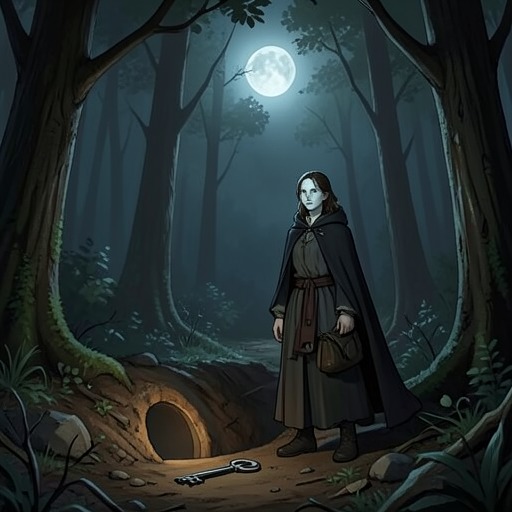
She has strayed from the forest road during the struggle, but, having noted its position, finds it again and runs. Before daybreak she reaches the edge of the forest and the small hill from which, six months earlier, she had first seen the monastery. Freedom brings relief, but not uncomplicated triumph: Therese kneels to ask God to forgive the sins she unwillingly committed inside the institution, and tears follow. She compares her present condition with her earlier departure, when she had set out under a devout principle that proved disastrously misplaced. Her reflections are partly relieved by the knowledge that she is free; she continues toward Dijon, believing that only there can she properly lodge her complaints.
Framing and Aftermath
The escape is recounted not as an independent scene in the outer narration but as part of Therese’s testimony to Madame de Lorsange and Monsieur de Corville at Montargis. The listener’s response gives the flight a second consequence: when Therese pauses, exhausted by the emotion of her account, Monsieur de Corville brings refreshments, and she resumes the story in detail. The frame makes her escape both an ordeal she survived and evidence placed before people with the power to act on her behalf.
The account’s aftermath also clarifies that getting beyond the monastery’s barriers does not end Therese’s exposure to danger or injustice. Earlier, after escaping the immediate reach of the Comte de Bressac, she tried to recover the clothes and more than forty louis left in her room at the château; she had only about six louis with her. She sent Jeannette with a carefully worded letter, concealing her location and asking for her belongings and money. The report that returned instead described the Marquise de Bressac’s death, the Comte’s accusation against the absent chambermaid, and the inheritance that made him substantially wealthier. Against this pattern, the monastery escape marks a physical break from one enclosure, not a guarantee that Therese’s innocence or security will be recognized.
At Montargis, the effect of hearing her accumulated misfortunes becomes decisive. Madame de Lorsange and Monsieur de Corville are deeply moved; Madame de Lorsange recognizes Therese as her sister, Justine, and the sisters embrace. Monsieur de Corville then writes to the Lord Chancellor, pledges responsibility for Therese’s innocence, and arranges for her to be placed at his château rather than returned to prison while her case is reviewed. The escape’s significance thus reaches beyond the forest road: the testimony that includes it helps turn private suffering into a claim heard by protectors, although the protection comes only after repeated captivity and long after the flight itself.