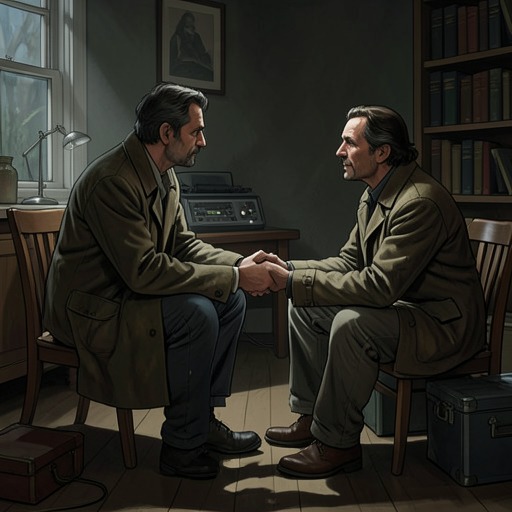
Don Aurelio's spiritual guidance of Massimo
LeilaDon Aurelio's spiritual guidance of Massimo Alberti rests less on formal instruction than on the example of a priest whose fidelity remains visible even when Massimo can no longer share his certainty. Their relationship passes through silence and doubt: Massimo fears that telling Don Aurelio of his crisis would cause pain, and doubts that an answer from him could resolve it. At Benedetto's funeral, however, Massimo reaches for his friend and announces that he has returned to Christ and the Church. Don Aurelio receives the confession with an embrace and joy, making their bond a point of human recognition within Massimo's religious return.
A living example amid Massimo's doubts
Massimo's crisis grows from more than a general loss of religious feeling. He recalls earlier doubts, his student years in Rome, and the period when Benedetto's teaching gave him confidence in his faith and in the Church. After Benedetto's death, accusations against his teacher, hostility toward Massimo as a disciple, and the corrosive influence of critical and negative reformist voices have, he confesses, weakened his beliefs. He fears that Catholicism might be a historical form whose divine element could pass into a higher religion, as Christianity had emerged from the religion of Moses. The possibility that he himself might be called to preach such a change is an anguish, not a settled conviction.
In his letter to Donna Fedele, Massimo admits that Don Aurelio does not know the state of his soul. He has not found the courage to speak to him and says he will not find the courage to write. The reason is tender as well as intellectual: he expects Don Aurelio's answer and does not want to inflict a great sorrow on him. He also recognizes Don Aurelio as an argument for the Roman Catholic Church, stronger than anything the priest could put into speech or writing. Yet Massimo immediately qualifies that force: noble, pure, convinced people exist in every church and outside them. Don Aurelio's goodness matters deeply to him, but it cannot by itself settle the theological and historical question that is undoing his certainty.
That assessment makes the guidance between them neither simple persuasion nor unbroken agreement. Massimo sees in Don Aurelio a person whose life testifies to faith, while still resisting the inference that such a witness proves the exclusive truth of one church. His silence protects his friend from pain, but also leaves Massimo alone with questions he cannot yet answer. The relationship holds both his attachment to Don Aurelio and his inability, at that point, to follow the priest's example without reservation.
Fidelity under pressure
Don Aurelio's example is sharpened by his own vulnerability. The notice from the Vicenza diocesan authorities dismisses him from the curacy of Lago di Velo within fifteen days and requires the house to be cleared of its furniture and occupants so his successor can bring his mother and sister. The official wording leaves him facing the loss of his peaceful home, his small congregation, and the practical question of where he will find shelter and food. Even as he wonders what the reference to occupants might mean, his attention turns away from his own predicament toward finding the Bible seller and recalling a grave, delicate conversation with Marcello Trento.
The episode does not show Don Aurelio teaching Massimo directly, nor does it establish that Massimo knows the details of the dismissal. Its relevance to their spiritual bond lies instead in the contrast it creates: Don Aurelio's religious life is not insulated from institutional hardship, while Massimo is questioning whether the Church can endure its conflicts and remain a vessel of divine life. Don Aurelio's conduct, rather than an argument attributed to him, is the kind of evidence Massimo says he cannot dismiss, even though it is not enough to quiet his doubts.
Reunion on the way to Oria
The relationship comes into sharpest focus aboard the boat carrying Benedetto's body toward Oria. As the passengers recite the De profundis, the boat pauses when a dark vessel crosses its course; the prayer then resumes amid the lights along the lake and the approach to the shore. In that charged passage, Massimo takes Don Aurelio by the arm and asks whether he is speaking. The question opens a private moment inside the public funeral journey. Massimo tells him, trembling, that he has returned to Christ and the Church, and that the return has happened now.
Don Aurelio's response is physical before it is explanatory: he embraces Massimo tightly and whispers that he is glad, and that Massimo has lifted a great weight from his heart. The exchange reverses the earlier silence. Massimo had kept his crisis from Don Aurelio to spare him sorrow; now he chooses to disclose the change himself, and Don Aurelio receives it not as a victory in debate but as relief within a friendship. The scene also preserves the uncertainty and struggle that preceded it: Massimo returns after a period of real doubt, rather than being shown as someone who never questioned his faith.
Don Aurelio later reflects that the young people who have come from Rome are now content, and that the excesses of some reformers and their contempt for Benedetto produced a salutary reaction in them. He adds that, had it not been too late, he would have preferred to entrust the funeral address to one of those young people. This gives a context for Massimo's change without reducing it to a single cause. The disrespect shown toward Benedetto has mattered; Don Aurelio recognizes a collective response among the young, while Massimo's own return has already been confessed in their intimate exchange.
Benedetto's memory and the limits of judgment
Don Aurelio's public words at the burial clarify the religious inheritance within which Massimo's return takes place. He distinguishes Benedetto's central work from the theological propositions for which critics had condemned him: Benedetto, he says, called believers of every rank back to the spirit of the Gospel as embodied in human lives, feelings, and actions. Don Aurelio presents him as faithful to the authority of the Church and the Holy See, and describes his love for the Church through the image of a small stone that would glory in being part of a great temple, even while being pressed by it. The address joins filial devotion to obedience, insisting that love of the Church could include suffering over the wounds inflicted upon it.
He also asks the gathered mourners to forgive those who accused Benedetto without authority to judge him, and those who mocked or insulted him for his faith. Because people know too little to judge the ignorance of others, Don Aurelio urges them to seek the way together, call to one another in darkness, and pray for all. This language echoes the difficulty at the heart of Massimo's crisis: the religious community is not free of conflict or error, yet the response Don Aurelio advocates is fidelity joined to humility and restraint in judgment.
The final bedside scene at San Mamette offers another, quieter glimpse of Don Aurelio's place in Massimo's life. As Donna Fedele waits gravely ill for Massimo, Don Aurelio arrives with him and bends to speak privately at her ear. Those standing apart cannot hear his words; they hear only Donna Fedele's faint replies, marked by surprise and joy. The contents of that exchange remain undisclosed, so it cannot be treated as a further lesson to Massimo. Its dramatic weight is in the trust surrounding the priest: at a moment of impending death, his arrival and private speech bring comfort, while Massimo is present within the circle of care. Taken together, these scenes make Don Aurelio a spiritual guide not because he resolves every doubt for Massimo, but because their friendship can contain doubt, silence, confession, and renewed faith without becoming merely an argument.