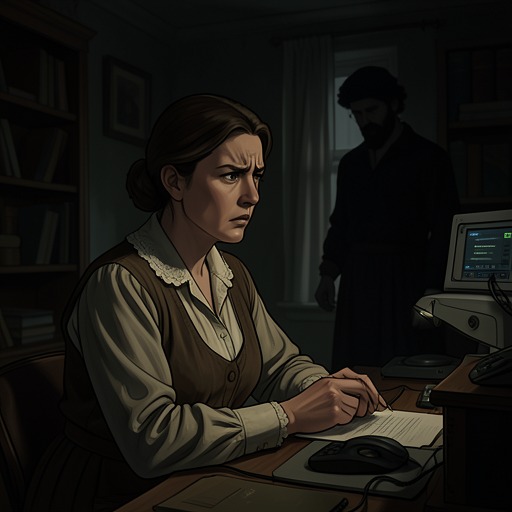
Teresina and Lelia
LeilaTeresina and Lelia are joined by an everyday intimacy that acquires greater weight as Lelia’s choices come under pressure. Teresina is her maid, but her attention is not merely routine: she notices changes in Lelia’s expression, understands the danger she may be in, and speaks up when others would restrict her. Their relationship emerges through these small acts of observation and intervention, then becomes most urgent when Lelia vanishes and Teresina fears she may have gone to harm herself.
Household Proximity and Unequal Positions
Teresina’s connection to Lelia is formed within the household, where she serves as a maid and encounters the consequences of Lelia’s dependence on others. The relationship is not one of equal standing: Teresina works within a domestic hierarchy, while Lelia’s future is shaped by her inheritance, her father’s claims, and the decisions made by people who shelter her. Yet Teresina’s position gives her access to the practical details of Lelia’s life. She sees who visits, hears what is being planned, and can relay information between the household and Lelia’s protectors.
That practical role appears when the agent handling Marcello Trento’s affairs reports that he acted at Teresina’s request. His letter informs Donna Fedele that Lelia is the universal heir, that Teresina herself has been left a daily legacy of five lire exempt from tax, and that Lelia’s father has announced his arrival. The episode places Teresina at the point where household knowledge meets legal and family upheaval. She is not the decision-maker in the inheritance dispute, but she helps ensure that those responsible for Lelia’s welfare learn what is happening.
Attentiveness and Advocacy
Teresina’s concern is especially visible after Lelia receives a letter that transforms her mood. When they meet at the villa entrance, Teresina remarks on the Alpine roses Lelia carries, but what truly astonishes her is the new brightness in Lelia’s eyes. She also tells Lelia that Siora Bettina Fantuzzo is evidently offended because Lelia has left her for Donna Fedele. Lelia asks what Bettina wanted, then goes upstairs without waiting for an answer. Teresina thus notices both Lelia’s private happiness and the social friction around her, even when Lelia is absorbed in her own secret.
Her loyalty becomes more explicit in dealings with Lelia’s father. Teresina dislikes him for his lewd advances toward her, his meanness, and his personal uncleanliness. After she resists his advances, he changes his manner, becoming ingratiating and respectful; having noticed her devotion to Lelia, he begins to speak to her about his daughter as though she were a listening device. His approach is self-interested, but it also gives Teresina an opportunity to answer him directly. When he suggests that Lelia’s religious visits might expose her to improper influence, Teresina tells him that Lelia may visit as many convents as she wishes and that going to Monte Berico would be a good thing. Her reply rejects the father’s effort to frame Lelia’s devotional choices as a danger.
Lelia’s Father as a Source of Pressure
The contrast between Teresina’s protective attention and her father’s calculations sharpens the significance of their bond. Before visiting Donna Fedele, Lelia’s father considers how to secure control over money and obtain support from his daughter once she reaches adulthood. He wants to draw her back into his home, but he also wants to preserve his relationship with Gorlago, which makes keeping Lelia and Gorlago together impossible in his view. When he later visits Lelia, he offers her money and speaks of accounting for it, while she receives his kisses rigidly and does not invite him to sit.
Teresina is not able to resolve this conflict or provide Lelia with independent legal or financial security. Her advocacy is narrower but meaningful: she refuses to echo the father’s suspicions, and she is attentive to Lelia’s wishes rather than treating her as an instrument of household or financial plans. The difference is also reflected in the narrative’s portrait of her father. He tries to use Teresina’s access to Lelia for his own purposes; her concern for Lelia instead guides what she tells him and what she reports to Donna Fedele.
Flight, Fear, and Trust
When Lelia flees, Teresina becomes one of the people who tries to understand where she has gone. The news reaches her through a chain of local reports: a railway worker told the station custodian, who passed it on, and others in the village also heard. Teresina initially considers whether Lelia may have gone to a convent, but then fears that she has gone to throw herself over a precipice. Her alarm is grounded in the fact that Lelia has once before been close to such a danger.
Teresina goes to Donna Fedele in tears, hoping she knows something. After hearing Teresina’s fear, Donna Fedele writes to reassure her that the catastrophe she dreads is not to be feared because she has Lelia’s solemn promise. The reassurance reveals that Teresina’s concern is serious enough to prompt a direct response, and that Lelia’s promise not to take her life has become part of the trust between the women. Teresina is not present in the later arrangements for Lelia to leave Valsolda with Donna Fedele, so the narrative does not show her role in that decision or give a final account of their relationship. What it does establish is the force of her anxiety during the disappearance and her confidence in seeking news from the person closest to Lelia.
The Bond’s Narrative Significance
The relationship is defined less by shared conversation than by attention, mediation, and protective judgment. Teresina notices what Lelia may not explain; she carries news across the household; and, when her employer tries to enlist her, she answers according to what she believes is best for Lelia. The pattern is not uncomplicated: Teresina is herself vulnerable to the father’s sexual conduct and remains a servant within the household that he controls. Her loyalty therefore operates without equal power, expressed in what she observes, what she reports, and the advice she is willing to give.
The flight brings that quiet loyalty into sharper focus. Others speculate about Lelia’s destination, but Teresina’s first urgent concern is whether she has endangered herself. Donna Fedele’s reply, grounded in Lelia’s solemn promise, turns their separate concern into a small network of care around Lelia. The novel leaves the bond’s later course unstated, but its evidence makes Teresina one of the figures who recognizes Lelia’s vulnerability and acts on that recognition.