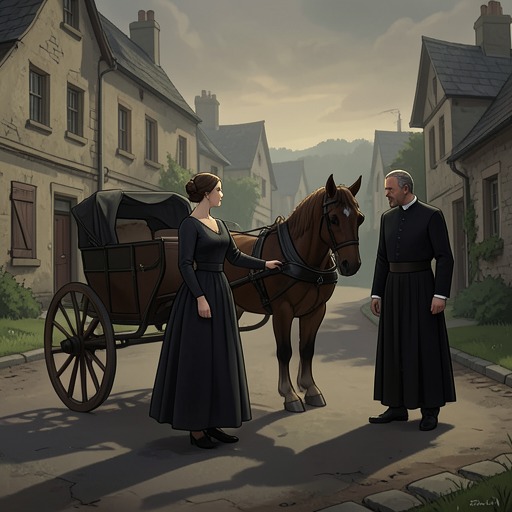
Donna Fedele's severe frailty
LeilaDonna Fedele’s severe frailty is both a physical limit she works to conceal and a condition that alters how she cares for others. Her illness does not immediately remove her from an active life: she continues to give practical help while tolerating pain in silence. But as her strength fails, small acts—rising from bed, crossing a room, keeping vigil—become measures of the cost of that devotion. In the final crisis, a high fever and general infection make clear that her body can no longer resist.
A Hidden and Intermittent Illness
Donna Fedele is notably tolerant of physical pain and rarely speaks of her own suffering. The severity of her condition is therefore often legible to others through interruptions in habit rather than through her complaints. She normally rises at six and lives by a demanding routine, but one morning Massimo Alberti finds her still in bed. Her maid takes this departure from custom as a sign that she must be suffering badly. Even when illness prevents her from keeping up her usual activities, Donna Fedele has been reluctant to let it become the subject of conversation.
Her ordinary days encompass the care of her household and roses, visits to sick people and the poor, correspondence, reading, and even lessons. She teaches arithmetic and composition to a doorkeeper’s daughter and French to the physician’s young daughter in Arsiero; although ill, she finds it difficult to refuse anyone the help she can provide. This routine gives her illness a particular shape: it is not only pain but the repeated struggle to continue obligations and forms of service that exceed her available strength.
The narrative shows that limit in sudden physical collapses as well as in quieter absences. After a confrontation that leaves her trembling, Donna Fedele has no strength to continue on foot. The fresh wind in the Astico Valley revives her somewhat, but not enough to undo the exhaustion. On another occasion, she tries to rise in anger and effort, then struggles to take a few steps before admitting that the attempt is too much. Her stoicism does not mean that she is unaffected; it means that the extent of her suffering becomes visible only when ordinary movement is no longer possible.
Frailty and the Work of Care
Donna Fedele’s illness becomes entangled with her care for Lelia. When Lelia is found after going out at night in a state of severe agitation and loses consciousness, Donna Fedele summons the doctor and explains what he needs to know, asking him to preserve Lelia’s confidence by treating the episode as sleepwalking. She manages the practical details even as her own health is failing. After Lelia develops a high fever, Donna Fedele stays close, monitors her, and calls for medical help.
The physician does not recognize the true cause of Donna Fedele’s own suffering. He attributes her condition to fatigue and advises her to sleep alone and in peace. She does not correct him. For her, solitude is not peace: she wants to give herself to Lelia, partly out of love for the young woman and partly out of devotion to Marcello Trento and the love Marcello had continued to give his dead son. Donna Fedele has a bed placed beside Lelia’s and accepts the suffering this care entails. The contrast is sharp: the doctor sees a patient who should rest, while Donna Fedele understands her remaining strength as something to spend in attendance on another.
That work is not presented as effortless. During Lelia’s fever, Donna Fedele must dress with painful effort before speaking privately with the doctor. She conceals the reason for Lelia’s nighttime departure, asks that the fiction of sleepwalking be maintained, and remains near her as Lelia refuses both food and medicine. The sickroom thus holds two bodies in different kinds of danger: Lelia’s fever and agitation are visible and treated, while Donna Fedele’s own condition remains largely unspoken and unexplained.
Medical Judgment and Diminishing Choice
The medical evidence about Donna Fedele’s condition accumulates without establishing a single earlier diagnosis. Her bodily weakness is evident, and later a doctor finds her heart very weak and fears for her life. Yet she retains a measure of agency in how she approaches treatment. When the doctor visits, he cannot conduct the complete examination he considers necessary to assess her real condition. Donna Fedele tells him that she intends to leave for Turin for an operation the next morning, but says she will not depart without his permission and asks him to return and give his judgment.
Her plan makes the tension between intention and physical vulnerability explicit. She is preparing to seek treatment, but the journey depends on a medical assessment she has not yet received; the doctor’s concern about her heart makes the risk plain. The evidence does not specify the operation or establish what treatment might have changed. Instead, it shows Donna Fedele trying to decide responsibly while her strength and time are narrowing. She has not simply abandoned medical care, but neither can she control the course her illness will take.
Final Deterioration
Donna Fedele’s condition worsens almost suddenly after midday. She has no pain, but her fever rises sharply, and the doctor identifies the onset of a general infection. Nothing more can be attempted; her body has lost the power to resist, and death is near. Fully conscious of her state, she asks at once for a priest and the viaticum. The provost of San Mamette arrives, and by five the religious rites have been completed. Her response is composed and deliberate even as the medical account closes off the possibility of recovery.
Her attention remains fixed on Massimo Alberti’s return. A telegram from him, sent from Porto Ceresio, visibly displeases her; she believes he might have avoided going there. She repeatedly asks when he will arrive, then apologizes to Lelia for asking so often, understanding that the message means he cannot come sooner. She wants to say a few final things and fears that he will not arrive in time. The frailty that has long constrained her actions now imposes a final limit on speech and farewell: she remains lucid, but must wait, uncertain whether her strength will last until the person she hopes to see returns.