Il pianoforte della Montanina
LeilaThe piano at Montanina is an old, poor-sounding instrument whose importance lies less in its condition than in what the people around it entrust to its keys. For Marcello Trento, it gives musical form to religious feeling, remorse, and enduring grief for Andrea Trento; for Lelia Camin, it holds memories bound up with Andrea; and, heard from elsewhere in the house, it gives Massimo Alberti an impression of Lelia that conversation alone has not supplied. Its recurring presence turns a domestic object into a private medium of expression, carrying what the characters struggle to say directly.
The piano and Marcello’s musical life
Marcello is not a strong pianist, but his musical sensibility is deep. Music gathers together his religious faith, his affections, and his response to artistic and natural beauty. He reveres composers alongside poets and saints, and reads daily from the works of the great composers as he would from the Gospels. At night, especially in the hour of memories and reverie, he often gives himself over to improvisation. He can become so absorbed in trying to bring musical expression into accord with his inner life that he loses track of present concerns and the passing of time. The piano is thus not simply an instrument he plays: it is the means through which private experience becomes audible.
That intimacy is registered in the object’s shabby material state. The piano is described as an old, wheezing instrument, one Marcello’s confidant of dreams, and one Lelia has scorned. Marcello nevertheless feels tenderness for it, and fears that its life may end in some miserable fashion. The contrast matters: the instrument that seems inadequate beside the elegant lamps in the house can still serve him as a more faithful companion than its polished surroundings. Its worn sound does not prevent emotional force; it is the medium through which that force emerges.
Marcello’s nocturnal improvisation
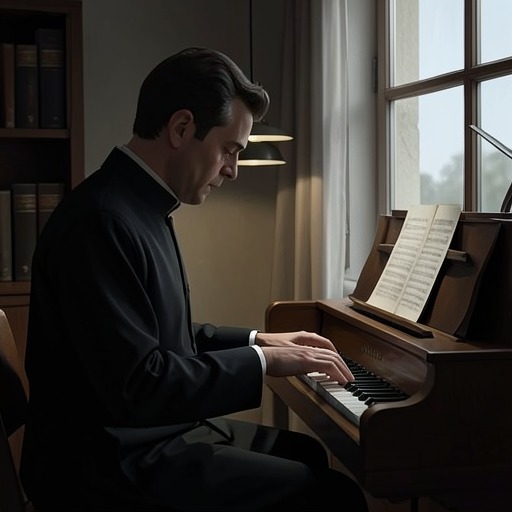
One night, while the household sleeps, Marcello leaves his room carrying a closed wallet. In the salon, he places it on a lectern and opens it with trembling hands to look at Andrea’s portrait. He gazes at his son for a long time, kisses the portrait on the forehead, and puts it back with reverence. Then he sits at the piano. A small brass lamp illuminates the scene, set on the piano’s lid, while Marcello plays with his face lifted and his eyes closed, feeling his way across the keys.
His playing turns first toward sacred music and the thought of death. As he reaches for the last song of Pergolese, his tears fall silently. The music carries his longing to be reunited with Andrea within a larger, divine love. But the piano also brings painful memories of his own sins into view. At that point his hands fall still against the silent keyboard and his head sinks to his chest. The pause does not last: in humility, he finds it possible to surrender himself to divine mercy. He resumes, and the piano carries a passionate prayer, a Miserere shaped by sorrow but also by sweetness, gratitude, and the image of cleansing. The instrument gives sound to both grief and repentance, without making either one simple.
Teresina, sleeping on the ground floor that night, hears the music and worries that Marcello may be unwell. She wakes Lelia Camin, and they descend quietly to watch him. From the stairs they see his bent back following the music’s movement. Lelia restrains Teresina when the maid is about to intervene: she understands the playing as inspired rather than delusional and wants to listen before disturbing him. Marcello ends the improvisation with grave chords, closes the wallet, folds his arms, and rests his forehead on it. Lelia then goes down to him herself. The piano has turned an apparently alarming episode into a moment of intimacy with his grief, which Lelia approaches through listening rather than interruption.
Andrea’s memory and Lelia’s playing
The piano also connects Lelia to Andrea through a melody associated with their shared past. Earlier, Lelia had used a particular inflection in speaking to Marcello; she remembers that Andrea liked the sound of it, and recalls Marcello’s dark silence when she mentioned this. Now, as Marcello watches her, he touches out the melody Andrea used to hum and that Lelia sometimes played in the dark, without either of them speaking about it before or afterward. The piano makes the remembered relationship present through repetition, while the silence around the music preserves its delicacy. It is not merely an accompaniment to recollection: its melody is itself the means by which that recollection passes between Marcello and Lelia.
Lelia’s own playing can reveal a different strain of feeling. In a later encounter, after Massimo Alberti answers her suggestion that he may not care for music with a faint smile that wounds her, she abruptly opens the piano and plays a piece from Schumann’s Carnaval from memory. Her performance is too nervous to have sweetness. When she finishes, she remains still. Massimo’s earlier response has been followed by a musical gesture that he recognizes as personal: the black dress and flowers of remembrance, her questions at dinner, her attention to his stories, and now her choice of an impassioned piece all make him reconsider whether she is indifferent or hostile. The piano allows a slight, exposed reaction to take shape without Lelia having to explain it.
A sound heard across the house
On another night, Massimo hears piano music from inside Montanina and cautiously opens his door to listen. He initially thinks Marcello has gone to bed, and recalls Andrea’s admiration for Lelia’s pianistic talent. The instrument sounds poor, but the playing strikes him as expressive, passionate, and disordered. He recognizes something of the Stabat of Pergolese before losing his bearings in the improvisation. What reaches him is not an image of a person closed within sorrow or expecting nothing more from life: the music communicates pain together with a thirst for love and joy.
The playing pauses; Massimo hears nearby footsteps and whispers, retreats toward his room, and then listens again as the music resumes. Now it moves through lament and prayer into tenderness and ardor. The scene makes the piano a conduit between people who are not yet speaking openly to one another. Marcello’s nighttime playing is bound to his son, faith, and repentance; Lelia’s sound reaches Massimo as evidence of emotional life beyond the reserve he has observed. Across its separate appearances, the battered piano gives private memory a public edge: someone else may hear, interpret, and be changed by what is played, even when the player has not meant to address them.