La lucerna fiorentina di ottone
LeilaLa lucerna fiorentina di ottone is a three-spouted brass lamp whose importance lies in more than its practical light. It has illuminated two generations of the Trento family, and its return in moments of prayer, grief, and music makes it a domestic heirloom through which Marcello Trento’s present is continually measured against the dead. Its flame belongs at once to the ordinary rooms of the Montanina and to Marcello’s private reckoning with mortality.
An Inherited Lamp
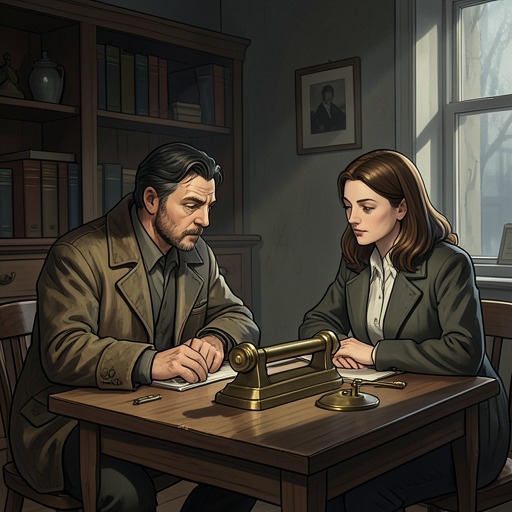
The lamp stands on Marcello’s crowded study table, where its light falls on papers and on his graying head. The narrator emphasizes that it had once illuminated the head of Marcello’s father. The object’s history is therefore visible in the scene: the same familiar light has passed from father to son, while the faces beneath it have aged and changed.
Its three spouts and brass construction give the lamp a particular, tangible presence among the house’s furnishings. It is not described as a decorative piece set apart for display. Rather, it serves the intimate work of lighting a room, and its connection to family memory emerges because it has remained in use across years. In the study, the old lamp is an everyday possession; beside Marcello, its inherited past quietly accompanies the present.
The Flame and the Father's Death
When Teresina leaves him alone, Marcello rises and turns toward the great window, looking out at the dark sky over Mount Torraro and the slopes descending toward the Posina ravine. His silent gesture of prayer is set against the lamp still burning on the table. The scene recalls his father’s final illness and death: at the age of seventy-two, the older man had shown symptoms that a doctor identified as arteriosclerosis, and five months later he was found dead in bed. The same brass lamp had been burning beside him.
That recollection gives the object a grave, intimate association. The lamp has not merely survived its first owner; it was present at the end of his life, and now illuminates a son who is approaching the same age. Yet Marcello experiences the moment not simply as terror. He regards the prospect of death as solemn and, in his religious imagination, as a possible passage toward reunion with the souls he longs for. The flame’s continuing presence holds these responses together: it recalls a particular death while lighting the living man’s prayer.
The narrator makes the lamp seem almost animate, as though its silent flame could remember and understand the solemnity of the hour. That personification grows from its actual history in the household rather than from any supernatural action. The object has witnessed the father’s death and now stands beside the son’s inward preparation for his own; its familiar light makes the parallel difficult for Marcello to ignore.
Portrait, Night, and Music
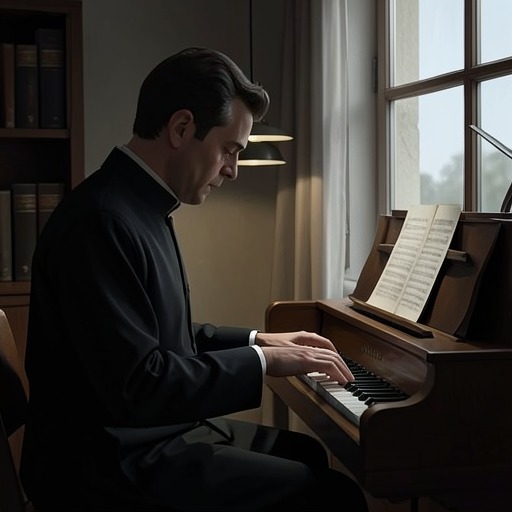
Later, when the house has been dark for some time, Marcello comes out of his room carrying the lamp in his left hand and a closed portfolio against his chest. He passes through the study and billiard room into the hall, raises the lamp, and sets it on the piano, which stands at an angle beneath one branch of the staircase. The movement takes the family light out of its customary place and brings it to the instrument where Marcello turns to memory.
He opens the portfolio with trembling hands. Inside is a portrait of his son, Andrea Trento. Marcello gazes at it for a long time, his eyes filling with tears, then kisses the portrait on the forehead and carefully returns it to the music stand. The lamp’s light makes this private act possible. The narrator imagines the little brass lamp as glad to show the young man’s face, giving the object a tenderness that matches Marcello’s reverence for both the image and the dead.
Marcello then lays his large, thin hands on the keyboard and begins to play with his face lifted and his eyes closed. The lamp remains close to the portrait as music takes over where speech does not. Marcello is not a powerful pianist, but music gives expression to his religious faith, affections, and responsiveness to beauty. In this scene, the lamp does not cause his playing or stand for music itself; it illuminates the portrait and the hands through which grief is being turned into sound.
Memory, Use, and Meaning
The lamp’s appearances link separate kinds of remembrance. In the study, its light recalls Marcello’s father and the death that happened beside it. In the hall, carried from room to room after dark, it helps him face Andrea’s portrait and enter the musical reverie that follows. Its significance develops through these repeated, concrete uses: the lamp remains a source of light, but each return brings an earlier family loss into the present scene.
Its contrast with the elegant lamps hanging from the ceiling clarifies Marcello’s attachment. Those furnishings may be more refined, but the old brass lamp is dearer to him because it bears the accumulated intimacy of family life. It has illuminated his father and now accompanies Marcello as he looks upon his son’s image. The object gathers three generations into one household space without erasing their separations: the grandfather is dead, Andrea is dead, and Marcello is still alive, praying and playing beneath the same inherited light.
The lamp’s power is therefore both material and narrative. Its flame joins domestic routine to the exceptional moments when mortality becomes present to Marcello, while its mobility lets the narrative carry that memory from the study to the hall and piano. It does not resolve grief or prevent death. Instead, it preserves a continuity of light across loss, making inheritance something seen and used, rather than merely remembered.