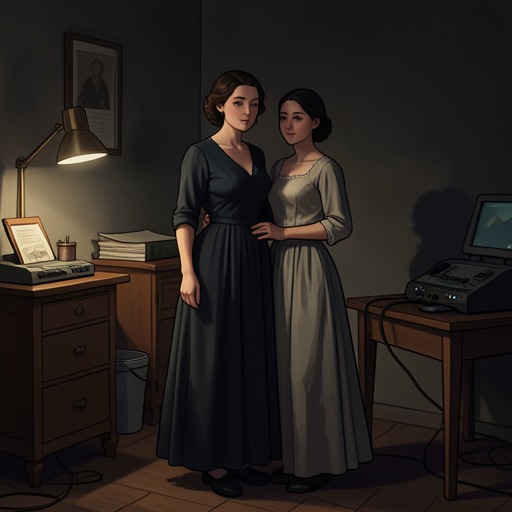
Lelia and Massimo's conflicted feelings
LeilaLelia and Massimo's conflicted feelings are shaped by a striking imbalance: Massimo recognizes that he is falling in love, while Lelia's desire emerges through resistance, suspicion, and private fantasy rather than a clear declaration. Their attraction grows amid bereavement, religious scruple, and questions about Lelia's future, then meets the practical demand that she leave Valsolda. The relationship is therefore marked less by a settled romantic decision than by repeated approaches and withdrawals, in which small gestures carry more weight than direct explanation.
Massimo's growing attachment
After ten days at Montanina, Massimo experiences Lelia as an absorbing presence. Fleeting exchanges of glances and other indirect, involuntary communications have become, for him, a source of both sweetness and pain. Her reserve has not stopped the feeling; it has made her seem wrapped in darkness and uncertainty. He even finds himself unable to attend to the evening landscape, absorbed instead in the thought of her.
Massimo connects his attraction to the encouragement he thinks he has heard from Donna Fedele and Marcello Trento. Their remarks about Lelia's family, her future, and the anxieties surrounding it seem to him like hints that he might take the place left by Andrea Trento, whom Lelia had loved. He cannot decide whether he is reading their intentions correctly. That uncertainty matters: his hope is accompanied by remorse, and the possibility that others are quietly helping to bring them together only deepens his confusion.
Don Aurelio's hand on Massimo's shoulder, after the two men have embraced, makes Massimo wonder whether his feelings are visible. At dinner, Lelia has given him neither a look nor a word, and he takes his friend's gesture as a warning. When he asks whether he has betrayed himself, Don Aurelio's silent surprise tells him that he has. Later, asked what signs he has of Lelia's feelings, Massimo can offer no certainty: he thinks something about him attracts her and something repels her. He identifies Benedetto as the obstacle. His account captures the central asymmetry between them: Massimo can name his love, but he cannot confidently interpret Lelia's response.
Lelia's resistance and imagined surrender
Lelia's feelings become visible in the aftermath of a bitter conversation. She hides in the gallery to watch Donna Fedele leave Marcello Trento's study, hoping not to meet her. At first she takes Fedele's departure as proof that the matter is over and that no one will trouble her again. Yet relief does not follow. Her earlier irritation gives way to weariness, and she questions whether Massimo had really come to Montanina by chance, rather than as part of a plan.
Pride gives Lelia a way to resist what she feels. She recalls taking satisfaction in rejecting love just as she had rejected wealth, and inwardly disparages Massimo for not explaining himself directly. But the rejection does not hold. On the chestnut path, the possibility of encountering him makes her change direction; sitting alone, she tries to quiet her thoughts by listening to the wind and watching the grass. Instead, she falls into a dream in which Massimo finds her at night in Parco di Velo, draws her close, and kisses her. In the fantasy, the park and even time disappear. The scene gives her desire a vivid form, but it remains a dream, not an encounter between them.
When the bell calls her back, Lelia returns to the villa and meets Marcello Trento in a tense silence. She reads his initial displeasure as another response to her refusal of his inheritance, while he believes her refusal reflects excessive pride and little affection. His later gentleness pains her almost as much as his frowns. Her tears combine several feelings that she cannot separate: indignation, anguish at her own inner conflict, and self-pity. Her emotional life is not resolved by either rejecting Massimo or resisting the inheritance; both refusals leave her unsettled.
Distance, dignity, and misreading
The contrast between private attraction and public conduct sharpens when Lelia encounters Massimo at the church. He has tried to calm villagers angered by Don Aurelio's departure, urging them not to punish their priest or harm him before his superiors, and insisting on respect for the sacrament. He feels that he has risen above resentment and has resolved to regard his period of love as a weakness: he will suppress it and reserve himself for a woman more like him in thought and feeling.
Massimo's composed manner strikes Lelia as unlike him and unnatural. She asks who wrote the notice on the church door; he explains the circumstances and scrubs it away with a sponge. She is pale and uncertain about what his ease means. The scene does not show that his decision has extinguished his feelings. Instead, it reveals how each reads the other through incomplete signs: Massimo turns restraint into a moral resolution, while Lelia's pride and longing leave her alert to the possibility of insult or concealment. His visible service to the church and his private attempt to suppress love occupy the same moment, without reconciling the two.
Family pressure and the limits of choice
Lelia's romantic uncertainty unfolds alongside a struggle over her independence. After Marcello Trento's death, the opened holographic will names her universal heir, while a letter reports that Girolamo da Camin claims to be her father and is coming to see her. The letter also says that Lelia is twenty years and a few months old, although Marcello had believed her older. These details place her inheritance and her relationship with her father inside an unsettled question of age and authority; they do not, by themselves, settle what freedom she can exercise.
The later account of Girolamo's visit makes the material pressure explicit. He approaches Donna Fedele cautiously, hoping to bring Lelia home without openly insisting on paternal rights. The narrator reveals that he plans to use the remaining months of his authority to secure as much of her movable property as possible and hopes for favorable treatment from her once she comes of age. Donna Fedele, meanwhile, has to persuade Lelia to receive him. Lelia stands rigidly through his greeting and kisses, accepting the encounter without warmth. Her guardedness toward her father is not evidence of a particular response to Massimo, but it helps explain why decisions about where she may stay and whom she can rely on are never merely romantic questions.
Understanding without resolution
In Valsolda, Donna Fedele judges that Lelia cannot remain there and says that she will take her either home or, at least temporarily, to the villa. Massimo accepts that Lelia must leave, although he expects it will be difficult to persuade her. Lelia protests: she had hoped Donna Fedele would rest there for a few days, and she herself dreads returning to Velo d'Astico. With only months remaining before she can be her own mistress, the prospect of waiting under other people's decisions weighs heavily on her.
The group settles on a practical plan: Donna Fedele will rest that day, consult a doctor the next morning, and, if allowed, travel with Lelia to Turin. Lelia will be received at Santhià by Donna Fedele's cousin, while Eufemia continues with her; letters sent to San Mamette will be forwarded. Donna Fedele yields on obtaining Girolamo's permission, believing the arrangement safe and knowing that Lelia dreads returning to Velo d'Astico. When Lelia rebels again, Massimo appeals to her affectionately, and she quiets at once. That response shows the force he still has in her emotional life, but it does not settle what either will choose afterward. Their feelings remain caught between intimacy and restraint, with departure—not romantic union—setting the immediate terms of their understanding.