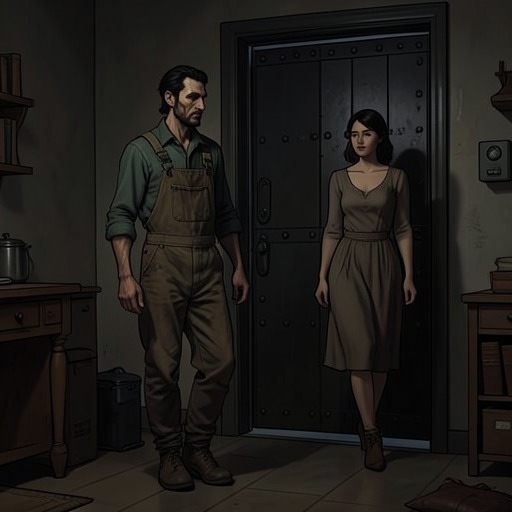
Lelia's Resolve to Refuse the Trento Inheritance
LeilaLelia Camin’s resolve to refuse the Trento inheritance is not simply a rejection of wealth: it is her attempt to keep affection, gratitude, and financial dependence from being confused. Although Marcello Trento regards her as a daughter and ultimately names her his universal heir, Lelia is determined not to become the beneficiary of his estate. The decision exposes the gap between the family she has chosen in her heart and the legal and material power still held by her biological father, Girolamo da Camin.
An expected inheritance she does not want
For a long time, Lelia suspects that Marcello means to make her his heir. The household, his dependents, and the surrounding community share that expectation: Marcello has no known close relatives, and Lelia is treated as his adopted daughter, though no legal adoption has taken place or could take place. The estate is described as not enormous but substantial. To Lelia, the prospect is therefore both credible and alarming; she fears that a will in her favor could turn an unspoken assumption into a bitter family dispute.
Her resistance has a moral and emotional foundation. She has wanted to give herself to Andrea Trento’s parents in Andrea’s memory, and she distinguishes gratitude for what Marcello has done from accepting additional compensation. She also recoils from the possibility that others might judge her a calculating flatterer or an inheritance hunter. Her refusal protects not only her money-free intentions but her reputation and sense of self: she does not want the care she has received to be read as a transaction.
The fear behind her refusal
Lelia’s concern is sharpened by the prospect of her father’s intervention. Girolamo has written to her repeatedly asking for money, and she sees his appeals as ignoble. Although he presents himself as poor, she distrusts that posture and imagines him arriving at Villa Montanina if Marcello dies, attaching himself to the household and to the estate. She is not afraid of her father so much as repelled by the thought of his presence and by the prospect of having to resist him over Marcello’s property.
The inheritance thus threatens to place Lelia between two forms of dependence. Accepting Marcello’s fortune could expose her to the charge that she has sought material advantage; refusing it may not prevent Girolamo from claiming a place in her life or seeking access to the money. Her insistence that Marcello leave the estate to distant relatives, if any exist, or to the poor gives voice to her refusal, while her deeper unease concerns the struggle that a bequest could set in motion.
Telling Marcello she cannot be his heir
When Marcello speaks of the future of Villa Montanina and of buying chestnut trees beyond the road, Lelia understands that he is considering her future as his heir. She reacts with an anguished plea for him not to speak of it. Then she states plainly that he must not think of her as his heir: she cannot be so. Marcello is offended and asks why, but her position has already been formed by the fears and convictions she has privately rehearsed.
The refusal is striking because it comes within a relationship of genuine affection. Marcello addresses her as a dear daughter and has treated her as someone closer than a daughter; Lelia’s resistance is not presented as indifference to him. Rather, she wants the bond to remain free of the consequences she associates with inheritance. Marcello’s understanding of her character reinforces that tension. He praises her purity, ardent heart, and impulsive charity, recalling how she once brought home a motherless child to protect him from his drunken father, despite not knowing how she would care for him. In Marcello’s eyes, her generosity is part of what makes her worthy of trust; for Lelia, being trusted with an estate is precisely what she fears may be misunderstood.
The will and her father’s claims
After Marcello’s death, his will is opened before the magistrate in Schio. It names Lelia universal heir and leaves Teresina a daily allowance of five lire, exempt from tax. The bequest therefore reverses Lelia’s stated wish. A telegram from Padua, signed by Girolamo, announces his condolences, asserts that he is Lelia’s father, describes her as a minor, and says he will arrive that evening. Lelia acknowledges that he is her father and gives her age as twenty years and a few months; Marcello, the agent reports, had believed her older.
Girolamo’s arrival makes the danger Lelia anticipated concrete. He approaches Donna Fedele with studied deference, seeking a meeting with his daughter, and brings Lelia a packet of banknotes. He says the money is hers and promises to account for it after a few months. His private calculations, however, include taking as much of the estate’s movable property as he can while he remains in control, and trying to secure generous support from Lelia once she comes of age. His financial dispute with the creditor Molesin also reveals how directly he sees the inheritance as a resource: when Molesin proposes that his clients accept seventy-five percent, Girolamo protests that he cannot pay even the twenty percent he had previously offered. He adds that, whether Lelia wants to or not, she is legally obliged to provide him with bread. These are his claims and plans, not evidence that Lelia accepts his authority willingly.
Wealth refused, dependence unresolved
The outcome makes clear that refusing Marcello’s inheritance cannot by itself give Lelia independence. Later, when she is in Valsolda with Donna Fedele and Massimo Alberti, the question of where she can safely stay is still framed partly through her father’s permission. Lelia hopes to remain there for a time and says that only a few months separate her from becoming of age and master of herself. Donna Fedele proposes Santhià as a possible refuge with her cousin if Girolamo permits it; after discussion, she decides to proceed without waiting for his consent, arranging to take Lelia toward Turin and to send her onward to Santhià.
That later predicament clarifies the significance of Lelia’s earlier decision. Her refusal is a firm moral boundary, but it is not a legal escape from family power, financial vulnerability, or the need for shelter. Marcello’s will gives her the property she had explicitly rejected; her father sees that property as leverage and support; and the people trying to protect her must still negotiate the practical conditions of her movement. The inheritance becomes the test of whether affection can remain distinct from possession—and whether Lelia can defend that distinction while still needing help from others.