The Duty to Obey Church Authority
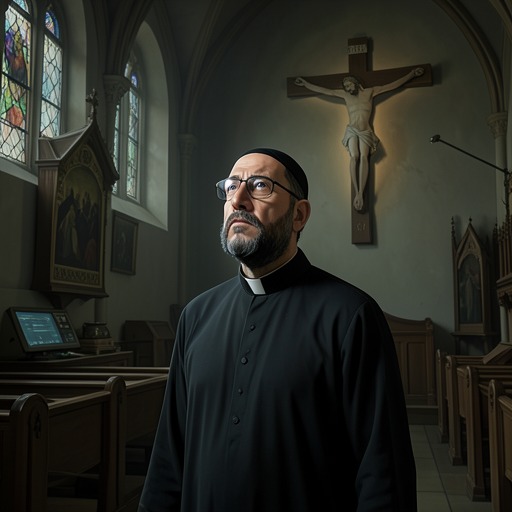
LeilaThe Duty to Obey Church Authority is presented as a demanding religious commitment, not a guarantee that a believer will never doubt or that church authorities will never act unjustly. Massimo Alberti’s crisis tests whether he can still assent to the Church’s authority; Benedetto’s life and Don Aurelio’s funeral defense, by contrast, make obedience a defining expression of fidelity. Together, these episodes distinguish submission to the Church from approval of every accusation made in its name.
Obedience Under Pressure
Massimo’s attachment to the Church had once seemed untroubled. As a student in Rome, he met the teacher who became the center of his religious life; while that teacher lived, Massimo says, doubt did not disturb him. He was willing to give his life for his faith and the Church. He could wish that Church Authority had taken a different course in a particular matter, but the possibility of rebelling against it had not entered his mind.
After his teacher’s death, that settled loyalty began to erode. Massimo saw the teacher accused in bad faith of dissent from Catholic doctrine by people he believed had no right to judge him. Massimo himself endured hostility as the teacher’s disciple, while contact with radical critics and negative innovators further unsettled his beliefs. In his account, this is not a casual rejection of Catholicism over an obscure doctrine or an aspect of worship. His deeper fear is that Catholicism, like the religion of Moses before it, might be a divine religious form destined to be completed by a higher one. The possibility that he might be called to preach such a successor faith places his intellectual uncertainty in direct conflict with his duty of obedience.
That conflict also touches Massimo’s public identity. His essays, lectures, and polemical articles had established his position in religious-philosophical controversies. The resulting moral persona gave him support and distinction, but at times felt like a prison. In the quiet after leaving Milan, he recognizes how tempting it is to withdraw from religious action altogether, especially after injuries and humiliations in a cause that may be lost. Yet the temptation is not, the narration clarifies, a settled decision to abandon the Church. His struggle is precisely that the obligation remains meaningful even as hope and faith falter.
Authority, Judgment, and Conscience
Massimo’s letter to Donna Fedele makes the distinction between obedience and intellectual certainty explicit. He fears that he may no longer be able to speak at Benedetto’s burial without hypocrisy: Benedetto believed firmly in the Catholic Church’s immortality and in the duty of obedience, while Massimo now doubts whether that belief is true. If he has come to think Benedetto was mistaken, speaking at the grave as though they shared the same certainty would dishonor the dead man’s memory. He therefore considers giving up the place to a more faithful disciple.
His account does not present every exercise of religious judgment as legitimate. At Benedetto’s funeral, Don Aurelio acknowledges that Benedetto was not a pope speaking from a chair of authority or a prophet, and that he could have erred in theological propositions. But he identifies the heart of Benedetto’s work not with disputation, but with calling believers of every station back to the Gospel spirit embodied in life, feeling, and action. Don Aurelio also affirms Benedetto’s professed obedience to Church Authority and the Holy See. The distinction matters: the funeral defense does not claim that every idea Benedetto expressed was beyond correction; it argues that his religious character was marked by loyalty.
The speech further separates the Church’s authority from the conduct of private accusers. Don Aurelio says Benedetto wanted forgiveness for those who condemned him without possessing the Church’s authority to judge him, including people who called him a theosophist, a pantheist, or alien to the sacraments. At the same time, he insists that Benedetto abhorred those errors and had conformed to the beliefs and practices of the Catholic Church from his turn toward God until his death. Obedience here coexists with an appeal against unjust accusations: respect for Church Authority does not require treating every private condemnation as an authoritative judgment.
Institutional Discipline and Its Human Cost
Don Aurelio’s own experience shows how Church authority can arrive not as an abstract principle but as an administrative decision with immediate consequences. A letter from the Vicenza Diocese dismisses him from the parish charge at Lago di Velo, requiring him to leave within fifteen days. The archpriest also asks that the house be cleared of both furnishings and people, since the successor will bring his mother and sister. Don Aurelio feels the bitterness of being driven from his peaceful home and small flock without knowing where he will find shelter or bread.
The order’s wording leaves him wondering whether the reference to people carries a particular implication in light of the circumstances surrounding Ismaele. Even so, after his first shock and grief, his thoughts turn away from his own case. He focuses instead on finding the Bible seller and on a serious, delicate conversation Marcello had initiated after Mass. The scene does not explain the dismissal as a formal test of obedience, nor does it say that Don Aurelio welcomes it. It shows the personal cost of a decision issued through church administration, while leaving his subsequent conduct grounded in service rather than self-pity.
Benedetto’s Example and the Rule’s Meaning
At Benedetto’s funeral, Don Aurelio portrays obedience as a fidelity that the world may misunderstand. Benedetto, he says, knew that people could despise religious obedience as cowardice, even while honoring military obedience and the sacrifices imposed by military power. Benedetto nevertheless loved the Church above all earthly things and imagined himself as the smallest stone within its great temple, taking glory in belonging to the whole even when compressed by it. The image makes obedience both a surrender of individual prominence and a form of belonging.
The defense does not pretend that the Church is free of injury or conflict. Don Aurelio says Benedetto believed evil spirits could trouble the Church and inflict cruel wounds, though they could not prevail against it. Benedetto’s appeal to the Pope is presented as an act of filial love and grief, not rebellion. He hoped that Christians would one day unite around the Holy See, and Don Aurelio asks the gathered mourners to pray for that end.
The speech closes by extending the rule beyond Benedetto’s own case. Don Aurelio urges the mourners to forgive both those who made false accusations and those who mocked Benedetto’s faith. People know too little, he says, to judge another person’s ignorance with certainty. His image of travelers in the night turns religious fidelity into a shared search: believers call to one another, offer guidance, and pray for all while waiting for dawn. The rule’s fullest meaning is therefore not mute compliance with every human judgment, but loyal attachment to the Church joined to humility, patience, and a refusal to claim final judgment over others.