The Principle of Obedience to Church Superiors
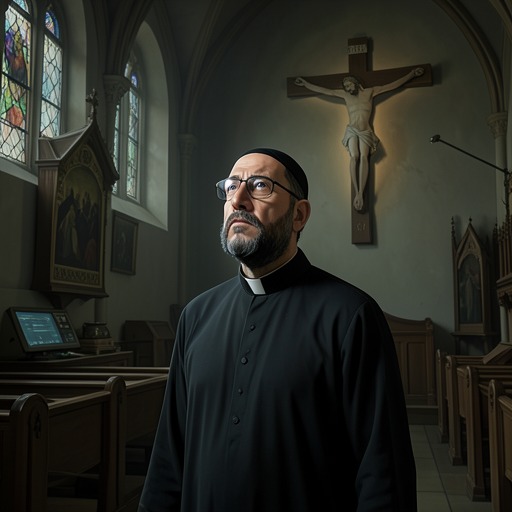
LeilaThe Principle of Obedience to Church Superiors governs some of the novel’s sharpest conflicts between conscience and religious authority. It requires Don Aurelio to accept his removal from Lago di Velo even when the decision wounds the parish he serves, and it shapes the community’s response to that removal. Later, the funeral oration for Benedetto presents obedience as central to his religious identity, while Massimo Alberti’s private doubts expose the strain that the principle can impose on a questioning believer.
Meaning and Practical Test
For Don Aurelio, obedience is not merely a rule to be followed when the decision seems just. After receiving the Vicenza Diocese’s notice that he must leave his curacy within fifteen days, he understands that he must comply, although the order expels him from a peaceful home and separates him from his parishioners. The instruction to clear the house of both furniture and people makes the loss concrete: his successor is expected to arrive with family, while Don Aurelio himself has no assured roof or livelihood.
The dismissal follows Don Aurelio’s decision to take Carnesecca into his home. The evidence does not establish that this was the stated cause of the order; Don Aurelio himself recognizes that uncertainty. Yet the circumstances make the phrase about removing people feel pointed. His response is not to organize resistance or insist that the authorities justify themselves. He turns instead to his immediate responsibilities: finding the Bible seller and addressing the grave matter Marcello Trento has raised with him.
The Parish and the Cost of Compliance
The people of Lago di Velo are distressed by the curacy’s impending loss. Some had disapproved when Don Aurelio sheltered Carnesecca, but his explanation from the altar—rejecting the Bible seller’s doctrines and recalling the Gospel—had quieted open criticism. Once the villagers learn that Carnesecca has left and Don Aurelio must follow, their sympathy turns into a dispute over what loyalty requires.
The neighborhood head counsels the fathers of families against disorder or pressure on the priest: a priest must obey his superiors, and the parish should petition those superiors instead. Women in the village are prepared to prevent Don Aurelio’s departure, even by appealing to the Pope, but he urges his flock, privately and from the altar, not to pursue such measures. A delegation approaches the archpriest and is rebuffed; prominent summer visitors then seek his intervention and receive promises, but the people remain unconvinced. The parish’s eventual plan to approach the Bishop for at least an extension shows how obedience redirects protest upward into petition rather than abolishing it.
The conflict is therefore not simply between a submissive priest and a rebellious population. Don Aurelio’s own appeal for restraint is affectionate but firm, while the villagers’ efforts arise from their attachment to him. Their loyalty cannot secure his continued appointment, and his obedience cannot make their grief disappear. The rule asks both priest and community to accept an authority whose decision they do not control, though they respond to that demand in different ways.
Don Aurelio’s Departure
When Don Aurelio tells Massimo Alberti that he must leave secretly, he explains that there is no hope the superiors will let him remain and that the parish might try to hold him by force. His duty, as he sees it, is to depart at once. He plans to walk through the night, catch the five o’clock train at Schio for Vicenza, present himself to the Bishop, answer the accusations he suspects have been made, and entrust what follows to Divine Providence. He hopes the Bishop may find him another post, perhaps in a mountain chaplaincy even more secluded than Sant’Ubaldo.
His acceptance is not an expression of indifference to the injury. When Massimo angrily condemns Don Aurelio’s presumed persecutors, the priest silences him and insists that they may believe they are acting rightly. Since neither man can see into their hearts or consciences, Don Aurelio says they must be prayed for; he asks Massimo to promise this. The act of obedience thus reaches beyond submission to a decision: it also forbids the easy certainty of condemning those who made it.
The same conviction appears in Don Aurelio’s exchange with Marcello Trento. Asked whether he can bring good news from the coming meeting, Don Aurelio answers that even if the rest is not good, God tells him that obedience is good. Marcello tries to kiss his hand; Don Aurelio recoils, and the two men embrace instead. Marcello weeps. The scene makes obedience visible not as a triumph over feeling but as a choice made amid affection, grief, and uncertainty.
Massimo’s Doubt and Benedetto’s Example
The principle has a different weight for Massimo Alberti. In a letter to Donna Fedele, he describes doubts that began in youth and were quieted while he followed the teacher he met as a student in Rome. After the teacher’s death, accusations against him and Massimo’s exposure both to hostile religious polemic and to radical criticism contributed, Massimo says, to the gradual disintegration of his beliefs. He fears that Catholicism may be destined to give way to a higher religious form, as Christianity succeeded the religion of Moses, and asks whether he himself should sacrifice his former convictions to preach what might follow.
That question makes obedience a matter of conscience as well as institutional discipline. Massimo fears that speaking at the burial of Benedetto would be hypocritical if he can no longer share Benedetto’s firm belief in the immortality of the Catholic Church and the duty of obedience. He has not told Don Aurelio the state of his mind, partly because he expects the priest’s example to support the Church more powerfully than argument and partly because he cannot bear to cause him pain. Don Aurelio’s steadfastness is therefore both a living witness to the principle and, for Massimo, insufficient to resolve the intellectual crisis.
The Funeral Oration and the Principle’s Public Meaning
At Benedetto’s funeral, Don Aurelio distinguishes the substance of the dead man’s religious work from possible errors in his theological statements. Benedetto, he says, was neither a pope pronouncing from a chair nor a prophet beyond error; the central purpose of his work was to call believers back to the Gospel spirit embodied in human lives, feelings, and actions. Don Aurelio presents Benedetto as having professed faithful submission to Church authority and the Holy See, and as having loved the Church despite believing that destructive forces within and beyond it could inflict real wounds.
The oration also gives obedience a public and communal meaning. Don Aurelio asks the crowd to forgive those who condemned Benedetto without authority to judge him, while affirming that Benedetto rejected the errors attributed to him and conformed to Catholic belief and practice until death. He urges listeners to forgive both accusers and mockers, warning that people know too little to judge another person’s ignorance. The image of wayfarers in the night turns this appeal into a shared ethic: believers should call to one another, offer help, pray, and refrain from condemning those whose path they cannot see.
Across these scenes, obedience is neither a guarantee that Church decisions are painless nor a claim that religious doubt has vanished. It governs Don Aurelio’s conduct under an order he experiences as unjust, restrains the parish from coercive protest, and defines Benedetto’s fidelity as Don Aurelio remembers it. Massimo’s crisis leaves the principle unsettled at the level of personal conviction, preserving the novel’s tension between submission, intellectual honesty, and the hope of religious renewal.