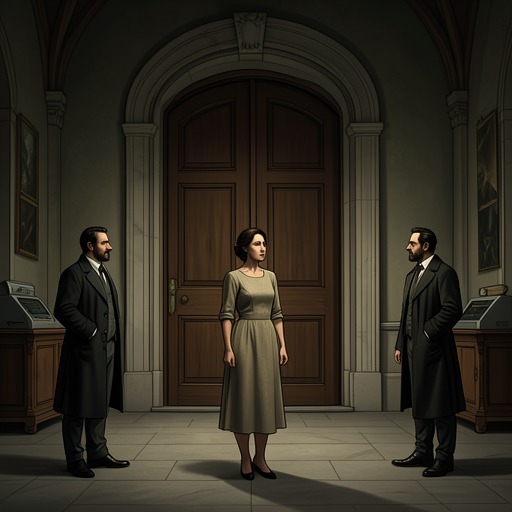
Lelia's estrangement from her father
LeilaLelia's estrangement from her father, Girolamo da Camin, is not presented as a simple refusal of reconciliation. It is a conflict between her intense aversion to living with him and the practical dependence created by her age, property, and uncertain freedom to choose where she will stay. His obsequious manner and offers of money cannot bridge that divide: when Lelia experiences life in his house directly, the distance becomes more acute, and even a possible departure still turns on whether he will permit it.
Identity and the Inheritance
The conflict sharpens when the will of Marcello Trento is opened at Schio. In a letter sent on behalf of the late master, the agent reports that Lelia is the universal heir and that Teresina has been left a daily legacy of five lire, exempt from tax. The same letter conveys a telegram from Padua, signed by Girolamo da Camin, who declares that he is Lelia's father, describes her as a minor, and announces his expected arrival that day. Lelia acknowledges that he is her father but says she is twenty and a few months old; Marcello, the letter adds, had believed her older. The information places their private estrangement beside the unsettled question of who may direct Lelia's life and deal with the inheritance.
The news also gives Girolamo an immediate reason to seek contact, but the narration makes clear that his approach is bound up with money and control. He has only a few months left in his period of authority, and plans to take as much as possible of the estate's movable property, then present himself humbly so that Lelia, once of age, might grant him a generous allowance. He also hopes to mislead Francesco Molesin about what is needed to reach an agreement with the creditors. These calculations make his solicitude difficult to separate from self-interest. At the same time, his intentions are not described as a plan to seize everything outright: he knows that keeping Lelia in his house would bring her into conflict with Gorlago, whom he is unwilling to dismiss. The narration depicts Girolamo and Gorlago as quarrelsome but attached to one another, and neither as willing to separate.
A Reluctant Meeting
Before Girolamo arrives at the Rose Villa, Lelia tells Donna Fedele that if her father comes she will say she is not well enough to see him. Donna Fedele objects that refusing him would violate convention, filial duty, and Lelia's own interest. Lelia rejects the appeal to interest and disputes that she owes him affection: she has already given him money and would give more if she had it, but believes that money is all he wants. Donna Fedele also invokes Lelia's religious convictions; Lelia answers that religion has no bearing on the matter. Their exchange shows how completely the relation has ceased, for Lelia, to resemble a bond of mutual care.
Girolamo nevertheless visits the Rose Villa, approaching Donna Fedele with exaggerated deference and asking, in halting phrases, to see his daughter. He approves of her journey to Turin and says he does not wish to disturb anyone. Donna Fedele has already insisted that Lelia receive him if he asks, and Lelia yields. She meets him standing, with a grave expression. He kisses her on both cheeks; she shudders but allows it, remaining stiff and offering him no seat. He praises her plans and gives her a packet of ten-lira notes, saying the money is hers and that he will render an account in a few months. The gesture is both an overture and a reminder of the financial arrangements that frame their relationship. It produces no visible warmth or trust.
Life at Montanina
The distance becomes harder to bear when Lelia tries living with Girolamo at Montanina. After returning to Donna Fedele the following afternoon, she falls to her knees and says she cannot go on there. What has happened, Donna Fedele learns, is less a single confrontation than the experience of a reality Lelia had already known and hated from afar. Teresina remains in service because another woman has left, but she too can no longer tolerate the house, its master, or its atmosphere. Lelia is especially repelled by Francesco Molesin, who tries to ingratiate himself by recalling old Camin family stories and figures from the past.
Lelia insists that her father has not treated her harshly. On the contrary, she says, she would almost have preferred harshness to his nauseating humility and ceremony. He asks her permission before moving a chair or having the hay gathered, and behaves with the same obsequiousness toward Teresina. When his careful advances meet resistance, he retreats quickly, as if to pass them off as a joke. The smallness of these encounters matters: the estrangement is sustained not by a single dramatic act of cruelty, but by a manner of approach that Lelia experiences as false and intolerable.
The house itself changes in her perception. What had once seemed alive and maternal now feels dead and indifferent to her, chilled and spiritually soiled by her father's presence. In her despair she even suspects, without telling Donna Fedele, that Girolamo might not be her father. The suspicion is reported as a private, monstrous thought, not as a truth about her parentage. Its place in the account conveys the extremity of her alienation: at Montanina, the acknowledged fact of their kinship no longer makes the house feel like home.
Fear, Dependence, and an Unsettled Departure
Donna Fedele's fear for Lelia is informed by what Lelia had said to Teresina in the past. Lelia had claimed that being forced to live with her father would make her ill; she described the prospect as one of hating him to the death and losing her moral sense. She framed such an illness not as defiance of divine law but as obedience to God's voice, which she believed could, exceptionally, command what was ordinarily forbidden. Teresina, deeply religious, had been frightened and taken her for mad. Donna Fedele instead understood these statements as signs of a distorted conception of religion, shaped by ignorance, intellectual anomalies, poor instruction, and bad examples. She hopes Lelia's words were not serious, but her long silences now alarm her. When Lelia goes out alone, Donna Fedele worries; the message that she has gone to Montanina for belongings and will return after six appears designed to keep her from obstructing a visit by Massimo Alberti.
Even after Lelia leaves her father's house, the practical hold of the relationship remains. In Valsolda, Lelia has written to Girolamo and is waiting for his reply. Donna Fedele initially expects a refusal, while Massimo Alberti believes the answer may not be negative. Lelia cannot simply stay where she is: Donna Fedele judges that she must leave, and considers taking her to Turin, with a possible stay at her own cousin's home in Santhià if Girolamo permits it. After a brief discussion, Donna Fedele decides to proceed without waiting for that permission, relying on her belief that Girolamo has always been deferential toward her and that the household in Santhià will be safe. The plan gives Lelia a way out of an immediate return to Velo, but it does not resolve the estrangement or establish what her father will answer. Their relationship remains marked by the gap between the formal claim of fatherhood and Lelia's lived sense of having no refuge in his home.