Lelia's Self-Imposed Vow Never to Love Again
LeilaLelia’s Self-Imposed Vow Never to Love Again is the rule Lelia makes for herself as she tries to preserve the memory of Andrea Trento and remain worthy, in her own eyes, of the place she has come to occupy in Marcello Trento’s household. It is not presented as a promise spoken aloud or imposed by another person: Lelia treats it as a personal duty, even while her reactions to Massimo Alberti make clear how difficult that duty will be to keep.
Origins and Grounds
The vow takes shape after the death of Marcello Trento’s wife, whose illness had drawn Lelia into tender, attentive care. That care softened Marcello toward her: increasingly paternal, he inspired in Lelia a filial reverence that sometimes displaced the feelings she had experienced when she first entered the Trento household. The change in their relationship makes her obligations feel more intimate, not less. She understands herself as having accepted the role of a living relic of Andrea, and regards loyalty to Marcello as bound up with honoring the dead.
Three years after Andrea’s death, Massimo’s impending visit unsettles the arrangement Lelia has made with herself. Massimo had not returned to La Montanina since attending Andrea’s funeral, although he remembered Marcello affectionately on anniversaries and at New Year. Marcello spoke of Massimo with esteem and sympathy; Lelia found those expressions increasingly irritating. Andrea’s painful words remained in her memory, and she felt that hearing Massimo’s name made that memory press upon her. Her growing aversion to the name and the person becomes one of the signs by which she recognizes that her feelings are changing.
Lelia interprets that recognition through a severe account of her own origins. She fears that blind instincts inherited from her parents may draw her toward love, and imagines that a latent passion could take root in her. Because she regards her parents as dishonored and her own blood as tainted, she sets against that inheritance an ideal of exceptional purity, which she believes fate has offered her. The vow is therefore not only loyalty to Andrea and Marcello; it is also a judgment Lelia passes on herself and a defense against becoming, as she sees it, one of the ordinary, innumerable women.
The Test of Massimo’s Arrival
Marcello’s cheerful announcement that Massimo will come as a guest produces a physical recoil in Lelia. She follows it with indignation and something like remorse, insisting inwardly that Massimo does not matter to her, while recognizing that the denial is not sincere. The episode exposes the contradiction at the heart of the vow: she has decided that she must not love again, but she cannot make herself indifferent by deciding so.
Her response is connected to a widening field of feelings she cannot comfortably explain. Andrea’s image is fading, while Lelia experiences nameless sadness, sudden happiness she struggles to suppress, tears prompted by music, and brief, almost frightening transports stirred by nature, including flowering meadows and woods in the freshness of June. She sees these states as possible signs of a passion forming within her. Rather than treating them as evidence that her self-imposed rule has become unnecessary, she turns them into reasons to police herself more harshly.
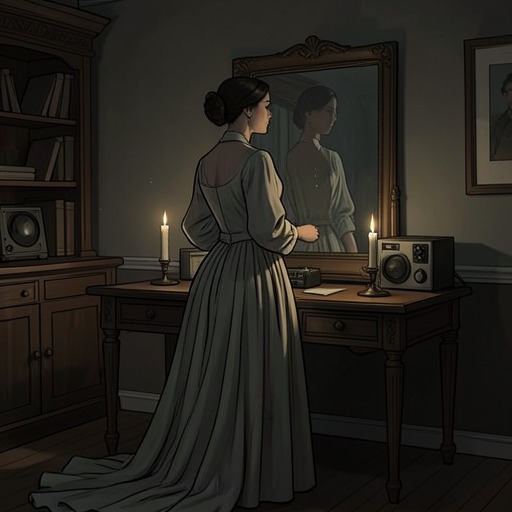
That night, before going to bed, Lelia kisses Andrea’s portrait in the medallion she wears and the small ring he gave her as a sign of reconciliation after a serious quarrel. She then turns toward the wall, draws the sheet over her hair, and cries. The portrait and ring make her attachment concrete: the vow is sustained not by an abstract rule alone, but by objects associated with Andrea and with a reconciliation she continues to remember.
Family, Inheritance, and Limited Independence
The circumstances surrounding Lelia’s place in the Trento household also complicate the ideal of self-command on which the vow depends. After Marcello’s death, the will makes her his universal heir. A letter from the estate’s agent reports that her biological father, Girolamo da Camin, has sent condolences, declared himself her father, and announced his arrival. The agent adds that Lelia has acknowledged the relationship and said she is twenty years and a few months old, although Marcello had believed her older.
Her father’s subsequent visit to the Villino delle Rose shows how affection and authority are entangled with money. He approaches Lelia cautiously and brings her a packet of banknotes, presenting them as hers and saying that he will render an account when she is of age. Yet his private plan is to obtain as much as possible from the movable assets during the remaining months of his administration, then secure generous support from Lelia once she becomes an adult. Lelia receives him standing and rigid; she shivers when he kisses her cheeks, does not invite him to sit, and remains visibly estranged despite allowing the encounter to proceed. Her inward rule about love exists alongside practical dependence and unresolved relations with her family.
Later Choices and Significance
The later arrangements made for Lelia in Valsolda show that her independence remains constrained by her age and by the decisions of those trying to protect her. She hopes Donna Fedele will stay for a few days and then accompany her to Turin, and says she has only months to wait before becoming her own mistress. She is horrified at the prospect of returning to Velo. After hearing that Lelia has written to her father, Donna Fedele considers a stay with her cousin in Santhià if he permits it; after discussion, she agrees to arrange the journey and have the cousin meet Lelia at the station. These negotiations do not establish that Lelia has abandoned her vow, but they show that her attempts to govern her own life unfold amid family authority, uncertain shelter, and the care of others.
The vow’s defining tension is between an ethical ideal Lelia sincerely embraces and emotional life she cannot command into silence. Remembering Andrea gives the rule its moral force; her sense of debt to Marcello and her aspiration to purity reinforce it. Yet the threatened arrival of Massimo, her awareness that her denial is false, and the intensity of her responses reveal that the rule cannot guarantee the feeling it demands. Its significance lies in that gap: Lelia’s resolve is both an act of fidelity and a form of self-denial, made more painful by her recognition that desire may already be taking shape.