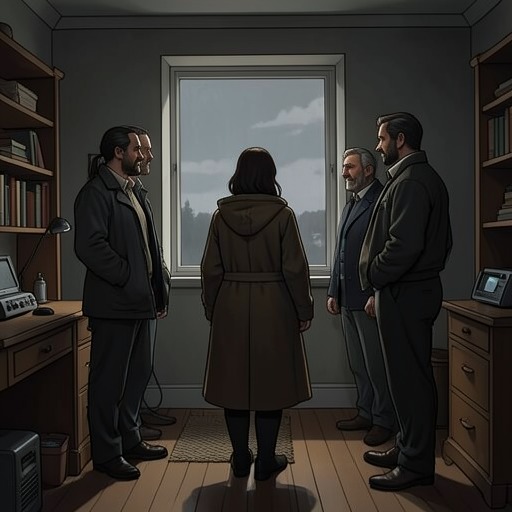
Lelia's estrangement from her biological parents
LeilaLelia’s estrangement from her biological parents is not a simple severing of contact: it takes the form of secret financial support for her father, deliberate silence toward her mother, and a sharp refusal of the family claims both make upon her. The death of Marcello Trento and the opening of his will bring that distance into the open. Her biological father appears not as a source of refuge but as a claimant to paternal authority and, in Lelia’s view, a man whose needs and professions she has no reason to trust.
Identity and Background
Lelia’s biological parents are distinct from the household and inheritance that shape her life at La Montanina. Her father, Girolamo da Camin, is living when Marcello Trento dies; her mother also remains in contact, writing occasionally. Yet neither parent occupies an intimate place in Lelia’s emotional life. Her dealings with them are governed by distrust, refusal, and the difficult practical question of where she can live.
The conflict becomes especially exposed through Lelia’s age. In the letter reporting the will’s opening, the agent says that Girolamo da Camin telegraphed to claim that his daughter was a minor and to announce his arrival. Lelia, by contrast, acknowledged that she was twenty and a few months old. The agent adds that Marcello Trento had believed her older. The discrepancy gives the father’s intervention an immediate practical force: following Marcello’s death, he presents himself as entitled to resume his paternal place, while Lelia rejects the relationship he invokes.
Money Without Intimacy
Lelia regularly sends her father a large portion of the personal allowance Marcello Trento gives her. She does so through Teresina, arranging for the money to be sent from Schio because she fears that indiscretion by postal officials at Velo d’Astico or Arsiero might bring the transfers to Marcello’s attention. The secrecy makes the payments an act of controlled assistance rather than an attempt at reconciliation: she helps her father, but keeps the arrangement concealed from the man who provides her allowance.
Her remittances are accompanied by only a few terse words. Lelia knows that she despises her father and believes herself justified in doing so; she sends money without advice or reproach, treating the transaction as something she can discharge without offering affection. She knows he is heavily indebted, but does not believe the tales of hardship he tells her. Memories of words and incidents from her time in his house have persuaded her that he knows how to evade creditors, display poverty, and conceal money. Her giving therefore coexists with contempt: it meets a material need without restoring trust.
Her relationship with her mother is more completely silent. The mother writes from time to time, asking for affection in pious, religious language, but Lelia never replies. She has even returned immediately a rosary her mother sent, blessed by the Pope. The rejected object makes the refusal tangible: maternal solicitude, expressed through a devotional gift, does not overcome the estrangement. Lelia’s silence is not limited to a dispute about money or residence; it extends to the forms of religious and emotional connection her mother offers.
The Father’s Claim and Lelia’s Refusal
After the will is opened and Lelia is named Marcello Trento’s universal heir, Girolamo da Camin announces that he is coming. Lelia refuses to see him. She suffers a severe crisis, and Donna Fedele takes her into her own home at her father’s request. Lelia does not attend Marcello’s funeral; Donna Fedele reports that she remained in bed all day with a violent migraine and that Girolamo da Camin was present at the funeral.
Donna Fedele’s account conveys why the prospect of contact is so disturbing to Lelia. She describes Girolamo da Camin as shabby in appearance, stiff in speech, and so deferential that he seems almost incapable of refusal. At the same time, she calls him sly: his submissiveness should not be mistaken for innocence or simplicity. After the funeral he visits Donna Fedele, asking to see Lelia in a manner that, to her, sounds more like a tenant farmer addressing someone than a father approaching his child. Lelia will have nothing to do with him. He leaves without pressing the matter, apparently content despite the refusal.
His later visit to Donna Fedele shows the distance between outward deference and private calculation. He comes to the villa intending to make himself agreeable and to suggest that he would like Lelia to live with him, while appearing not to insist. The narrator reveals that he hopes to use the remaining months before Lelia reaches majority to appropriate as much of the estate’s movable property as possible, then to present himself as humble and contrite in hopes that she will grant him a generous allowance. His conduct confirms the suspicion on which Lelia’s mistrust rests: the language of paternal concern is entangled with an effort to secure financial advantage.
When Lelia receives him, she stands rigidly and does not invite him to sit. He greets her repeatedly, kisses both her cheeks, and she endures the kisses with a shiver, stiff as a statue. He praises her planned journey to Turin, then hands her a packet of ten-lire notes, calling them her money and promising to account for it in a few months. The gift does not soften the encounter. Her physical rigidity and his awkward insistence on the money leave their meeting suspended between a claimed family bond and an unmistakable emotional refusal.
Distance, Dependence, and an Unsettled Future
Lelia’s estrangement does not remove her from dependence on decisions involving her father. Later, while staying in Valsolda, she has written to him and awaits a reply. Donna Fedele initially considers a negative answer certain and insists that Lelia cannot remain there; Massimo Alberti explains that the letter makes a refusal less certain. The evidence does not turn this correspondence into a reconciliation. Rather, it shows Lelia still having to address her father while seeking a place apart from him.
The proposed arrangement makes that constraint concrete. Donna Fedele agrees that Lelia should leave with her for Turin, and, if her father permits it, stay at Santhià with Donna Fedele’s cousin. After discussion, Donna Fedele decides to proceed even without waiting for that permission: Lelia abhors returning to Velo, the cousin’s home seems safe, and the months before Lelia reaches majority are few. Letters for Lelia are to be redirected from San Mamette to Santhià. The plan gives Lelia temporary shelter, but it does not resolve the underlying estrangement; it manages the consequences of her father’s authority while limiting his immediate control over her whereabouts.
Narrative Significance
The relationship is defined by a telling asymmetry. Lelia sends her father money but withholds trust and affection; her mother offers pious tenderness but receives no answer; her father invokes kinship while pursuing financial advantage. The story repeatedly distinguishes material provision from intimacy and formal parenthood from a bond Lelia can accept. Her refusal to see Girolamo da Camin after Marcello Trento’s death is thus more than a private dislike: it becomes a struggle over who may claim her, where she may live, and whether an inherited fortune will bind her to the parents from whom she has kept her distance. The later letter and the journey planned with Donna Fedele leave that struggle unresolved, showing a young woman’s attempts at self-direction still constrained by family claims, money, and age.