Massimo Alberti and Don Aurelio's friendship
LeilaThe friendship between Massimo Alberti and Don Aurelio is both a source of spiritual guidance and a test of what friendship can withstand. Don Aurelio can recognize Massimo’s love for Lelia Camin as a possible vocation rather than a distraction from religious life, and Massimo responds to the priest’s impending departure by choosing to accompany him. Yet the trust between them does not make their beliefs interchangeable: when Massimo’s faith later begins to disintegrate, he cannot bring himself to tell his friend. Their bond is intimate precisely because it combines candid disclosure, practical care, and a painful limit to what either can give the other.
Companionship Amid Religious Strain
Massimo’s friendship with Don Aurelio takes shape against the religious and social conflicts that have wearied him. Having left Milan, Massimo feels relief at escaping a society that condemned him from opposing sides: free-thinking critics regarded him as weak for remaining faithful to Church law, while religious hypocrites treated his contemporary thinking and writing as heretical. His exhaustion is not merely social. He has suffered setbacks and humiliation in religious work and is troubled by the possibility that the cause he serves may already be lost. At such moments, the public identity built through his essays, lectures, and polemics feels like both a support and a prison.
Don Aurelio faces a different kind of trial. A letter from the Vicenza diocesan authorities orders his removal from the parish at Lago di Velo within fifteen days and requires that the parish house be cleared for his successor’s family. The order leaves him without an obvious home or means of support. Though he first feels shock and grief at being separated from his community, he soon turns his attention to finding a Bible seller and to a serious conversation he has had with Marcello Trento. His capacity to attend to others even while his own future is unsettled becomes an important part of the friendship: he does not ask Massimo to solve his predicament, but remains available to him as a companion and guide.
Recognizing Massimo’s Love
After ten days of living in close proximity, Massimo’s attraction to Lelia has become an intense private preoccupation. In the evening, as he walks with Don Aurelio toward the church of Sant’Ubaldo, he is so absorbed by thoughts of her that he scarcely registers the evening landscape. Don Aurelio’s hand on his shoulder acts as an admonition; Massimo’s attention has narrowed until his friend’s gesture and concern nearly fail to reach him. The scene makes the friendship’s warmth visible but also shows how new love can temporarily displace other attachments.
Don Aurelio soon understands what Massimo has not yet openly said. When Massimo realizes he has betrayed his feelings, Don Aurelio responds with affectionate amusement rather than rebuke. He knows that Donna Fedele believes Massimo has reason to hope, but when Massimo presses for the signs behind her judgment, Don Aurelio cannot supply an answer on her behalf. Massimo immediately wants to go to the Rose Villa. Don Aurelio stops him and asks whether Lelia has become the only person who matters to him. The question brings Massimo back to himself: he takes his friend’s arm and does not feel reconciled until Don Aurelio kisses him in forgiveness.
On the walk, Massimo entrusts Don Aurelio with the history and full force of his feelings: his response to Lelia’s photograph while Andrea was still alive, their first meeting, the uncertain signs in her conduct, his growing passion and remorse, and his bewilderment at Marcello’s apparent encouragement. He also confesses a dream of leaving ordinary society with Lelia, living in a mountain solitude, working as a doctor, serving others, and practising religion with inward freedom. Don Aurelio listens without interruption. At the church he enters to pray; Massimo follows but cannot pray, his thoughts returning instead to Lelia and to the music she had played that morning. The difference does not end their confidence. It shows how Don Aurelio can receive Massimo’s feelings without requiring him to experience the moment as a religious one.
A Departure Shared and a Future Blessed
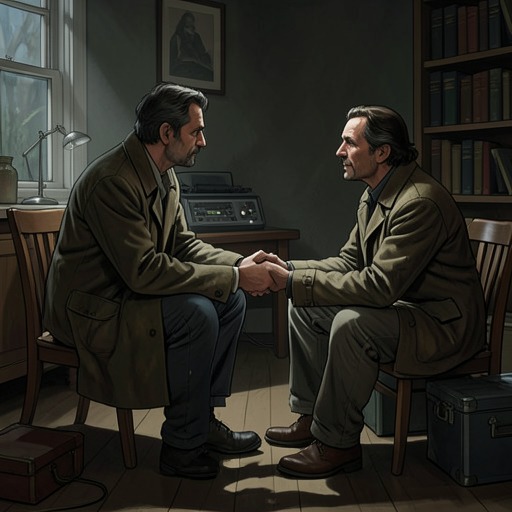
When Massimo learns that Don Aurelio is leaving, his first response is that he cannot remain behind if his friend goes. He offers to accompany him, a generous impulse that momentarily rises above the possessiveness of his newly awakened love. Don Aurelio embraces him. Later, in a darkened room, the priest reverses the arrangement: he tells Massimo that he will remain with him, revealing that he has prayed for him to receive a strong, full, and holy love. Don Aurelio does not regard marriage and family as rivals to a religious life. He imagines Massimo founding a family whose devotion to God would be handed down as a form of spiritual inheritance, and names this as his own dream. His counsel gives religious meaning to the future Massimo had described as a retreat from the world, even as Massimo’s vision had included freedom from religious despotism.
Their intimacy becomes physical as well as verbal. Massimo embraces Don Aurelio, and, when Giovanni arrives from Montanina to check on Massimo at Marcello’s request, Massimo falls at the priest’s knees before leaving. Don Aurelio urges him on and blesses him. They separate only with difficulty. Left alone, Don Aurelio kneels before the crucifix and prays even for the superiors who have made him feel humbled, homeless, and hungry. The scene places his blessing of Massimo beside his own appeal for forgiveness: their friendship belongs to a religious life shaped not only by affection, but also by obedience, injury, and prayer.
Trust and the Unspoken Crisis of Faith
The friendship’s limits emerge later, when Massimo writes to Donna Fedele about doubts he has not confessed to Don Aurelio. In the letter, Massimo traces his crisis to the period after the death of the Roman teacher he had revered. Attacks on that teacher, hostility toward Massimo as his disciple, and the corrosive influence of both religious opponents and negative critics have weakened his beliefs. His question is not simply whether particular doctrines are difficult to accept: he fears that Catholicism may one day be superseded by a higher religious form, just as Christianity emerged from Judaism, and wonders whether he is meant to proclaim that possibility against the teaching he has served.
Massimo says Don Aurelio does not know the state of his soul. He has lacked the courage to speak or write to him, partly because he can already anticipate the answer. Don Aurelio’s own life and fidelity constitute, for Massimo, a powerful argument for the Catholic Church, but not a sufficient one: Massimo notes that noble and sincere people can be found in other churches and outside any church. His silence therefore carries both affection and estrangement. He knows his friend’s goodness, yet fears that this goodness cannot resolve the intellectual and religious anguish he is experiencing. Donna Fedele, in turn, urges him to write to Don Aurelio, but the appeal underscores that the confession has still not been made directly.
The Friendship’s Significance
Don Aurelio’s friendship with Massimo moves between two forms of attention. He notices when Massimo has become so consumed by Lelia that he cannot hear or respond to a companion; he also gives Massimo room to describe desire, remorse, and an imagined future without dismissing them as unworthy of a religious man. His blessing of Massimo’s love is a genuine act of pastoral confidence, not a promise that love will settle every doubt. Massimo, for his part, responds to Don Aurelio’s departure with a willingness to leave the life he has been pursuing and share the priest’s uncertain road. Later, however, the very confidence that makes Don Aurelio a compelling example of faith cannot make Massimo’s crisis disappear. The relationship thus links care with difference: the friends can embrace, listen, and bless one another, while remaining separated by a doubt Massimo cannot yet bring himself to disclose.