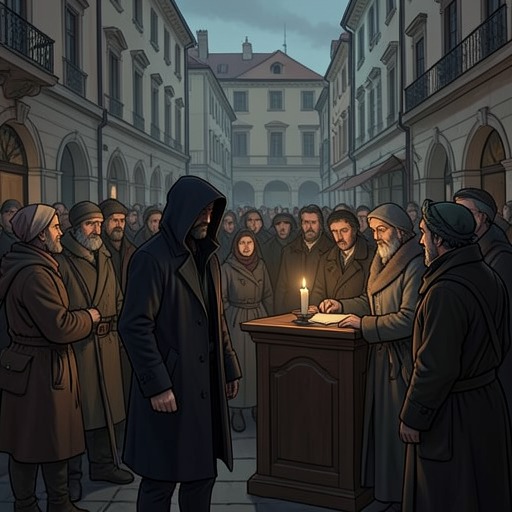
Massimo's crisis of faith
LeilaMassimo Alberti’s crisis of faith is not a sudden rejection of religion but a drawn-out unmaking of convictions that once seemed secure. It begins in conflict between his commitment to the Roman Catholic Church and his sense that its authority and established forms may be failing; it deepens into doubt about Christ and even the existence of a personal God. The crisis also puts his public identity, private attachments, and desire to serve others under pressure. At its most painful, Massimo cannot tell whether he is losing faith, trying to preserve it, or grieving the life that might have been possible without the struggle.
Origins and Pressures
Massimo’s uncertainty has roots that reach back to his student years in Roma, where doubts first troubled him. They were quieted by his encounter with a religious teacher whose living example restored his confidence. While that teacher was alive, Massimo says, doubt did not disturb him, and he would gladly have given his life for his faith and the Church. He could wish that Church authority had taken a different course on particular questions, but rebellion against it did not then seem possible to him.
The teacher’s death removed that stabilizing presence. Massimo’s distress grew as the teacher faced accusations of departing from Catholic doctrine, which Massimo regarded as unjust and made in bad faith. As a disciple, Massimo himself endured hostility from religious opponents, while also encountering corrosive criticism and negative forms of religious innovation. He saw himself caught between people who condemned him as weak for remaining faithful to Church authority and people who regarded his modern thinking as heretical. The opposing pressures did not resolve one another; they wore away at the structure of belief he had inherited and defended.
In Milano, the conflict was also a struggle over the life Massimo was expected to lead. He resented a society that offered pleasure as the apparent purpose of life and treated his refusal of its social conventions with sarcasm or contempt. He briefly imagined withdrawing from religious action altogether, leaving its arguments behind for love, beauty, and joy. But the thought was an embittered release rather than a settled decision: the public role he had taken on through writing and speaking about religious questions gave him support and distinction, yet could feel like a prison when his private convictions faltered.
The Letter to Donna Fedele
Massimo sets out the crisis most fully in a letter to Donna Fedele, whom he approaches as a trusted maternal confidante. He says he has sought refuge in Velo d’Astico after serious disappointments and has left Milano because he no longer wishes to live at his uncle’s expense. He describes his uncle as both charitable and religiously intransigent, but says that the uncle misunderstands his religious position and disapproves of his lack of regular employment. Massimo’s departure therefore combines financial independence, personal estrangement, and a search for quiet in which to examine his beliefs.
In the letter, Massimo distinguishes his doubt from a casual rejection of Catholicism. He dismisses objections based merely on disliked forms of worship or on doctrines that appear obscure to a superficial critic. His deeper fear is historical and theological: perhaps Christianity, as Judaism preceded it, could be completed by a later and higher religious form, leaving behind what has become outdated. If so, he wonders, might some people be called to sacrifice themselves as precursors? Might he himself be required to proclaim a new religious word against the one he has served? He does not present this possibility as a doctrine he has accepted. He presents it as an anguish he cannot settle.
That uncertainty makes the memory of Benedetto especially difficult. Massimo’s friends in Roma want him to speak at Benedetto’s burial in Oria, but he fears that a public eulogy would affirm beliefs he no longer holds. Benedetto, as Massimo understands him, embodied integral Catholic belief, steadfast faith in the Church, and humble obedience to its authority. To speak without sharing those convictions would feel like hypocrisy; to refuse would seem almost an insult to a beloved teacher. Massimo believes he should yield to a more faithful disciple if his own doubt makes honest homage impossible.
Massimo also hesitates to confide in Don Aurelio. He knows what his friend would answer, and regards Don Aurelio’s own life as a stronger argument for the Roman Catholic Church than anything he could say in debate. Yet even that example cannot settle the matter for Massimo, who observes that noble, pure, and convinced people can be found within many churches and outside them. His problem is not a lack of worthy believers to admire. It is the fear that he can no longer identify which religious claims are true.
The Depth and Stakes of Doubt
Massimo’s most painful admission is that breaking with Catholicism might leave him with no positive religious certainty at all. He describes the loss not as liberation but as a descent toward an emptiness he dreads. The possibility that a later religion might supersede Catholicism leads directly to harder questions: whether Christ’s Church can endure, whether Massimo should oppose the faith he once proclaimed, and whether his own convictions are dissolving beyond recovery.
The letter gives this intellectual crisis a bodily, immediate scene. On the night before the funeral, Massimo lights a lamp and kneels before an image of the Savior and Peter on the water, pleading inwardly for faith. The hope does not last. He feels mocked by the silent objects around him, then turns that scorn on himself. He tries to push Lelia from his thoughts, but the effort only reveals how firmly she remains in his heart. His religious doubt and his emotional longing do not stand apart: each makes the other harder to bear.
Massimo writes that he sometimes imagines death as rest, picturing himself buried among the cypresses of Dasio. Yet he resists presenting this wish as a simple consequence of disbelief. If the crisis of faith were the only issue, he says, he would want more intensely to live: to stop dwelling on religious affirmations and denials, to become a father, brother, and friend to poor people, and to give them whatever good he could while living simply. He imagines loving a companion and accepting the unknown at the end of life. That possible future, however, feels closed to him. He says his desire for death is also bound up with his love for Lelia, which he describes as a fever that has worsened and now consumes him.
Poverty, Service, and Private Attachment
The life Massimo chooses in Velo d’Astico gives his crisis a practical setting. He expects to live on the small return from what remains of his parents’ inheritance, roughly four or five lire a day, and worries that he may not win the local medical appointment. He needs paid work to afford books and periodicals, but takes a certain sweetness in his reduced means and in feeling less dependent on possessions and benefactors. His accounts of patients’ modest gifts—a meal, a bottle of vinegar, a basket of walnuts—make this village existence concrete, not merely an abstract retreat from the city.
His care for a neglected patient offers a glimpse of the life he says he might choose if he could stop struggling over religious belief. Massimo visits an impoverished, isolated man recovering from pneumonia, helps move him from a filthy stall to a more humane bed, and brings food each morning. With the help of two women from Dasio, he has the man cleaned and tries to restore his connection with his wife. This work does not resolve Massimo’s theology, but it gives visible form to his desire to be useful among people in need. His service persists while certainty does not.
The letter reaches Lelia as both confession and declaration of love. Reading that Massimo’s longing for her has become part of his wish to die, she is overwhelmed; the words also tell her that his feelings remain alive despite the estrangement between them. This response exposes another complication in the crisis: Massimo’s account of his suffering is sincere, but its religious and emotional strands are intertwined. His longing for a life of love and service remains imaginable to him, even as he experiences it as inaccessible.
The Funeral and an Unresolved Conflict
By the morning of Benedetto’s funeral, Massimo’s doubts have advanced beyond uncertainty about Church policy. He now believes that the Roman Catholic Church may be condemned to die, and has rapidly detached himself in thought from the divine and risen Christ. The apparent speed of this collapse, the narration explains, conceals a longer process: religious obligation had been holding traditional Christian beliefs together while criticism accumulated through reading and conversation. Once Massimo rejects the authority that had compressed those doubts, their effects become suddenly visible. He fears that belief in a personal God may be the next thing to fall.
The funeral intensifies rather than settles the conflict. Massimo has helped arrange the transport of Benedetto’s body from Porto Ceresio to Oria and still considers his friend’s memory sacred. A private act of homage would be welcome; a public one feels compromised by the beliefs it would appear to affirm. The distinction shows how much Massimo’s crisis concerns truthfulness as well as doctrine. He does not want to betray Benedetto by pretending to share a faith he may no longer possess, but neither can he treat their bond as disposable.
At the graveside, Don Aurelio speaks in Benedetto’s name, describing his fidelity to the Church and asking listeners to forgive those who misjudged or insulted him. The speech gives public form to the very questions that trouble Massimo: the meaning of obedience, the limits of private judgment, and the possibility of remaining charitable amid religious dispute. It does not provide evidence that Massimo’s doubts have been overcome. His crisis remains suspended between attachment and disbelief, service and despair, the wish to be honest about what has fallen away and the fear that nothing certain will remain.