Massimo's letter to Donna Fedele from Dasio
LeilaMassimo's letter to Donna Fedele from Dasio brings together the intertwined crises of Massimo Alberti’s faith, work, independence, and love. Addressed to the woman he asks to regard as a mother, it is both a careful account of why he has withdrawn from Milano and an intimate record of religious doubt. Its emotional force grows when Donna Fedele lets Lelia read it: the letter becomes a private confession passed to the very person Massimo is trying to forget, and its disclosures alter what she believes about his motives and feelings.
The letter and its readers
Donna Fedele gives Lelia the letter after receiving it from Massimo. She has hesitated over whether to share it, but decides that Lelia should at last know what kind of person he is. She draws the girl close, then directs her to read the letter alone in her room and return it the next morning. The arrangement makes the document at once a private communication and a test of trust: Lelia is invited into Massimo’s confidence, although he has expressly asked Donna Fedele not to speak to him about her.
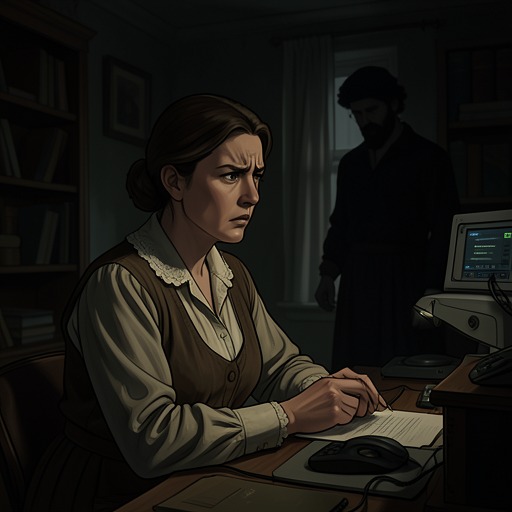
The letter is twelve pages long and comes from Dasio, a secluded village among mountains veiled by mist. Lelia first checks its length and place of origin, then jumps to the end before reading the opening. She finds Massimo’s request for peace and his sense that the road toward it is long. Unable at first to read steadily, she searches for her own name, skims the passages that concern her, and struggles between the desire to know and the fear of what the pages might say. Her response is bodily as well as intellectual: she trembles, presses the letter to her lips, and continues reading despite her resolve to keep her feelings under control.
Retreat from Milano and a new life
Massimo tells Donna Fedele that he has broken with Milano and, for the time being, with the world. He had felt uncomfortable for some time in his uncle’s home. Though he describes his uncle as a devout man capable of joining religious intransigence with charity, he says they differ sharply in intellectual outlook; his uncle also disapproves of his lack of regular, stable, remunerative work. Massimo’s account presents his departure not as a simple escape from the summer heat, but as a deliberate separation from a household and a social world in which he no longer feels able to live.
Earlier sorrows had led him to seek peace and silence at Velo d’Astico, where, he tells Donna Fedele, he found a particular kind of peace. After returning to Milano, he concluded that he should no longer live at his uncle’s expense. He had visited the cemetery at Velo d’Astico with Donna Fedele, and later saw an announcement for a medical post in Valsolda. The prospect drew him because he would have to go there in any case to perform a pious duty for the person and memory of the man he had loved most. He left to inspect a place that was entirely unfamiliar to him, while concealing from his uncle his broader intention: to leave Milano permanently if he could find a sufficiently solitary refuge, whether or not he secured the post.
His plans remain materially precarious. Massimo expects to live on the small capital left by his parents, which he estimates will yield only four or five lire a day. He doubts that he will be chosen for the medical position, since the doctor already serving provisionally may keep it. Yet he cannot do without books and periodicals and therefore needs to earn something by his own work; a local medical practice, he admits, would probably provide little help. He calls this uncertainty a dark point in his situation, but finds a quiet sweetness in relative poverty. What pleases him is not merely freedom from dependence on a benefactor, but the sense of being less bound to possessions and of descending from a world of appearances and simulation into one he considers more sincere.
A confession of religious doubt
The letter’s central confession concerns Massimo’s weakening Catholic faith. He describes its roots as distant and gradual. As a young man he was often assailed by doubt, and while studying in Roma he met the teacher whose body was soon to be laid to rest at Oria. Massimo says that his devotion to this master sustained his faith: while the teacher lived, doubt did not trouble him, and he would gladly have given his life for the Church. Although he could wish that Church authority had taken a different course in some matters, he says that rebellion against it never occurred to him.
After the master’s death, Massimo’s confidence began to erode. He connects the change both to accusations that his teacher had deliberately departed from Catholic doctrine and to the hostility he himself endured as a disciple. At the same time, he felt the corrosive influence of a hypercritical approach and of negative innovators whom his teacher had kept him away from. He distinguishes this crisis from a shallow rejection of Catholicism based on disliked forms of worship or apparent absurdities in dogma. His more unsettling question is historical and theological: could Catholicism, like the religion of Moses before it, be a stage from which a higher religious form might emerge? He wonders whether there must be precursors willing to sacrifice themselves for such a change—and whether he is being called to oppose the very message he has preached.
This uncertainty has immediate consequences. Friends in Roma want him to speak at Benedetto’s burial in Oria, but Massimo fears he could not do so honestly. Benedetto, as Massimo understands him, believed unshakably in the immortality of the Catholic Church and in the duty of obedience; if Massimo now believes that he was mistaken, speaking over his grave would dishonor his memory. Massimo has not disclosed the state of his soul to Don Aurelio, who is still in Milano awaiting teaching work. He expects Don Aurelio’s own life to stand as a powerful argument for the Church, but not a sufficient answer: Massimo observes that noble, pure, convinced people can be found in every church and outside them. His suffering comes partly from fearing that a break with Catholicism would leave him without any positive religious certainty at all.
Love, restraint, and the letter’s aftermath
Massimo’s account of Lelia is as conflicted as his religious confession. He admits that, in a moment of jealousy, he imagined her as his—humble and passionate—and then deliberately pictured her devoted to another man in order to turn himself against her and tear her from his heart. The fit passes, leaving him ashamed of his inability to judge her fairly. He recognizes that he had idealized her on the basis of her elegant figure, agreeable face, and expressive eyes, while attributing to her qualities of mind and heart that she did not necessarily possess. He expects that one day he may be grateful she rejected him, because he doubts they could have been happy so far apart in their ideas.
Still, he acknowledges a dangerous temptation: to seek love without the agreement of ideas, as a feeling and a physical union suspended outside past and future. He also believes that life would eventually shatter such a dream. Having admitted the force of his longing, he asks Donna Fedele not to speak to him of the young woman he calls someone to be forgotten. That request sharpens the irony of the letter’s journey. Donna Fedele gives it to Lelia, and Lelia reads the very words Massimo meant to keep from her.
His account also reaches Lelia through its description of poverty. She had accused him of sordid motives; his willingness to live on a few lire a day and his unexpected contentment with simplicity strike her painfully. By the end of the night, she has adopted a new resolve: because she considers herself unworthy of him, she must not disturb him, but must let him continue believing that she thinks of him with contempt. This decision gives her some renewed self-esteem even as her body remains shaken and tears rise without falling. In the morning she returns the letter to Donna Fedele with an air of indifference, concealing how profoundly she has been affected.
The letter’s significance continues beyond that private night. When Donna Fedele later discusses Lelia’s situation with Massimo in Valsolda, she reports that Lelia has written to her father and that she is awaiting his answer; they agree that Lelia cannot remain there and plan for Donna Fedele to take her toward Torino, with a possible stay at Santhià. Donna Fedele also arranges for letters reaching San Mamette for Lelia to be forwarded. The destination Massimo had given for his own correspondence thus remains part of the practical geography of their separation, even as the letter itself has made their emotional connection harder for Lelia to deny. Its layered form—Massimo’s self-explanation, Donna Fedele’s act of sharing, and Lelia’s silent reading—makes private writing an instrument not of simple reunion, but of painful knowledge and restraint.