Vicenza Diocese
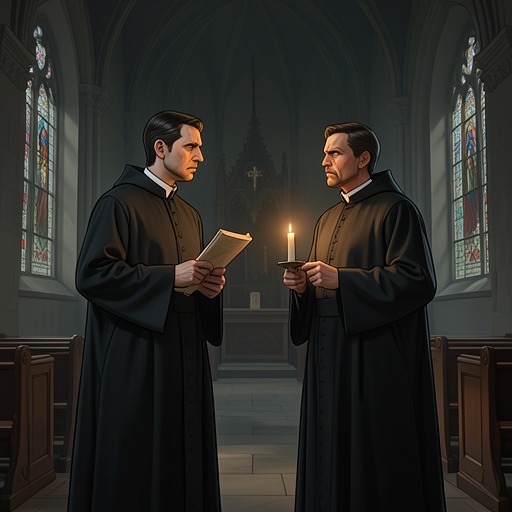
LeilaThe Vicenza Diocese is the local church authority that receives Don Aurelio into its jurisdiction, assigns him to Lago di Velo, and later ends his tenure there. The novel shows it chiefly through these administrative decisions rather than through a portrait of its internal structure: first as the institution that gives a displaced priest a modest parish, then as the authority whose terse notice requires him to leave it within fifteen days.
Appointment to Lago di Velo
Don Aurelio, a native of Rome who had studied at the Collegio di Propaganda Fide intending to become a missionary, abandoned that plan after a long illness and the superiors’ doubts about his physical strength. During his convalescence, a fellow student from Vicenza, who admired him, interceded with the bishop of Vicenza so that he would be received into the diocese and assigned to the curacy of Lago di Velo. Don Aurelio accepted the arrangement without seeking a more prominent position, content to serve a simple congregation and remain in poverty.
The appointment joins institutional administration to the priest’s private hopes. The bishop’s decision gives Don Aurelio a place of service after illness has closed off his missionary vocation; the poor parish, in turn, suits his desire to live among simple people and communicate with them through faith. His attachment to that small community makes the later diocesan order more than a change of post: it threatens the home and pastoral life he had come to value.
The order to leave
The diocese’s later action reaches Don Aurelio through an official letter from the Vicenza diocesan Curia, forwarded with a note from the archpriest. The notice dismisses him from the curacy within fifteen days. The archpriest asks him to ensure that the house is cleared of both furniture and occupants by the deadline, explaining that his successor will bring his mother and sister. The administrative language treats the residence as accommodation that must be vacated for the next priest; for Don Aurelio, it means losing both his peaceful home and the small congregation to which he is attached, with no clear roof or livelihood immediately in prospect.
The letter supplies no explicit reason for the dismissal. In the circumstances, Don Aurelio wonders whether the instruction to remove the occupants might refer to Ismaele, but he does not know that Ismaele’s case caused the decision. The distinction matters: the narrative presents the order and its consequences plainly while leaving its cause uncertain, rather than establishing a formal disciplinary charge or a doctrinal dispute with the diocese.
Personal consequences and institutional limits
After his first shock and grief, Don Aurelio finds a quiet, religious consolation in the thought that Christ’s loving hands rest upon him. He turns his attention away from his own misfortune toward finding the Bible seller and dealing with a grave, delicate conversation that Marcello Trento had raised after Mass. His response does not undo the material force of the diocesan decision: he still faces separation from his parish and the loss of his home. It does, however, show that the order does not wholly determine how he understands his vocation or what he considers most urgent.
The Vicenza Diocese is distinct from the wider Catholic Church whose authority occupies Massimo’s theological crisis and Don Aurelio’s pastoral concerns. At Benedetto’s funeral, Don Aurelio publicly defends obedience to the Church and its Roman authority, but that speech does not explain the diocese’s action against him. The novel leaves the local institution’s rationale unstated, setting its administrative power beside the personal cost of its decision without resolving the gap between them.