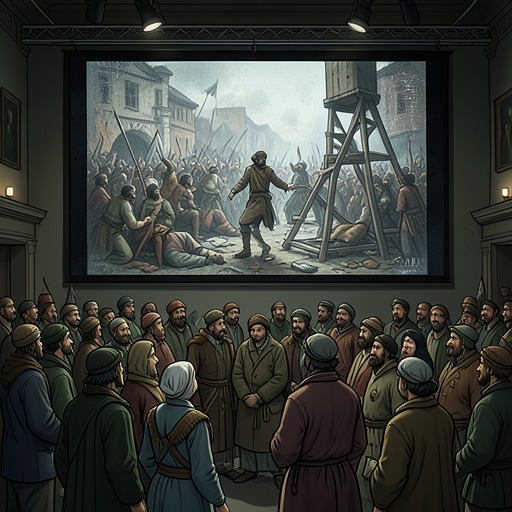
Video of the Ceaușescus' Trial and Execution
LimonovThe Video of the Ceaușescus' Trial and Execution presents the fall of Nicolae Ceaușescu not as a cleanly resolved act of revolutionary justice but as a filmed rupture: an elderly couple face a tribunal, the scene breaks, and their bloody corpses appear. In Emmanuel Carrère’s account, the footage meant to justify their murder instead makes visible the couple’s tenderness and the indignity of their summary execution. Its images provoke sharply different responses from Eduard Limonov and the narrator, while giving the close of the year’s revolutions a distinctly sour note.
Broadcast and Sequence
Filmed by Romanian television, the scene was broadcast across France on the evening of December 26, 1989. Carrère watched it before leaving for Prague for New Year’s; Limonov saw it after returning from Moscow. The recording dwells on the couple before the tribunal. Nicolae Ceaușescu fingers his chapka and says he does not recognize the tribunal’s legitimacy. Elena Ceaușescu periodically loses her temper and argues; at intervals, her husband places a hand on hers, calming her with a familiar, touching gesture.
Nicolae also looks at his watch from time to time. Observers took this as a sign that he was waiting for troops to rescue them, but no troops arrive. After half an hour, the scene cuts. Following a break, the next shot shows the couple’s bloody bodies lying on the pavement of a street or courtyard; the footage gives no way to establish where. The abrupt transition leaves the deaths outside the filmed exchange, while making their aftermath its brutal conclusion.
Limonov’s Response
The footage struck Limonov as having the strangeness of a nightmare. On returning from Moscow, he had found Natasha and brought her back with him. Carrère suggests that Limonov may have been thinking about their marriage and his dream of growing old and dying beside her; he is more certain that Limonov was thinking of his parents when he wrote in response to the broadcast.
Limonov’s account reads the recording through the couple’s mutual care. He acknowledges that a national leader cannot be wholly innocent, but distinguishes political culpability from the scene before the camera: hunted and cornered in an anonymous room, underslept, the two help each other face death. For him, the touch of a hand and a look become evidence of love, and their final journey together makes them, in his formulation, immortal lovers of world history. The footage’s political purpose is thus unsettled by the intimacy it records: the condemned rulers appear not only as figures of power but as an elderly couple confronting death together.
The Narrator’s Discomfort
Carrère does not share Limonov’s lyrical interpretation. He rejects the suggestion that the Ceaușescus were guilty only of the unavoidable errors of rulers, yet he too remembers feeling deeply uncomfortable as he watched what he regarded as a parody of justice and a summary execution. Even the supposedly exemplary staging, he argues, missed its intended effect: dignity remained with the accused, whatever their crimes.
That judgment does not exonerate the couple. Instead, it separates the question of their responsibility from the manner of their killing. A recording intended to legitimize the execution exposes the violence and theatricality of the proceeding, and leaves the viewer with the disquieting contrast between the accused couple’s private gesture of reassurance and the public spectacle of their deaths.
Place at the End of a Revolutionary Year
The recording acquires further force from its timing. The year had seen nonviolent revolutions bring humanists such as Václav Havel to power; the Ceaușescus’ trial and execution ended that sequence on a sour note. The contrast is not simply between a guilty regime and its opponents, but between the hope of political change and the brutal form taken by this particular reckoning.
For Limonov, the footage also became a prompt for writing about his parents and imagining shared old age with Natasha. For Carrère, it remained an image of justice staged so poorly that it gave the accused the dignity the proceeding was supposed to deny them. Its final cut—from a couple still able to reach toward one another to their bodies on the pavement—holds those readings together without resolving their conflict.