The Enchanted Hunters play
LolitaThe Enchanted Hunters play is a school theatrical production that becomes the crucial instrument of Dolores Haze's liberation from Humbert Humbert. Written by Clare Quilty, the playlet is performed by the students of Beardsley School in the spring of 1948, with Dolores cast as a farmer's daughter who imagines herself a woodland witch or Diana figure. The play's title echoes the name of the hotel where Humbert first sexually possessed Lolita, creating a dark symmetry that Humbert himself only dimly perceives. More than a mere school exercise, the production serves as the mechanism through which Quilty, who has been pursuing Lolita for months, finally makes direct contact with her and engineers her escape from Humbert's custody.
Origin and Authorship
The play was written by Clare Quilty, a celebrated American dramatist and the author of numerous plays for children, including "The Little Nymph" (1940). Quilty had been present at The Enchanted Hunters hotel on the night Humbert first brought Lolita there, and he had observed them from the porch, drunkenly questioning Humbert about the girl. The play's title was thus not a coincidence but a deliberate provocation, a taunt directed at Humbert. Quilty wrote the play in collaboration with Vivian Darkbloom, and it had been produced for the first time only three or four months earlier by a highbrow group in New York before being adapted for the Beardsley School production. Humbert, in his obliviousness, assumed the play was merely a standard school theatrical piece, one of many "Plays for School Actors" or "Let's Have a Play!" anthologies, and did not bother to read the complete text.
Plot and Structure
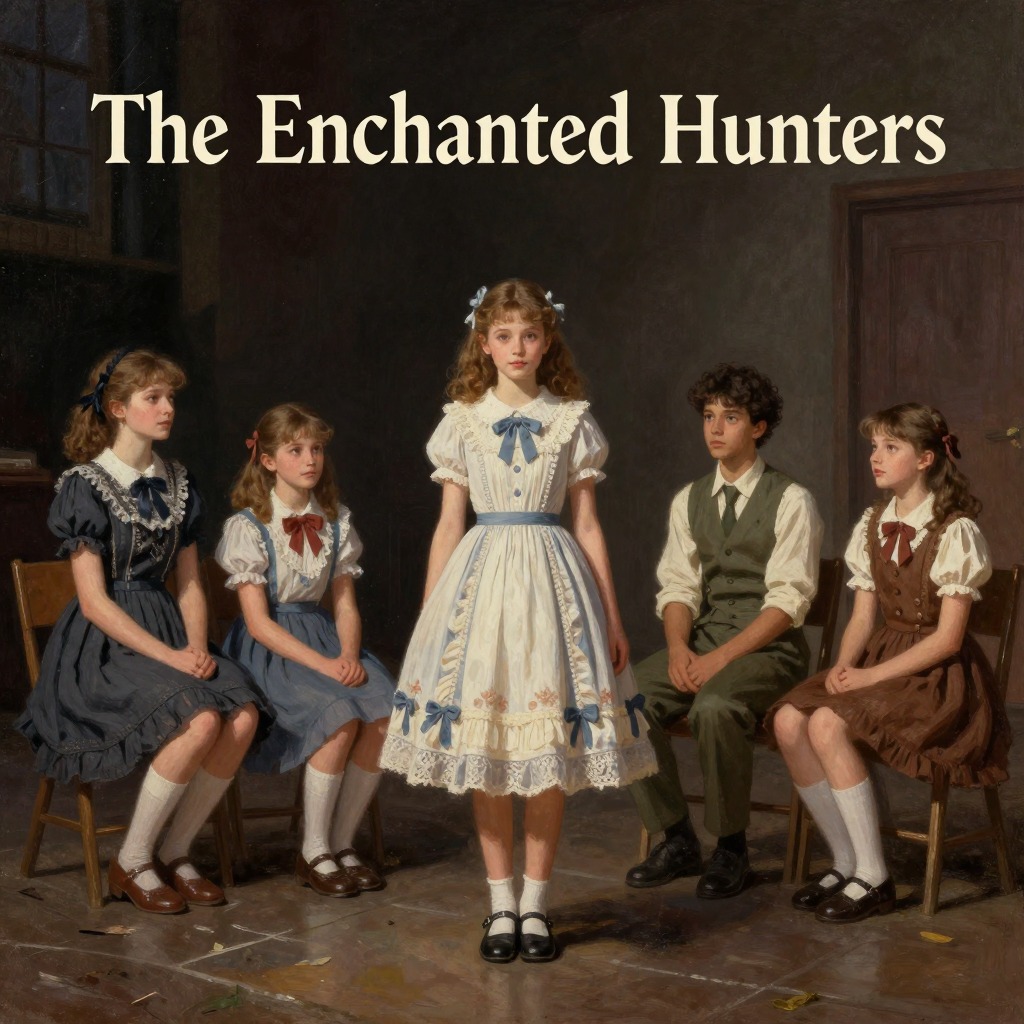
The playlet follows a group of red-capped, uniformly attired hunters—a banker, a plumber, a policeman, an undertaker, an underwriter, and an escaped convict—who wander into Dolly's Dell and undergo a complete change of mind, remembering their real lives only as dreams or nightmares from which little Diana (played by Dolores) has aroused them. A seventh Hunter, a Young Poet in a green cap, insists that Diana and the entire entertainment—dancing nymphs, elves, and monsters—are his own invention. In the climax, a barefoot Dolores leads check-trousered Mona Dahl (playing the Poet) to the paternal farm behind the Perilous Forest to prove she is not a poet's fancy but a rustic, down-to-earth lass, and a last-minute kiss enforces the play's message that mirage and reality merge in love. The play thus contains a meta-theatrical layer about the relationship between creator and creation, a theme that resonates darkly with Quilty's own manipulation of Lolita.
Rehearsals and Performance
Dolores threw herself into the production with an enthusiasm that Humbert found suspicious but could not suppress. She rehearsed obsessively, even skipping her piano lessons with Miss Emperor to rehearse the magic forest scene with Mona Dahl in a nearby public park. When Humbert discovered this deception, he confronted Mona's mother by telephone, but Mona smoothly deflected his anger with practiced eloquence. The play's rehearsals provided the cover under which Quilty—who had been following Humbert and Lolita across the country in a series of rented cars—finally made direct contact with her. At one very special rehearsal in May, Quilty was present, and afterward Dolores asked Humbert, with a radiant tenderness that should have warned him, whether the hotel where he had raped her was called The Enchanted Hunters. The play's performance was scheduled for late spring, but Dolores abruptly quit the production a week before its natural climax, telling Humbert she hated the school and the play and wanted to leave on another long trip. This sudden surrender was in fact the final stage of Quilty's plan: having established contact, she no longer needed the play as a cover.
Thematic Significance
The Enchanted Hunters play functions as a multi-layered symbol within the novel. Its title directly references the hotel where Humbert's "enchantment" of Lolita began, and the play's theme of hunters who are themselves enchanted mirrors Humbert's own delusion that he is the predator when in fact he is being hunted by Quilty. The play's central conceit—that reality and illusion merge in love—is bitterly ironic given that Quilty's "love" for Lolita is merely another form of exploitation. The play also represents Lolita's brief, doomed attempt to carve out a space of her own, a realm of theatrical make-believe where she could exercise some agency before being recaptured by the men who seek to possess her. For Humbert, the play becomes the emblem of his ultimate failure: it was through this seemingly innocent school production that his nemesis entered his life and stole from him the only thing he valued.