Catholic Worker Movement
LongingThe Catholic Worker Movement made social action and religious practice inseparable: its newspaper exposed poverty and injustice, its houses offered food and shelter, and its commitment to nonviolence framed the changes it sought. Founded through the collaboration of Dorothy Day and Peter Maurin, the movement treated care for people in need not as a substitute for social reform but as one of the ways Christian faith had to be lived.
Origins and Social Mission
When Day returned to New York, Peter Maurin was waiting for her. A French peasant and former member of the Christian Brothers, he had worked as a laborer in Canada and later supported himself in New York with just enough paid work to meet his physical needs. Much of his time went to reading at the New York Public Library and talking with people at Union Square. He described his occupation as agitation and had developed a program of Christian action, but wanted someone able to present his ideas to a wider public. An editor at Commonweal suggested that he approach Day. Their meeting became the beginning of a partnership that changed the course of her work.
Maurin set out to deepen Day’s Catholic intellectual background, giving her Christian spiritual classics and teaching her church history and the lives of the saints. They then began a monthly newspaper to promote social action grounded in Catholic teaching. From the outset, their aim was not simply to describe hardship but to connect it to moral responsibility and Christian practice. The movement’s stated purpose was to realize in individual life and society the expressed and implied teaching of Jesus Christ. It sought substantial social change, but insisted that change must be pursued through pacifism rather than violence or force.
The Newspaper and Public Argument
The first issue of The Catholic Worker appeared on May 1, 1933. Its subjects included unemployment, trade unions, cooperatives, the exploitation of Black Americans, child labor, and a local strike. Maurin argued that reporting should include moral commentary: an account of a wealthy man’s estate, for example, should ask why the money had not been given to poor people for Christ’s sake. Day and Maurin rejected political partisanship as a route to social reform and never endorsed a political party.
The paper began modestly. Its first edition consisted of 2,500 copies, offered for a penny each at Union Square. Sellers of the Communist Daily Worker called out to passersby; Day’s supporters answered with the name of their own paper. Circulation rose to a peak of 190,000 in 1938. It fell during the Second World War, in part because of Day’s pacifism, and had stabilized at about 104,000 by 1984. The newspaper addressed racism, labor, unemployment, poor housing, hunger, and injustice, and increasingly treated war and peace as urgent public questions. Its combination of reporting and ethical interpretation gave Catholic readers a publication focused on the lives of poor people and on the social conditions shaping them.
Hospitality and Nonviolent Practice
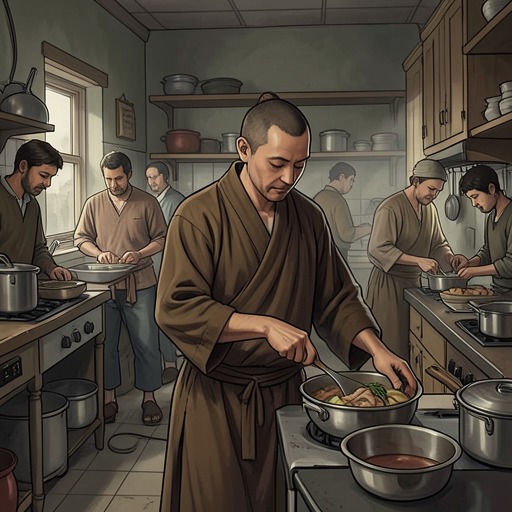
The movement’s other major undertaking was establishing a House of Hospitality, where people in poverty could receive food and shelter. Day and Maurin envisioned a society in which it would be easier for people to be good. Their approach therefore joined immediate assistance to a broader demand for change: caring for those already suffering mattered even while the causes of suffering remained to be confronted. Hospitality was not a separate charitable supplement to the movement’s politics; it was a practical expression of the social and religious principles behind them.
The work required commitment in difficult circumstances. Catholic Worker houses served people who might be alcoholic, mentally unwell, or addicted to drugs, and some guests could be hostile or violent. Day did not treat such difficulty as evidence that hospitality had failed. She understood service to people who were hard to help as a demanding form of love, rather than an idealized gesture made at a distance. She believed that Christ was present in people who were poor and that giving them food or shelter was a way of serving Christ. In this account, the recipient was not merely the object of aid: that person was also the one through whom the giver encountered the sacred.
Spiritual Meaning and Daily Life
Day’s religious life included regular prayer and daily Mass, but the central form of her spiritual perception was recognizing God in other people. She grounded this understanding in the Gospel passage about the last judgment in Matthew 25: Christ identifies himself with the hungry, thirsty, stranger, unclothed, sick, and imprisoned, and says that what is done for the least is done for him. For Day, this teaching made service more than an ethical duty. It disclosed where God could be found. She believed that Christ was present in poor people and in the bread shared together, although that presence could be obscured by the circumstances and behavior of those seeking help.
This conviction also shaped her response to criticism that practical aid merely treated symptoms while leaving larger social problems intact. Day maintained that care for wounded people was necessary even while working against the forces that caused the harm. She understood such service as an explicit demand of Jesus Christ and as a matter for which people would be judged. Her emphasis on hospitality thus joined two scales of action: meeting an immediate need and pursuing a society less marked by poverty and injustice. Neither scale, in her view, made the other unnecessary.
Growth and Influence
Catholic Worker houses eventually opened in other American cities, and the movement attracted college students who spent summers working in them. Its influence also reached beyond its own institutions. Michael Harrington, an early editor of The Catholic Worker, later wrote The Other America, a landmark book reporting on a major study of poverty that influenced politicians. The movement’s reach therefore extended through both direct service and the circulation of arguments about poverty in public life.
Day remained active in protest as well as hospitality. She was arrested while demonstrating with Cesar Chavez’s United Farm Workers during strikes, and again after refusing to take part in civil-defense drills in New York City. Visitors to the Catholic Worker house included people who were not poor; in 1943, two sailors, Joe and John F. Kennedy, spent a night there talking with her about war, peace, humanity, and the state. Such encounters place the house not only as a site of material assistance but also as a gathering place for sustained discussion of social responsibility.
The movement’s daily life was marked by voluntary poverty. Its New York house stood in a slum area, and Day described workers laboring without salaries and trusting that they would be able to care for the people sent to them. That chosen dependence on limited resources was part of the movement’s witness, not simply a background condition: its members sought to live among the urban poor rather than serve them from a position of distance. Day’s death in 1980 brought friends and fellow Catholic Workers together in a funeral procession led by her grandchildren carrying her pine coffin. A man with dementia approached it and stared; those present did not stop him. The scene recalls the movement’s central spiritual claim in concrete form: the people most easily dismissed were precisely those in whom Day had learned to recognize Christ.