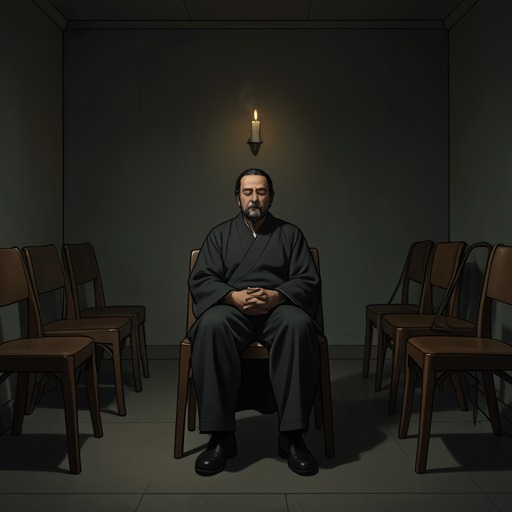
Detachment
LongingDetachment is the practice of loosening the will, images, and attachments that obstruct awareness of God. In Meister Eckhart’s account, it is not chiefly bodily hardship or escape from human life, but an inward freedom that lets the soul receive what it cannot secure by its own effort. The book places this teaching beside forms of silence, worship, and social engagement that clarify a central distinction: relinquishing self-interest is not the same as indifference to other people.
Eckhart’s inward discipline
Meister Eckhart developed detachment as a persistent theme in his spiritual teaching. After returning to Erfurt in 1294 as prior and an official in the Dominican order, he began writing in German as well as Latin, hoping to reach a wider audience. His early German work, The Talks of Instruction, was initially directed to novices. Its wider readership was reflected in the survival of fifty-one manuscripts. Rather than making rigorous bodily austerity the measure of holiness, Eckhart emphasized the denial of self-will and the freedom to seek God without distraction.
In The Talks of Instruction, obedience and detachment are linked: the decisive question is not simply what a person does, but whether the person’s own interests govern the action. Eckhart described the most powerful prayer as prayer from a free mind, one that seeks no advantage for itself and yields to God’s will. Holiness, in this account, depends less on a tally of accomplishments than on the kind of person formed through relinquishment. Keeping God present in the mind allows a person to possess God wherever life takes them, rather than confining prayer to a particular act or place.
Detachment also addresses the experience of God’s apparent absence. Eckhart advised returning to the practice followed when God had seemed present, instead of allowing frustrated self-will to dictate the search. His example of Mary’s acceptance of God’s word illustrates the surrender of a claim to control. The principle does not mean passivity toward wrongdoing: it means that spiritual seeking cannot be governed by the demand that God conform to the seeker’s own will.
The soul’s ground and unknowing
Eckhart distinguished inward penance from visible feats of asceticism. Fasting, vigils, and going barefoot were not, by themselves, true repentance. Repentance meant turning away from what was not God and raising the mind toward God. He also cautioned against relying on difficult spiritual achievements as supports for holiness: even impressive practices could become props on which a person depended, whereas divine mercy rested on God’s goodness rather than on human accomplishment.
This discipline reaches its fullest expression in the Ground of the soul, the secret depth where no creature can enter and where ordinary activity and understanding fall silent. When the soul is free of images, Eckhart taught, God can unite with it and the Son can be born there without the mediation of imagined forms. The way toward this stillness is Knowing by not knowing: letting go of inadequate images and knowledge received through the senses, rather than treating any mental picture as a possession of God. The teaching does not reduce God to an inner idea; it asks the soul to become receptive by releasing the images and concepts that would confine divine mystery.
Eckhart’s language could be misunderstood. His claim that a person in whom Christ had been born could not commit mortal sin was not, the book explains, an endorsement of abandoning moral norms. Unlike the Brethren of the Free Spirit, who taught that mystical union released them from ordinary moral requirements, Eckhart held that Christ’s birth in the soul would lead a person to avoid sin. The distinction matters: detachment is not permission to act without regard for others, but a transformation of the will and its desires.
Silence, worship, and shared experience
The book’s later accounts of contemplative practice show silence working not only as private withdrawal but also as a condition for shared attention. At the Abbey of Gethsemani, a Protestant seminary student encountered about 250 monks singing Latin psalms in Gregorian chant. The visit, organized for students studying medieval monasticism, also included the Divine Offices, meals, a tour, and a conversation about monastic life. The silence of the monastery and the warmth of its community made the contemplative life tangible to visitors; the narrator returned five times, and Thomas Merton joined two afternoon sessions to answer questions.
Douglas Steere’s account of Quaker worship offers another form of relinquishment. Meetings were silent unless someone felt moved by the Holy Spirit to speak. Steere valued waiting rather than forcing an utterance, and recalled silence helping members of a group overcome an ugly barrier and begin asking forgiveness. Here detachment from the impulse to control the moment could have a social consequence: it made room for attention to others and for reconciliation. In 1945, while organizing Quaker relief for Finland, Steere described a brief prayer at a planning meeting followed by an intense experience of release, closeness to those present, and a sense that others shared the experience. His account joins inward change to communal work rather than separating contemplation from service.
Howard Thurman likewise brought contemplative practice into public worship. As dean of the chapel at Howard University, he introduced periods of silence for meditation and prayer, as well as liturgical dance and staged presentations of six European Madonna paintings, recreated with attention to costumes, colors, backgrounds, and lighting. The congregation and participants, he later reflected, experienced a moment of unity. In this setting, inward attention did not require identical beliefs or backgrounds; worship could make common ground perceptible across divisions.
Detachment without indifference
The book also tests any equation of detachment with turning away from suffering. Thurman’s childhood unfolded within the rigid segregation of early-twentieth-century Florida. His grandmother, a former slave, inspired his faith, while her refusal to hear Paul because of his words to enslaved people kept the history of Christianity and slavery close to his religious formation. During a 1935 pilgrimage to India, a college principal challenged Thurman over the Christian role in slavery, segregation, lynching, and racial violence. Thurman did not defend Christianity as it had been compromised by those realities; he distinguished it from the religion of Jesus and affirmed the presence of people in the United States committed to freedom, liberty, and justice. His inward religious life did not require detachment from the consequences of racial injustice.
The same distinction appears in Simone Weil’s decision to leave teaching temporarily and work in a factory in 1934–35. She wanted firsthand knowledge of factory labor, not only theoretical discussion of workers’ conditions. Her journal records the pressure of production quotas, machine failures, fatigue, and the repeated failure to make the rate required for full pay. This experience is not presented as Eckhart’s doctrine, but it sharpens the ethical boundary around detachment: distance from personal advantage cannot stand in for attention to the conditions endured by others.
Dorothy Day’s work makes that boundary explicit in daily hospitality. The Catholic Worker, which she and Peter Maurin began in 1933, addressed unemployment, labor, racism, child labor, and other social concerns without endorsing a political party; their accompanying houses offered food and shelter to people in need. Day understood the poor as a place where Christ was encountered, including guests whose behavior could be difficult and whose needs could not be made ideal. For her, love in practice meant receiving people in their actual circumstances, not cherishing a comfortable spiritual image of them. Across these examples, detachment is most fully distinguished from withdrawal when it frees attention from the self and directs it toward God, fellow worshippers, workers, and the poor.