Ground of the soul
LongingThe ground of the soul is Meister Eckhart’s central image for the deepest part of human interiority, where God and the soul meet beyond the reach of ordinary thought and representation. It is not simply a private refuge: Eckhart’s account makes inward stillness the condition for divine action, while the book’s wider examples of silence, shared worship, and service show how contemplative attention may take form in common life.
Definition and theological meaning
Eckhart described the ground as both “the hidden depths of God” and “the innermost of the soul.” The two descriptions converge in mystical experience. His compact formulation, “God’s ground and my ground is the same ground,” names a unity that is more radical than emotional closeness or intellectual agreement. The Christian seeks, in Eckhart’s account, a union in which the divine ground and the ground of the soul come together, so that there is no difference between a human being and God in that mystical unity.
The book relates this teaching to the Gospel of John, where Jesus Christ prays that his disciples may be in God as God is in him. Eckhart’s interpretation also draws on the claim that the Word was with God, was God, and became flesh: the Word descends from God, while human beings may ascend by becoming one with God. Because God took on human nature, Eckhart held that human nature can be united with God. This is a claim about the possibility of participation in divine life, not a description of the soul as an independent divinity.
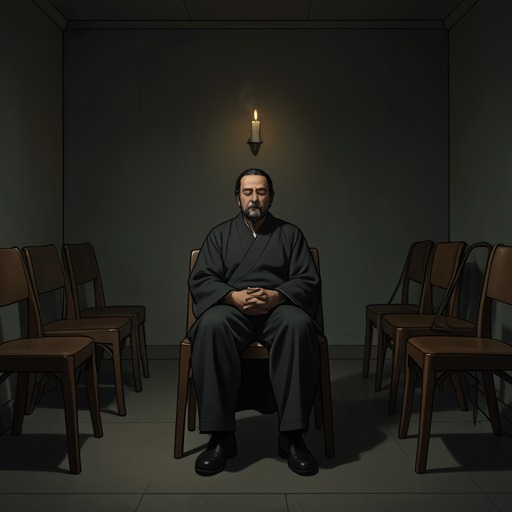
The ground is characterized by radical inwardness. It is the soul’s most secret part, which some interpreters call the spark of the soul. No creature can enter it; in the account presented here, it contains no activity or understanding of its own. The language therefore marks a limit: the ground is not an object the mind can inspect or master. It is where God may work when the soul is no longer crowded by images and created things.
Stillness, unknowing, and spiritual discipline
Eckhart’s account gives inward preparation a distinctive meaning. In his sermon on the birth of the Word, he asks where God speaks that Word and answers: in the purest part of the soul, the ground, of a person who lives nobly, gathers inwardly, and turns away from distraction. The birth is not available through indiscriminate pursuit of what the five senses can supply. The emphasis falls on a collected and receptive life rather than on accumulating experiences.
Nor does the seeker reach the ground by constructing more refined pictures of God. Eckhart advises letting go of thoughts, words, deeds, and images, so that God may work within. The book identifies this approach as apophatic theology: understanding God through the relinquishment of images and concepts, rather than through created things. Silence is not an empty performance or a technique for producing a desired state. It makes room for divine action without claiming to define what that action must be.
This discipline distinguishes Eckhart’s teaching from severe bodily asceticism. He describes people who fast, keep vigils, or undertake unusual hardships, but argues that such accomplishments can become props on which spiritual confidence depends. God’s gifts, in his account, arise from God’s goodness, not from a person’s achievement. True penance is a turning away from what is not God and a raising of the mind toward God; sharing in the suffering of Christ is presented as a means by which sin falls away. Eckhart’s self-denial is therefore chiefly inward: releasing inadequate images, distrusting knowledge limited to the senses, and purifying one’s attitudes. The book calls this knowing by not knowing.
The Word born in the soul
The ground is also the setting for Eckhart’s teaching on the birth of the Word in the human soul. His Sermon 101, apparently preached during the Christmas season in the early fourteenth century, begins a series of four sermons and uses a question-and-answer form. Although Eckhart was a scholastic theologian seeking to relate faith and reason, the series gives reason a diminishing role as it proceeds. Its subject is not only the historical birth of Jesus Christ but the birth of Christ in the soul.
The sermon draws on a passage in the Wisdom of Solomon in which the all-powerful Word leaps from heaven in the stillness of night. Eckhart turns that scriptural image inward: in the soul’s secret ground, silence and freedom from images allow God to give birth to the Son and do the divine work. A perfected person who walks in God’s ways may experience this birth; someone undisciplined, the account says, would not recognize it. The movement from darkness to the light that enlightens everyone gives the teaching its paradoxical shape: the soul does not bring God into view by imagining God more vividly, but becomes receptive by ceasing to rely on images.
The book gives the ground lasting importance in its assessment of Eckhart. Although his teaching attracted heresy proceedings and Church authorities judged some of his propositions heretical, the pope later absolved him, citing his final profession of orthodox faith and his repudiation of condemned articles. The controversy did not erase his popularity or the appeal of his ministry. The account presents the ground as the heart of his legacy: a depth untouched by anything other than God, to be sought and nourished not by confident possession of divine knowledge but by relinquishing what cannot adequately represent God.
Silence, shared life, and practical consequence
Other episodes in the book resonate with Eckhart’s emphasis on stillness and inward encounter, though they are not presented as applications of his terminology. In the late 1950s, a Protestant seminary class visited the Abbey of Gethsemani to study living monasticism. The students attended the Divine Offices, ate in the guest house, toured the monastery, and met with a monk. About 250 monks sang Latin psalms in Gregorian chant; the visitors were impressed both by the silence of the place and by the monks’ warmth. The experience offers a communal, ritual setting for contemplation, distinct from Eckhart’s account of the soul’s ground but suggestive of how silence can be practiced together.
Douglas Steere’s account of Quaker worship likewise connects silence with relation rather than isolation. At a planning meeting for relief work in Finland, a prayer and another participant’s prayer preceded an experience he described as an immediate release into the life of God; he felt close to those present and saw that others seemed to share the experience. He also wrote of silent meetings in which people felt bound to one another and a division between two members began to give way to requests for forgiveness. These episodes do not establish Eckhartian influence. They show, in a different religious setting, how quiet attention may accompany a sense of divine presence and a change in human relations.
Howard Thurman’s work at Howard University brought contemplative practice into creative public worship. To engage students in chapel, he introduced meditation and prayer in silence, liturgical dance, and staged tableaux recreating six European Madonna paintings. In the presentation, life-sized scenes appeared one at a time within a large frame, with silence between displays and “Ave Maria” played for each. Thurman said the congregation and participants were joined in a moment of spiritual transcendence, and that worship had shown him how unity among peoples could become more compelling than what divided them. The example shifts the emphasis from solitary inward preparation to an assembled community; its connection to the ground is an analogy of spiritual unity, not an identification of the practices.
The book’s accounts of racial injustice and care for poor people give inward spirituality an ethical horizon. Thurman, raised amid segregation in Florida, read the Bible to his grandmother, a former slave who rejected passages associated with the command that enslaved people obey their masters. During his 1935 pilgrimage, a college principal challenged him to explain how a Black Christian could represent a faith implicated in slavery and racial oppression. Thurman refused simply to defend a discredited Christianity and distinguished it from the religion of Jesus, while condemning slavery and prejudice and affirming that some Americans found in Jesus’ spirit a ground for freedom, liberty, and justice. This encounter does not reduce the ground to a political doctrine; it shows that claims about divine unity cannot be separated easily from the ways people treat one another.
Simone Weil’s factory work and Dorothy Day’s Catholic Worker work make a related contrast between abstraction and embodied attention. Weil took a factory job to encounter workers’ conditions rather than rely only on theoretical accounts; her journal records production quotas, faulty machines, and the strain of trying to keep pace. Day and Peter Maurin, meanwhile, created a newspaper that addressed unemployment, labor, racism, child labor, and other social issues, and established hospitality for people in need. Day understood poor people as a primary revelation of God’s presence and treated food and shelter as acts of hospitality to Christ. These examples are not stated as expressions of Eckhart’s doctrine. They broaden the article’s central tension: if divine presence is sought in depths beyond appearances, spiritual life must also reckon with the people obscured or dismissed by social appearances. In the book’s account, the inward search and outward attention remain distinct, but neither is allowed to make the other irrelevant.