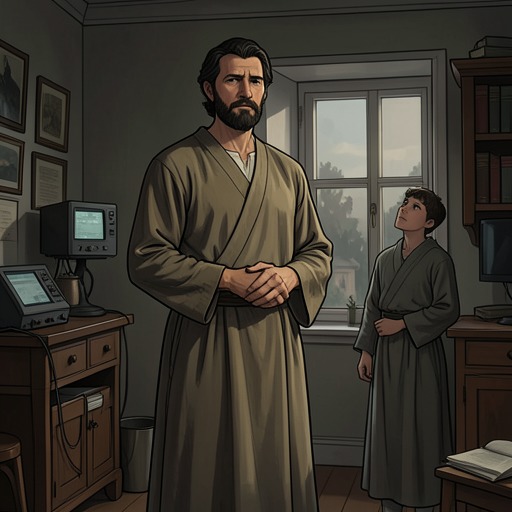
The Exemplar
LongingThe Exemplar is Henry Suso’s collection of writings and the form in which his autobiographical Life of the Servant was prepared for readers. The work brings together stories of visionary experience, accounts of extreme bodily discipline, and extended teaching on reason, detachment, and knowledge of God. Its importance lies not simply in what it recounts about Suso, but in how those experiences become instruction: the narrative follows a changing spiritual life, while its teachings direct attention from outward self-punishment toward inner transformation.
Formation and textual history
The Life of the Servant is often regarded as the first autobiography written in German, specifically Middle High German. Its origins were not straightforward. Elsbeth Stagel, one of Suso’s spiritual directees, took notes on his life during their conferences. When Suso learned of the notes, he took them back and began to burn them. He stopped when he came to believe that God wanted him to preserve what remained. The resulting account therefore grew from surviving conference notes, supplemented by material Suso added for the purpose of spiritual instruction.
Suso later assembled his writings under the title The Exemplar. He may also have edited the Life again for this collection. The book thus has more than one textual layer: recollections first recorded by Stagel, Suso’s additions, and a later act of compilation and possible revision. The account should not be treated as a transparent record untouched by arrangement. Its personal history is presented through a work consciously shaped to instruct as well as to recount.
A life turned into spiritual instruction
The autobiographical material traces Suso through markedly different stages: scholastic education, severe asceticism, and later work as a teacher, spiritual director, preacher, and writer. The movement between those stages gives the work its developmental shape. Suso’s spiritual life is not represented as a settled achievement from the outset; it is a process in which practices and understandings change.
The early ascetic episodes are especially vivid. Suso reported carving the monogram IHS into his flesh over his heart. He described an undergarment with 150 brass nails turned toward his body, leather gloves fitted with brass tacks to stop him removing it at night, and a belt around his neck fastening his hands. After sixteen years of such practices, he recounted a vision of a heavenly gathering in which God told him to stop. He then threw the garments into a river. The narrative makes the change concrete: a discipline once worn against the body is finally cast away.
The account also records later forms of bodily penance. Suso said that he wore a cross on his back fitted with thirty nails, pressing it against himself to wound his flesh and identify with Christ’s suffering. He whipped himself while contemplating the crucifixion. On one occasion, after holding the hands of two girls sitting beside him in church, he felt such regret that he went to a private place and threw himself onto his back, where the cross was fastened. These episodes show the extremity of the conduct described, but the book’s significance does not depend on taking every detail as a verifiable report.
Visionary episodes and changing practice
The Life presents mystical experience through a succession of distinct encounters. One morning, as Suso noticed the morning star, he heard a voice sing of Mary as the Star of the Sea; he joined in and felt what he described as a supernatural surge. He then experienced an embrace and heard a promise of loving embrace in eternal splendor. Elsewhere, the narrative relates encounters with a heavenly youth, an angel who directed him inward to contemplate Eternal Wisdom, and a young man who said he had come from God to give him heavenly joys amid suffering. In another chapter, Suso tells of the souls of the dead appearing to him.
Among these apparitions is Meister Eckhart, shown clothed in glory and wholly deified in God. Eckhart’s message to Suso is one of deep detachment: he is to withdraw from himself and receive everything from God rather than from creatures. The episode connects visionary narrative to the book’s practical and theological concerns. Such experiences are not presented only as wonders; they reinforce a teaching about the orientation of the self.
The autobiographical portrait also records Suso’s movement away from excessive bodily asceticism. Rufus Jones doubted that the reported self-inflicted torments should be read literally, and Bernard McGinn likewise questioned whether some could have occurred as described. The account therefore carries an acknowledged uncertainty about historicity. Its exemplary function remains significant: whether or not every episode is literal, the stories make visible both the peril of treating physical suffering as a complete route to purity and the later turn toward inward discipline. By the 1330s, Suso had abandoned excessive asceticism and anticipated that suffering would come in another form.
Doctrine, detachment, and the inner life
The Life gives sustained space to Suso’s mystical doctrine, especially in Chapters 46–53. His position on reason is not a simple rejection of thought. He criticized those who judged by merely human standards and whose outward conduct contradicted their inward beliefs, but praised inward reasoning as a God-like faculty. Reasonable doctrine, in his account, can detach a person from sensuality and direct the person toward truth. The spiritual task is to move beyond reason’s limitations without making unreason a virtue.
Suso distinguished three kinds of withdrawal. Complete withdrawal would mean ceasing to exist, which cannot apply to the rational soul. Half-withdrawal describes a temporary transport in contemplation, illustrated by Paul’s conversion: the person is lifted toward the Godhead but returns to ordinary life as the same person. Borrowed withdrawal occurs when someone surrenders free will to God moment by moment. Because body and soul remain joined, this surrender cannot be permanent; it must be renewed repeatedly. The distinctions turn mystical language into a description of different conditions and limits of spiritual experience.
Chapter 49 presents six pages of short instructions on inward conduct. Among the practices it commends are discretion rather than impulsiveness, freedom from the form of creatures, formation in Christ, and transformation in the Godhead. A detached person should attend not constantly to what is needed, but to what can be done without. In the final chapters, Stagel asks Suso theological questions, including how God can be one and three and where God is. His answers insist that God exceeds thought and intellect while remaining knowable through diligent seeking. God, he explains, has no location in the ordinary sense but is present in everything.
The collection as an exemplar
The title The Exemplar suits a work in which life-writing and instruction are inseparable. Suso’s reported actions provide the material for reflection, while the teachings interpret what spiritual progress demands. The book’s arc resists a simple equation between visible austerity and inward purity: its own narrative of painful disciplines culminates in their abandonment, and its counsel places greater weight on detachment and transformation within the person.
This emphasis accords with the later direction of Suso’s life. After years spent wrestling with inner questions and recounting mystical visions, he devoted himself more outwardly to the salvation of others, with the inner transformation of the Christian as his central concern. The collection preserves both sides of that development: the striking episodes that give the Life its narrative force and the measured instructions that redirect attention from spectacle to the work of the soul. Its account is therefore at once a spiritual autobiography, a compilation subject to revision, and a guide to the inward change Suso regarded as the heart of the mystical life.