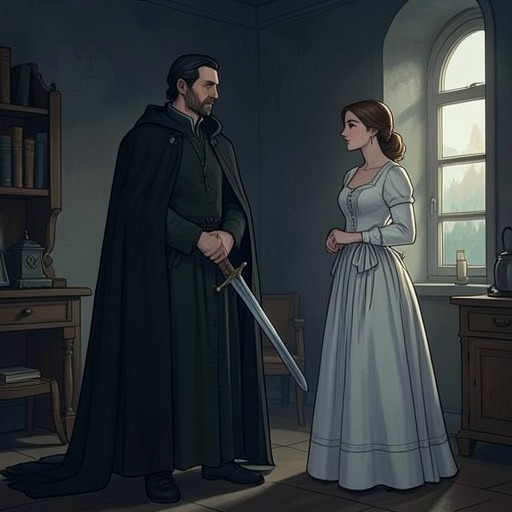
Arianrhod’s Fates for Lleu
MabinogionArianrhod’s Fates for Lleu are three successive restrictions laid by Arianrod upon her son: he cannot have a name until she gives him one, cannot receive arms and armor until she equips him, and cannot marry a woman of the race then inhabiting the earth. Gwydion answers each pronouncement with a contrivance rather than accepting it as final. The sequence turns the boy’s growth into a contest over who can define the conditions of his life, while its outcomes depend on staged recognition, deception, and finally magical creation.
The First Fate: A Name
Arianrod lays the first destiny when Gwydion brings the boy to her castle. The child has been raised by Gwydion after being found as an infant in a chest, and by four years old he has grown to the size of an eight-year-old. When Arianrod asks who the boy is, Gwydion identifies him as her son. She responds not by welcoming him but by objecting that his upbringing has brought her shame. Asked for the boy’s name, Gwydion says he has none; Arianrod then declares that he will remain nameless until he receives a name from her.
Gwydion refuses to let her condition stand, but he does not simply announce a name. He takes the boy to the shore between Caer Dathyl and Aber Menei, makes a boat from sedges and seaweed, and fashions and colors leather from dry sticks and sedges. Disguised in appearance, he and the boy approach Arianrod’s castle as shoemakers. Arianrod sends for the craftsmen, and Gwydion uses the encounter to draw her attention to the boy’s skill and, in turn, to a wren standing on the boat’s deck.
The boy shoots the bird in the leg, between sinew and bone. Arianrod praises the steady aim and calls him a lion; Gwydion treats her words as the opening she has unwittingly supplied. He declares the name Llew Llaw Gyffes for the boy. The work and disguise disappear into sedges and seaweed, ending the shoemaking performance. The naming is therefore not a gift Arianrod knowingly grants: her own description of the shot provides the occasion by which Gwydion secures a name for her son despite her decree.
The Second Fate: Arms and Armor
After the naming, Arianrod imposes a second restriction: the boy is never to have arms and armor unless she invests him with them. Gwydion again rejects the force of her condition. He takes Llew Llaw Gyffes to Dinas Dinllev and raises him there until he can manage any horse and has attained exceptional stature, strength, and appearance. Yet Gwydion sees that the youth languishes for want of horses and arms. The obstacle is not his ability to use them but Arianrod’s claim to control whether he may receive them.
Gwydion brings Llew Llaw Gyffes back to Arianrod’s castle in disguise, presenting them as bards. Before dawn, he uses magic to create the appearance of an approaching invasion: the land resounds with uproar, trumpets, and shouts. Arianrod, believing the castle is threatened by ships and an army, asks what can be done. Gwydion counsels her to shut the castle and defend it. She approves the plan and fetches armor, bringing two suits for the two men.
Arianrod herself arms Llew Llaw Gyffes, cheerfully and in direct response to the supposed emergency. Once she has finished, Gwydion reveals that there is no army: the uproar was devised to break her prophecy and obtain arms for her son. The ruse makes her the agent of the very act she had reserved for herself. She condemns Gwydion for the alarm, noting that youths in the cantrev might have lost their lives because of it, but her stated restriction has already been circumvented. Unlike the first fate, which was defeated through a moment of accidental naming, this one is answered by a deliberate deception that induces Arianrod to perform the forbidden act herself.
The Third Fate: A Wife
Arianrod’s third destiny follows the exposure of the false invasion. She declares that Llew Llaw Gyffes shall never have a wife of the race then inhabiting the earth. Gwydion again refuses to accept the prohibition as conclusive, and he and Math son of Mathonwy decide to form a wife for the youth through charms and illusion. Their response is not another disguise or a trick that makes Arianrod unknowingly provide what she denied. Instead, they create a bride by a different means.
The two men gather blossoms of oak, broom, and meadowsweet and produce a maiden described as exceptionally fair and graceful. They baptize her and name her Blodeuwedd. She becomes Llew Llaw Gyffes’s bride; after their marriage and feast, Math grants him the cantrev of Dinodig to hold. The narrative thus supplies a wife after Arianrod has excluded women of the earthly race, but it presents the bride’s flower-made origin without further specifying how she relates to that race. The resolution rests on the distinction between an ordinary woman and a maiden made through enchantment, rather than on Arianrod’s consent.
The Pattern and Limits of the Destinies
The three pronouncements concern successive public markers of Llew Llaw Gyffes’s adult identity: a name, the means to bear arms, and a wife. Each arrives after Gwydion has brought him to Arianrod, and each attempts to reserve for her the power to withhold a necessary condition of his development. The sequence escalates in scale, from recognition of the child to his equipment as a youth and then to the terms of his marriage.
Gwydion’s answers also change in kind. He first arranges a meeting in which Arianrod’s own words can be used to name the boy; next, he engineers a false military crisis that prompts her to arm him; finally, he joins Math son of Mathonwy in creating Blodeuwedd from flowers. The first two outcomes exploit Arianrod’s participation, conscious in the naming encounter but unwitting in the armor episode. The third bypasses her altogether. The fates therefore structure the episode as repeated restrictions followed by distinct solutions, while leaving the reader with a clear limit: the story shows how the conditions are overcome, but does not explain a general rule governing Arianrod’s power or the nature of the flower-made bride.