Three Goodly Concealments and Three Ill-fated Disclosures
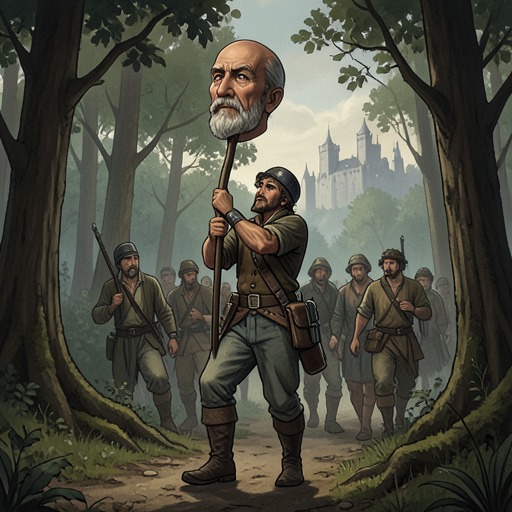
MabinogionThree Goodly Concealments and Three Ill-fated Disclosures describes a recurring contrast between secrets that protect the island and revelations that bring suffering. The episode of Bendigeid Fran’s head gives the pattern its clearest consequence: buried at the White Mount, the head keeps invasion from across the sea at bay for as long as it remains concealed.
The Pattern of Concealment and Disclosure
The account identifies the burial of Bendigeid Fran’s head as the third goodly concealment and its later disinterment as the third ill-fated disclosure. These paired labels make concealment more than the hiding of an object: it preserves a condition of safety, while disclosure breaks that protection. The passage does not detail the other two pairs, so the head’s fate stands here as the stated example rather than a full account of the series.
The Closed Door at Gwales
Before the burial, the survivors carry the head to Gwales in Penvro, where they spend fourscore years in a spacious hall overlooking the ocean. They are joyful and remain unaware of the time passing; their memories of food, sorrow, and loss have fallen away. One door, facing Cornwall, is closed, and Manawyddan identifies it as a door they must not open.
Heilyn son of Gwynn breaks this prohibition to see whether the warning is true. Looking toward Cornwall and Aber Henvelen restores the companions’ awareness of every evil they had suffered, every lost friend, and the misery that had befallen them, especially the fate of their lord. The disclosure changes their state at once: perturbed and unable to rest, they leave Gwales and carry the head toward London. The scene links forbidden knowledge with the return of grief, though the named third ill-fated disclosure is specifically the head’s later disinterment.
The Head at the White Mount
The companions bury the head in the White Mount. That act completes the third goodly concealment, and the text associates the burial with a long protective interval: no invasion from across the sea comes to the island while the head remains hidden there. The concealment therefore has a public consequence beyond the companions’ private respite at Gwales.
The paired designation of the head’s eventual disinterment as the third ill-fated disclosure makes the protection conditional. The account does not describe the circumstances of that later uncovering here; it defines its significance through the danger attached to breaking the concealment. The pattern turns the head’s burial into both a memorial act and a safeguard, setting guarded memory against revelations that reopen suffering or expose the island to peril.