Ravens
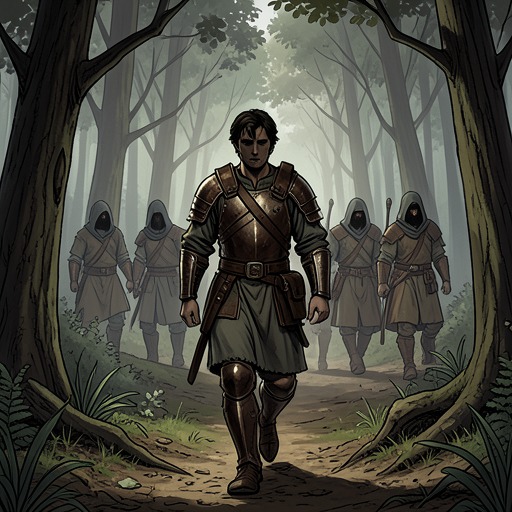
MabinogionRavens are the three-hundred-strong force left to Owain son of Urien by Kenverchyn. In the episode at Arthur’s court, they are not merely a body of animals in the background: they are Owain’s dependants and a formidable fighting force, exposed to attack while he plays chess with Arthur. Their response to a banner, and the eventual need to lower it, makes them central to the scene’s movement from courtly amusement to conflict and back to peace.
Identity and Place in Owain’s Following
The account identifies the Ravens as an army of three hundred that Kenverchyn had left Owain. It gives no further explanation of their origin or nature, but their place in Owain’s following is clear: they accompany him after he returns to Arthur’s court, and wherever he goes with them, he is victorious. Their strength therefore belongs to Owain’s wider standing as a leader, not only to the dramatic incident at the chessboard.
The narrative shows that this following can be harmed as well as feared. Arthur’s young attendants harass and torment the Ravens; as the episode develops, some are killed and others are so badly hurt that they cannot rise into the air. The repeated appeals to Owain make their vulnerability part of the court’s political tension. They are his, and their treatment is presented as a matter requiring his consent or intervention.
The Attacks and Owain’s Response
While Arthur and Owain play chess, messengers arrive in stages to report what is happening. The first asks whether the attendants’ harassment is with Owain’s permission and requests that Arthur forbid it if it is not. Owain turns the appeal to Arthur, but Arthur tells him to continue the game. The messenger returns to the conflict without a remedy.
A second messenger renews the complaint, now reporting that the attendants are killing some Ravens and worrying others. Owain again asks Arthur to forbid his men, and Arthur again directs him to play. The repeated interruption sharpens the contrast between the composed chess game and the violence taking place beyond it: the Ravens’ danger is plainly reported, yet the game continues and no prohibition is issued.
The third messenger brings a more urgent report. Most of the Ravens have been killed, and those still alive are so wounded and bruised that none can lift its wings even a short distance above the earth. This time Owain gives an instruction of his own: the youth is to return to where the fighting is fiercest, raise the banner, and let events take their course. The decisive signal comes from Owain, not from Arthur’s permission.
The Banner and the Counterattack
When the youth raises the banner, the Ravens recover their strength and rise into the air. The account describes them as wrathful and fierce, their wings beating as they shake off their exhaustion. They then sweep down upon the men who had attacked them. Their response is coordinated and forceful, turning the attackers’ violence back upon them and producing a tumult that interrupts the court’s play.
The episode gives the banner a practical role in the Ravens’ return to action: its raising coincides with their recovery and attack. The narrative does not explain the mechanism behind this change, but it makes the relationship between Owain’s order, the banner, and the Ravens’ renewed strength unmistakable. Their apparent helplessness is reversed, and those who had treated them as vulnerable targets face the consequences of that misjudgment.
The Ravens’ counterattack also changes the balance of the scene. What began as a series of complaints about harm to Owain’s following becomes an immediate danger to Arthur’s men. A later knight reports that the Ravens have killed members of his household and the sons of leading men of the island, and asks Arthur to make Owain restrain them. The complaint confirms that the conflict has spread beyond the attendants who began it.
Restraint and Narrative Significance
Arthur now asks Owain to forbid the Ravens. His appeal marks a reversal in the earlier exchanges: Arthur had twice declined to stop his attendants, but once the Ravens’ retaliation threatens his men, he seeks Owain’s intervention. Owain orders Gwres son of Rheged to lower the banner. The banner is lowered, and peace follows. The ending establishes that Owain can not only call the Ravens into action but also end their response.
The chess game frames the entire confrontation. Arthur and Owain repeatedly begin or continue a game while reports arrive from the battlefield; only the growing cost of the conflict finally breaks that pattern. Arthur crushes the golden chessmen on the board until they become dust just before Owain orders the banner lowered. The destruction of the pieces gives visible form to the collapse of the game’s orderly pretense, while the lowered banner marks the return of peace.
As an element of Owain’s characterization, the Ravens make his authority tangible through both loyalty and consequence. Their treatment cannot be separated from his standing: an attack on them draws repeated messages to him, and his command determines whether they fight or stop. Their wider record of victory with Owain extends this episode’s image of them beyond a single clash, presenting the Ravens as an enduring source of his military power.