Llwyd’s enchanted mice
MabinogionLlwyd’s enchanted mice are the transformed members of Llwyd son of Kilcoed’s household, deployed to destroy Manawyddan’s harvest and continue a feud rooted in an earlier deception. What begins as an infestation becomes a contest of leverage: Manawyddan catches one mouse, discovers that it is Llwyd’s pregnant wife, and refuses to release her until the captives and enchanted lands of Dyved are restored and the threat of renewed vengeance is removed.
Nature and Origin
The mice are not ordinary animals but Llwyd’s own household in transformed shape. Llwyd explains that, after Manawyddan came to live in Dyved, his household asked him to turn them into mice so they could ruin Manawyddan’s corn. The first group went out on the first night, and they returned on the second; the losses to the crops thus arise from a deliberate magical attack rather than natural blight.
The attack also has a longer history. Llwyd says he laid the enchantment over Dyved to avenge Gwawl son of Clud, to whom he was bound by friendship. His vengeance against Pryderi reaches back to the Game of Badger in the Bag, which Pwyll had played on Gwawl at the court of Heveydd Hen. The mice therefore carry an old grievance into Manawyddan’s household, turning a past humiliation into present material damage.
The Destruction of the Crops
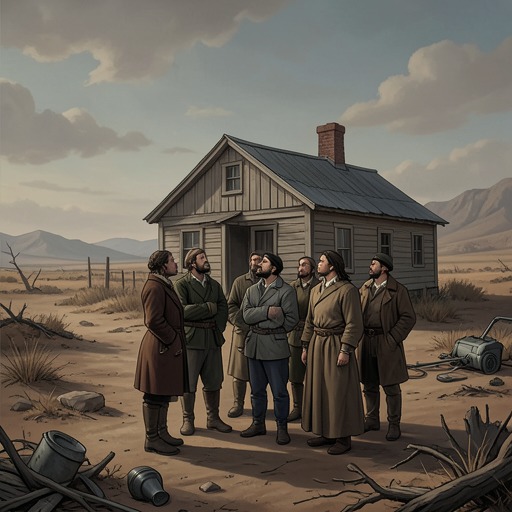
The mice’s work unfolds across Manawyddan’s crofts. After two crops have been destroyed, he sees a third field of exceptionally fine, ripe wheat and decides to keep watch through the night, suspecting that whoever took the earlier harvest will return. At midnight an immense host of mice pours into the field. Each climbs the straw, bends it under its weight, cuts off an ear of wheat, and carries it away, leaving the stalk behind. Manawyddan sees that not a single straw has escaped them.
He rushes after the swarm, but the mice move beyond his reach, like gnats or birds in the air. One, slower than the others, falls behind. Manawyddan catches it, puts it inside his glove, ties the opening with a string, and carries it back to the hall. To Kicva he calls it a thief and recounts how the fields have been wasted. He intends to hang it, and says that he would hang all the mice if he could catch them; Kicva urges him to let the creature go, warning that punishing so small a prisoner would be undignified. He rejects her advice because he knows of no reason to spare it.
Capture and Negotiation
Manawyddan takes the mouse to the Gorsedd Arberth and prepares to hang it. A poor, tattered scholar arrives first, followed by a bishop with attendants and baggage horses. The bishop offers successive ransoms: seven pounds, then twenty-four pounds, then his horses and their loads. Manawyddan refuses each offer. He asks instead for Pryderi and Rhiannon to be freed, and for the charm and illusion to be removed from the seven cantrefs of Dyved.
Even after those terms are accepted, Manawyddan will not release the mouse. He requires that no further enchantment be laid on Dyved and that no vengeance be taken against Pryderi, Rhiannon, or himself. Only then does the bishop disclose that the mouse is his wife. Llwyd explains that she and the ladies of his court had asked to be transformed on the third night; his wife was pregnant, and that circumstance made her slow enough for Manawyddan to catch. Her capture gives Manawyddan the bargaining power to secure not merely the return of his companions and the end of the spell, but protection against retaliation. When Pryderi and Rhiannon appear free, Manawyddan releases her.
Consequences and Narrative Significance
The mice’s attack links the magical desolation of Dyved to the personal conflict between Llwyd and Manawyddan’s companions. Their raids make the enchantment visible in the threatened harvest, while the captured mouse turns an unseen household conspiracy into a negotiation with its responsible leader. The reversal is exact: Llwyd’s household uses transformation to make itself difficult to catch, but one pregnant member’s reduced speed exposes the scheme and places Llwyd under pressure.
The episode also distinguishes vengeance from its limits. Llwyd’s spell is motivated by loyalty to Gwawl and retaliation for the earlier game, but Manawyddan insists that the settlement must prevent the cycle from continuing. The mouse is released only after the captives are restored, the enchantment is lifted, and future vengeance is renounced. The mice thus serve both as instruments of reprisal and as the means by which the conflict is brought to a negotiated close.