Federal Bureau of Investigation
MasqueradeThe Federal Bureau of Investigation becomes the principal federal partner in the investigation when local authorities conclude that the crimes they have uncovered may have continued for years or decades and exceed the town’s investigative resources. Its agents bring specialist experience and a broader operational reach to the case, but the motel ambush and safe-house attack show how quickly carefully arranged protections can be tested by a criminal who adapts to them.
Entry into the Investigation
After local officials confront the scale of the discoveries, Dan Stevens calls in federal assistance. Special Agents John Brice and Robyn Dyer arrive and meet with Stevens, who acknowledges that serial-killer investigations are beyond the town’s usual capabilities. The federal response is therefore a collaboration with local law enforcement, not a replacement for it: Stevens and his deputies remain involved in planning and site security.
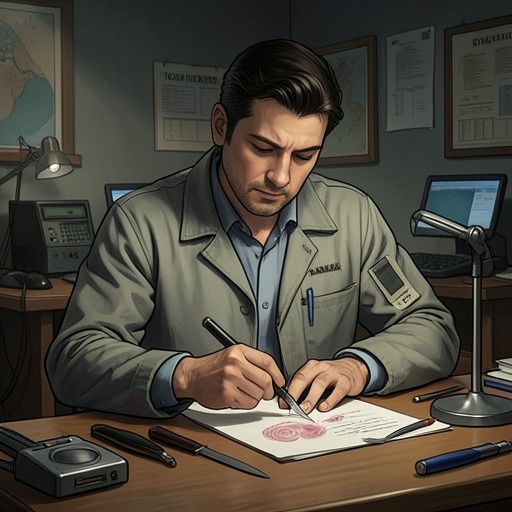
Brice recruits Jessica White and her husband as civilian consultants. He had met them during the Samantha Ryan kidnapping case and specifically seeks Jessica’s psychiatric expertise as he deals with Claire Rothman. Their presence gives the investigation access to professional knowledge beyond the agents’ own roles, while the case continues to depend on coordination among federal agents, the chief, and his deputies.
The initial work includes an effort to speak with Claire, who is recovering but has not yet given investigators an account. At the interrogation room, Dyer identifies herself as a federal agent and Jessica as an observer, and asks Claire whether she knows where her husband is. Claire reacts to the camera and to the possibility of arrest, then describes the personal catastrophe behind her silence: her mother has been murdered, and she has discovered her husband’s nature. The scene places the Bureau’s investigative questions beside the human shock surrounding the case.
Investigative Methods and Operational Planning
The investigation’s methods combine questioning, observation, and attempts to anticipate Robert Rothman’s next move. Dyer notices that the local interrogation room is kept at seventy-four degrees and argues that it should have been colder, on the theory that discomfort might make a suspect more talkative. The detail shows an agent applying a practical interrogation tactic in a facility whose equipment and conditions are controlled by the town, rather than by a dedicated federal installation.
The Bureau also treats Claire as a possible route to Rothman, without assuming that she is already a suspect. Brice hopes she is right that her husband will return for her and views that possibility as a chance to capture him. He proposes requesting additional assistance; Dyer considers reinforcements unnecessary, confident that her and Brice’s training gives them an advantage. Their disagreement reveals different assessments of the threat even within the federal team.
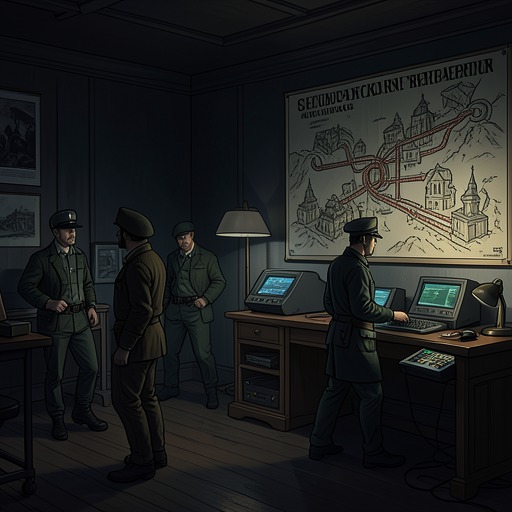
At the Pines Way Motel, Brice organizes a staged environment intended to make the location appear occupied and ordinary. A used-car dealership owned by his brother-in-law is to supply ten vehicles to park outside the rooms. Two female agents are assigned to pose as maids, while Joe Perkins, one of Stevens’s deputies, is to act as a handyman so he can move around without attracting notice. Robyn Dyer is placed in charge of the motel operation; Brice instead plans to watch over Claire at the FBI Safe House by the lake, accompanied by Jessica and her husband.
The plan also includes a decoy made up to resemble Claire. Brice says that the agents, Claire, and the decoy are arriving together, and Stevens’s double take when the two women enter in succession registers how the deception is meant to work: Rothman may see what appears to be his wife without being able to know at once that the person before him is not Claire. The scheme relies on controlled appearances, concealed roles, and the hope that Rothman will approach the bait.
Safe-House Attack and Response
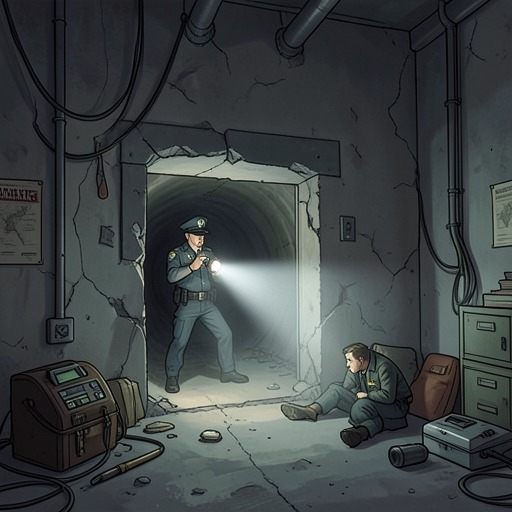
The protective arrangement at the FBI Safe House is tested when Kaye Swan reaches the house seeking help. Agent Martin Cantwell sees her from the kitchen window and alerts the other agents, but he cautions that her arrival could be a ruse. He assigns one agent to remain with Claire, sends another to guard the front, and tells him to contact Brice while he handles the rear entrance. The response shows the agents balancing an urgent appeal for help against the possibility of deception.
Victoria Belle follows Swan to the house. Concealed with a knife, she attacks before Cantwell can secure the situation, takes his weapon, and moves through the kitchen as gunfire breaks out elsewhere in the house. The safe house, which had been organized around guarding Claire and monitoring approaches, becomes a point of escape and renewed danger. The episode demonstrates the cost of a security plan built around expected movements when an attacker arrives by a different route and is already armed.
After the attackers leave, federal agents and local authorities act quickly to restrict their movement. Robyn Dyer tells Jessica that roads were cordoned off within three minutes and that deputies, state troopers, and federal agents are checking vehicles; a house-to-house search is also being prepared. She believes the fugitives are still nearby and assures Jessica that the search is continuing. Brice emerges from the house with his arm in a sling and sits on the steps rather than standing with the others, a visible sign that the operation has also taken a toll on its lead agent.
Role and Significance
The Federal Bureau of Investigation’s part in the story grows from a call for expertise into a combined investigative and protective operation. Brice and Dyer bring federal agents into a case that the local department cannot manage alone, while Stevens and his deputies provide local knowledge, personnel, and access. Jessica’s psychiatric consultation, the motel’s staged cover, the Claire decoy, and the subsequent road checks each represent a different effort to turn information into action.
The operation’s strengths and limits are presented together. Federal agents devise layered disguises and coordinate with local officers, yet Dyer’s confidence about the need for reinforcements contrasts with the danger that materializes at the safe house. The Bureau’s response after the attack is expansive and immediate, but its pursuit is still underway when the search is announced. Its significance lies less in effortless control than in the sustained effort to adapt: from a small-town call for help to a multi-agency search after the protection plan has been breached.