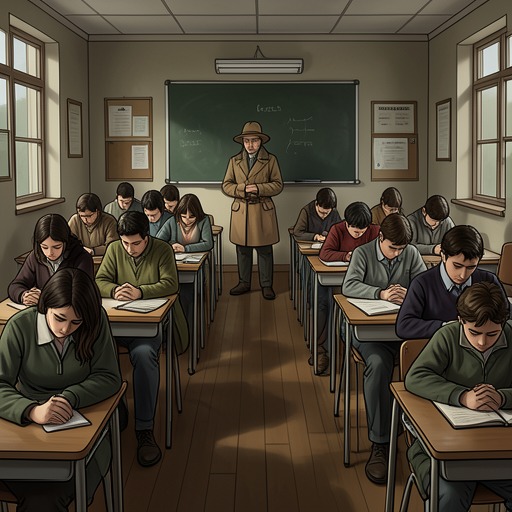
Bulstronk’s classroom conduct rules
MatildaMiss Trunchbull’s classroom conduct rules turn ordinary lessons into exercises in submission: pupils are expected to arrive clean, speak only when permitted, stand to answer, and never challenge or joke with her. The warnings are not abstract etiquette. They prepare the children for a school where a wrong answer or a perceived breach of her preferences can bring physical punishment, while Miss Honey remains present as a largely powerless witness.
The weekly lesson and its warnings
In the first week of school, Miss Honey tells her class that Miss Trunchbull takes over each class for an hour every week. Their turn is fixed for two o’clock on Thursday afternoon, immediately after lunch. Miss Honey will stay in the room, she explains, but only as a silent witness. The arrangement gives Miss Trunchbull a regular place inside each classroom and makes the threat of her authority part of the school timetable.
Before the first lesson, Miss Honey tells the children to wear clean clothes and keep their faces and hands clean. They must speak only when asked, stand up before answering a question, never argue or contradict Miss Trunchbull, and never make jokes. The instructions are framed as precautions: if Miss Trunchbull becomes angry, the children will be in danger. Compliance is therefore demanded not through a shared account of good learning, but through anticipation of what the headmistress may do.
Discipline as a lesson in obedience
Miss Trunchbull’s conduct in the classroom makes the warnings concrete. She insults the pupils and says she wants to get as many of them expelled as possible so she will not have to endure them for the next six years. Her opening posture establishes that they are not being addressed as learners whose abilities she intends to develop, but as troublesome bodies to be controlled or removed.
When Robert gives the wrong answer to a multiplication question, Miss Trunchbull grips his long golden curls, lifts him from his chair, and holds him suspended while insisting that he repeat the correct answer. Miss Honey protests that she is hurting him and pulling out his hair, but the lesson’s stated arithmetic is inseparable from its demonstration of who may command and who must submit. Robert changes his answer under physical pressure; the scene presents the correction as forced compliance, not patient instruction.
The same logic governs her treatment of Erik. After the boy shouts an answer, Miss Trunchbull lowers him into his chair by his ears and brushes her hands as if she has touched something dirty. She then explains that children learn by having knowledge beaten into them and claims that hanging and rough handling help them remember. She acknowledges that Erik’s ears have been stretched, treating the injury as an amusing consequence rather than a reason to stop. Her account of teaching thus makes pain part of the method, while Miss Honey’s objection exposes the harm that the rules of obedience conceal.
Rules enforced through bodily punishment
The classroom warnings sit within a wider pattern of Miss Trunchbull enforcing her preferences through force. At the playground, she seizes Amanda Thripp by her braids, swings her around, and hurls her over the school fence. The episode is not a classroom lesson, but it clarifies the threat behind the classroom instructions: a child’s appearance or conduct can become grounds for punishment, and resisting the headmistress is not presented as a safe option.
Together, the rules and their enforcement establish a hidden curriculum alongside the formal work of learning. The pupils are asked to master multiplication, but they are also trained to anticipate authority, regulate their speech and appearance, and avoid provoking the person who controls the room. Miss Honey’s warning that the children should obey is an attempt to protect them within that system; her position as silent witness during the weekly lesson shows how little power she has to prevent its violence.