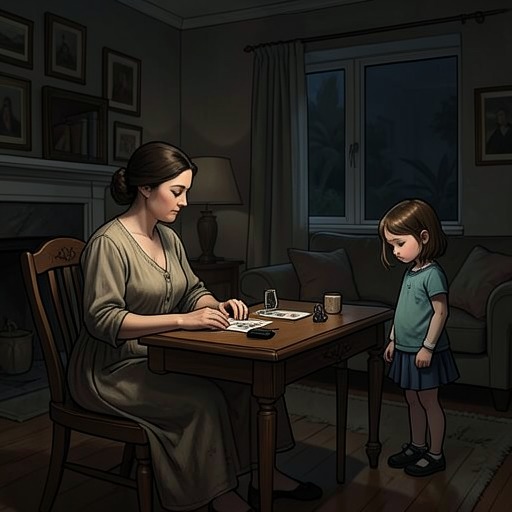
Matilda and Mrs. Wormwood’s mother-daughter relationship
MatildaMatilda and Mrs. Wormwood’s mother-daughter relationship reaches its decisive turning point when Matilda asks not to leave with her family but to stay with Juffrouw Engel. In the hurried departure for Spain, Mrs. Wormwood gives permission without hesitation; her remark that Matilda’s leaving means one fewer person to care for makes the distance between them explicit. The scene ends with Matilda held close by Juffrouw Engel as her family drives away, converting a strained parent-child bond into a separation that Matilda herself has chosen.
The Relationship at the Point of Departure
The evidence presents the relationship through a concentrated episode rather than a history of their life together. Matilda returns home after visiting Juffrouw Engel and finds her parents filling suitcases with clothes and belongings. The family plans to leave for the airport in half an hour, and Matilda is told to pack because she is expected to go with them. Her mother is part of the hurried activity in the hall, but the account does not show her pausing to discuss the move with Matilda or asking how she feels about it. The immediate assumption is that the child will accompany the adults.
Matilda’s response makes clear that remaining with her family is not what she wants. She runs back to Juffrouw Engel, out of breath and red-faced, to report that her parents are leaving and that they say she must go too. This urgent appeal establishes the central imbalance in the relationship at this moment: Matilda must make her wish to stay known and seek another adult’s help, while her mother is occupied with the practical demands of departure. The scene does not supply a fuller account of the mother’s feelings, so the relationship is best understood here through what each does and says under the pressure of the family’s imminent journey.
Matilda’s Request and Her Mother’s Answer
At the car, Matilda makes her request directly to both parents. She says that she does not want to go with them and wants to live with Juffrouw Engel, who is willing to have her, provided the parents consent. Her repeated pleas to her father and mother show that Matilda understands permission is required and that she is asking for a consequential change in where she will live. She does not simply disappear or leave on her own: she brings Juffrouw Engel to the family and asks openly for the adults’ agreement.
Mrs. Wormwood’s answer is brief and practical. While placing a suitcase on the back seat because the luggage compartment is full, she tells her husband to let Matilda go if that is what the girl wants. She adds that this will be one fewer person for them to look after. The circumstance of the remark matters: she speaks amid the loading of the car, and her attention remains tied to fitting the luggage and getting the family away. Her response grants the permission Matilda needs, but the explanation frames the departure as a reduction in responsibility rather than as a painful loss or a discussion of the mother-daughter bond.
Juffrouw Engel, by contrast, tells the parents that she would be delighted to have Matilda, would care for her well, and would pay for everything. She stresses that the proposal originated with Matilda and that she will take her in only if the parents genuinely agree. Mrs. Wormwood does not contest this offer or ask for further conditions. Her agreement therefore enables Matilda’s chosen arrangement, even as the reason she gives emphasizes the burden of care rather than affection.
Separation and Its Meaning
The family’s departure completes the change in the relationship. After Mrs. Wormwood agrees, Mr. Wormwood also says Matilda may stay, explaining that he is in a hurry to catch the plane. Matilda throws herself into Juffrouw Engel’s arms, and the two embrace. The mother does not join that embrace in the account; instead, she gets into the car with her husband and son. Her response is thus part of a wider family separation, but the scene gives particular weight to the contrast between Matilda’s physical closeness with Juffrouw Engel and the departing parents’ attention to leaving.
The final gestures distinguish the family members without requiring any further explanation of their private thoughts. Matilda’s brother waves through the rear window. Neither parent looks back. Juffrouw Engel continues to hold Matilda as they watch the large black car disappear around the end of the road. The narration gives no later reconciliation or further exchange between mother and daughter in this scene; its closing image is one of separation. Mrs. Wormwood has permitted Matilda to remain, but the permission is accompanied by no farewell gesture toward her daughter.
The Relationship’s Turning Point
This episode resolves the immediate question of whether Matilda will be forced to accompany her family: she stays with Juffrouw Engel, with her parents’ consent. Mrs. Wormwood’s decision is important in practical terms because it allows that new household arrangement to happen. At the same time, the scene makes the emotional contrast unmistakable through actions rather than explanation. Matilda runs, pleads, and embraces the adult she hopes to live with; her mother handles luggage, agrees to the request, and leaves without looking back.
The relationship is therefore defined here by a combination of agency and estrangement. Matilda has to express her own preference and enlist Juffrouw Engel’s support, while Mrs. Wormwood accepts the arrangement in the midst of the family’s departure. Her comment about having one fewer person to care for gives the moment its sharpest measure of distance. The ending does not erase the mother’s role in granting permission, but it places that practical consent beside Matilda’s chosen attachment to Juffrouw Engel and the parents’ final, unreturned departure.