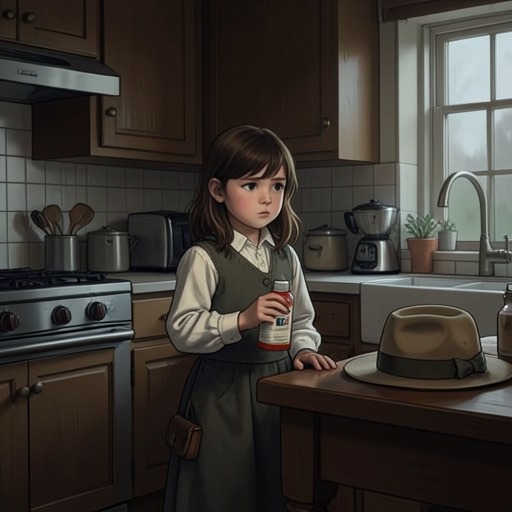
Matilda dyes her father’s hair
MatildaMatilda dyes her father’s hair in a calculated act of retaliation: after Mr. Wormwood calls her a cheat, she uses the household’s own hair products to transform his prized black hair into a dirty silver-blond. The prank depends on patient observation as much as mischief. Matilda knows the routines, bottles, and vanities of the adults around her, and turns that ordinary domestic knowledge into a way to answer an accusation she cannot otherwise make him take back.
Cause and Background
Mr. Wormwood’s accusation follows Matilda’s correct answer to a question whose answer she could not have read from where she stood. Rather than accept her explanation that she was across the room, he insists she must have looked at his paper and cheated. He extends the charge into a denunciation of her character, calling her a liar and a cheat. The chapter presents Matilda’s response as deliberate: she decides that this latest nasty trick by her father deserves strict punishment, thinks through her options over dinner, and knows what to do by bedtime.
The prank also targets a particular source of Mr. Wormwood’s pride. His hair is thick, black, and parted down the middle, and he treats it as evidence of his intelligence, often claiming that strong hair means strong brains beneath it. Matilda has already punctured that boast by pointing out that Shakespeare was bald; Mr. Wormwood responds by telling her to keep quiet if she has nothing sensible to say. His insistence on the link between appearance and intellect makes the coming change more than cosmetic: the hair he values as proof of himself becomes the surface on which Matilda exposes his self-importance.
Preparation and Method
Early the next morning, Matilda locks herself in the bathroom. Mrs. Wormwood’s hair is kept a bright platinum blond, with a major bleaching session at the hairdresser twice a year and a monthly touch-up at home to cover the darker roots. The bathroom cabinet holds the product she uses, Extra Strong Platinum Blond Hair Dye, whose label warns that it contains peroxide and should be kept out of children’s reach. Matilda has read that label with fascination before; now the stored detail becomes practical knowledge.
Mr. Wormwood’s own routine supplies the cover. Every morning after shaving, he massages large quantities of Violet Hair Lotion into his scalp. The bottle, an unpleasant-smelling purple liquid, is always left on the bathroom shelf beside the toothbrushes. Matilda pours three-quarters of it down the drain and replaces the lost liquid with her mother’s dye. She leaves enough lotion in the bottle for the mixture to remain reasonably purple, shakes it thoroughly, then returns both products to their usual places. The plan is carefully concealed inside a familiar routine: the bottle looks sufficiently ordinary to wait for its owner’s next use.
The Breakfast-Table Reveal
At breakfast, Matilda quietly eats cornflakes while her brother stuffs himself with bread covered in peanut butter and strawberry jam. Their mother is in the kitchen preparing Mr. Wormwood’s usual substantial meal: eggs, sausages, bacon, and tomato. Matilda keeps her head bent over her bowl. She does not know exactly what she will see when her father comes in, and fears she will not be able to keep her composure if the result is what she expects.
Mr. Wormwood enters noisily, as he habitually does, and approaches the head of the table just as Mrs. Wormwood comes out carrying his plate. She stops dead, screams, and drops the food onto the floor. Her first reaction makes the change visible before Mr. Wormwood understands it: she points at his hair and cries out, while he demands to know what is wrong and his son also reacts to his appearance. The spilled breakfast and sudden commotion turn Matilda’s private bathroom operation into a household spectacle.
Matilda says nothing. She admires the result: her father’s once-beautiful black hair has become the dirty silver color of a circus performer’s tights that have gone unwashed for an entire season. The comparison echoes the description of her mother’s platinum hair, but the result on Mr. Wormwood is deliberately far from its glossy silver brightness. Mrs. Wormwood tells him that he looks dreadful and like a monster. He denies having dyed his hair, grabs it with both hands, and asks what has happened; his face turns a pale green, like unripe apples.
Consequences and Significance
The change is not permanent, but undoing it requires an immediate response. Mr. Wormwood cannot imagine continuing to go around with his hair as it is. Mrs. Wormwood advises that it will have to be dyed black again, but first it must be washed. He orders her to make an emergency appointment with her hairdresser, even if someone else has to be displaced from the list, and rushes upstairs to wash his hair. She sighs and begins calling the salon.
Matilda’s final comment to her mother—that men can do foolish things—quietly reverses the household’s usual direction of judgment. Her father had dismissed her intelligence and accused her of dishonesty; now his own appearance, and his inability to control what has happened to it, become the subject of the family’s astonishment. Mrs. Wormwood answers that men are not always as clever as they think and says Matilda will discover this when she is older. The exchange makes the prank’s point without requiring Matilda to confess: her father’s confidence in his own authority and judgment has been answered by a plan that used his daily habit against him. The scene turns revenge into a precise domestic reversal, with the man who loudly announces himself as master of the house left scrambling for a hairdresser while Matilda watches in silence.