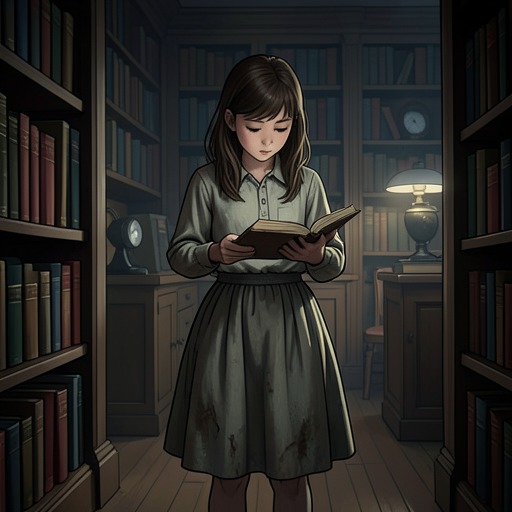
Matilda’s library reading
MatildaMatilda Wormwood’s library reading turns the hours in which she is left alone into an expansive education of her own. After Mr. Wormwood refuses to buy her a book, she walks to the village library without an adult, introduces herself to Mrs. Phelps, and asks whether she may sit and read. What begins as a child’s answer to a dismissed request becomes a sustained routine: the library supplies books, while Matilda’s small bedroom becomes the place from which she travels through them.
A reader left to find her own books
Matilda’s first journey to the library follows a pattern of parental absence. Her older brother is at school, Mr. Wormwood is at work, and Mrs. Wormwood spends five afternoons each week playing bingo in a town twelve kilometres away. Matilda is nearly always left at home alone. The afternoon after her father refuses to buy her a book, she sets out by herself; Mrs. Phelps is surprised to see such a small child arrive without a parent, but allows her to stay. The episode makes the contrast plain: Matilda’s curiosity has to find its own support in a household that offers her little attention.
At first, Matilda goes to the library as a place to read rather than borrow. The walk takes ten minutes, and the two hours she spends there become a regular stretch of quiet attention. When Mrs. Phelps directs her to the children’s books, Matilda declines help choosing one and selects for herself. She reads through the entire children’s section; only then does she begin wandering in search of something else. Her progress is not presented as a formal lesson or a parent-guided program. It is driven by her own appetite, and the exhaustion of the shelves marks how quickly that appetite outruns the library’s obvious provision for a child her age.
The books she chooses
Matilda’s account of what she has read shows that she is not merely turning pages. She distinguishes between books she did not enjoy and those she found wonderful, and singles out The Secret Garden as her favourite. What captivates her is its arrangement of secrets: a room behind a closed door and a garden behind a high wall. The details she remembers reveal an alertness to the book’s mysteries and to the way one hidden place leads toward another. Mrs. Phelps is astonished by Matilda’s reading and asks her age; Matilda says she is four years and three months old.
Her pace is striking even by the measure of a substantial novel. Matilda finishes Great Expectations, in an edition of 411 pages, within a week. She tells Mrs. Phelps that she loved it and asks whether Dickens wrote more books. Mrs. Phelps, still surprised, offers to find another. During the following six months Matilda continues reading under the librarian’s watchful, sympathetic eye. The evidence presents not just precocious speed but an emerging literary appetite: after finishing one writer’s book, Matilda wants to follow the writer into more.
From library visits to a room of her own
Mrs. Phelps eventually explains that library books can be borrowed and taken home. Matilda has not known this was possible. The arrangement changes the rhythm of her reading: instead of coming every afternoon to read at the library, she visits once a week to return old books and collect new ones. The library remains essential, but its books now accompany her home and allow her to read beyond the hours she can spend there.
At home, Matilda makes her small bedroom into a reading room. She spends nearly every afternoon there, often with a mug of hot chocolate beside her. Because she cannot reach everything in the kitchen, she uses a little box from the scullery to stand on; she warms milk in a pan on the stove and adds cocoa, sometimes making Ovomaltine instead. These ordinary, practical details show how much of the reading life she has assembled independently. In a quiet room in an otherwise empty house, she provides herself with a warm drink, a place to sit, and another book.
Imagination, neglect, and the meaning of reading
The books carry Matilda beyond the limits of her village and her family’s indifference. Through Joseph Conrad she sails on old ships; with Ernest Hemingway she goes to Africa; with Rudyard Kipling she travels to India. The narration describes her as circling the world from her little bedroom in an English village. Reading therefore offers both knowledge of other lives and a concrete imaginative enlargement of a childhood otherwise confined by isolation. The contrast is not that books erase her circumstances, but that they open a world her parents do not provide.
The wider narration sharpens this contrast by setting Matilda’s reading against adult assumptions about children. It first mocks parents who insist that their children are brilliant, then describes the Wormwoods as parents who barely care about their daughter. Matilda’s intelligence is not something she advertises: later, the narration says that an ordinary encounter would give little indication of the clarity of her mind unless conversation turned to mathematics or literature. Her reading is one of the places where that unshowy ability becomes visible. At school, when Miss Trunchbull praises the harsh methods of the schoolmaster in Nicholas Nickleby and assumes the pupils will never read the book, Matilda quietly says that she has already read it. The reply links her private reading to a later public moment: books have prepared her to recognize what an adult authority invokes, even when that authority imagines children incapable of understanding it.