Long Shot native cephalopods
Mickey7The Long Shot native cephalopods are the sentient inhabitants of Long Shot, a remote world where humans achieved a rare outcome: coexistence with native intelligence. Tree-dwelling and almost invisible among the canopy, they were not encountered for twenty years after landfall. Their story complicates human assumptions about technological progress and suggests that peaceful contact may depend as much on circumstances and time as on recognition of another people’s intelligence.
Habitat and Appearance
Long Shot is a dwarf planet orbiting a gas giant, which in turn orbits an M-class star at the far end of the spiral arm. The nearest colony lies almost twenty lights away; the expedition that reached Long Shot was the longest successful jump humans had made. The cephalopods live in trees, with their population concentrated in the central highlands of the planet’s only continent.
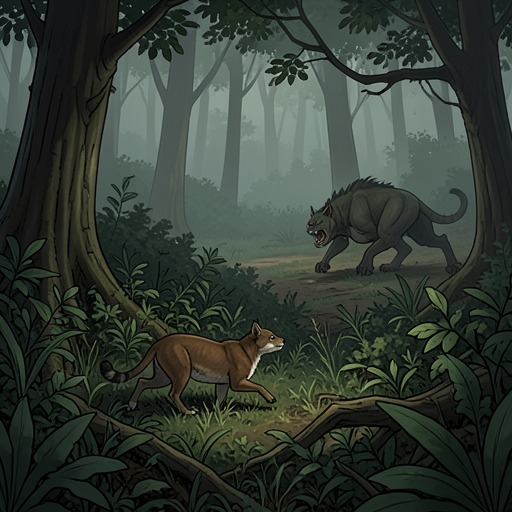
Footage shows them moving rapidly from branch to branch and changing color to blend into the canopy so effectively that they can generally be seen only in infrared. Their concealment is not simply a visual curiosity: together with their localized population and shy behavior, it helped keep them outside the colonists’ notice for years.
Intelligence and Environmental Mastery
At the time of human landfall, the Long Shot native cephalopods were scientifically and culturally advanced, while their material development was described as no further advanced than that of humans before agriculture. The account presents this contrast not as evidence of incapacity but as a consequence of their success in their own environment. They had mastered their surroundings without developing rifles or the material technologies humans associate with advancement.
The narrator reports that several explanations for this difference have been proposed. The most persuasive to him is that humans developed tools and infrastructure because they were poor at surviving as ordinary animals, whereas the Long Shot native cephalopods were exceptionally capable of doing so. This remains an interpretation, not a confirmed account of their history, but it shifts the measure of technological achievement: the cephalopods’ way of life reflects adaptation to a world they already knew how to inhabit.
First Contact and Coexistence
The human beachhead was established on the coast, hundreds of kilometers from the cephalopods’ mountain habitat. The natives ignored the newcomers, while the colonists failed to recognize the natives as present: the latter were shy, confined to a particular region, and difficult to see. For the first twenty years after landfall, humans did not know they were there.
Long Shot is identified as the only world in the Union where humans and native sentients have managed to coexist. The histories, as the narrator understands them, do not explain why this encounter turned out differently from other meetings between colonists and native life. He offers a tentative explanation: by the time the two groups finally encountered one another, the colonists had become sufficiently established that they were no longer in a state of constant fear.
Significance
The cephalopods’ delayed appearance makes the circumstances of contact central to their place in the story. Their intelligence was not made legible to humans by cities, roads, or weapons; their command of the canopy and their near-invisibility meant that colonists could mistake absence of familiar signs for absence of a people. Long Shot therefore presents a counterexample to the assumption that human settlement must end in conflict with native sentients.
The narrator’s explanation emphasizes time, but does not turn it into a guarantee: the record leaves the reasons for Long Shot’s exceptional outcome uncertain. What it does establish is that distance between habitats and the colonists’ growing security shaped when contact occurred. The cephalopods’ history thus offers a pointed contrast to encounters in which fear and failure to recognize native intelligence come too late to prevent catastrophe.