parasitic worms
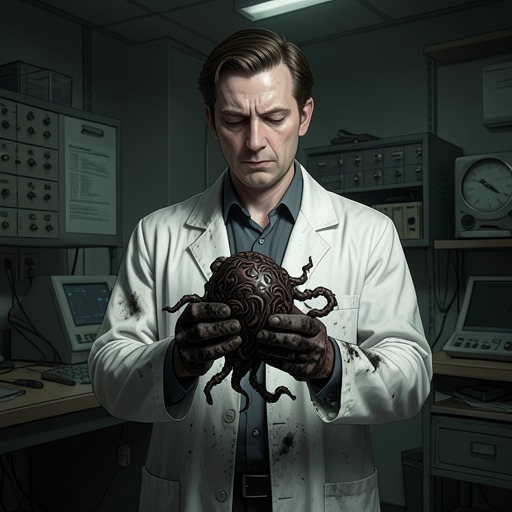
Mickey7The parasitic worms are an organism whose infestation makes a newly printed body’s unexplained brain abnormality the beginning of a prolonged death. Their life cycle is never discovered: the larvae emerge from their host, but are sterilized before they can develop further, and the remains are used to produce a new Mickey Barnes.
Discovery and Uncertainty
When an image of the narrator’s brain shows a dark curl, Nasha points to it and asks what it is. Mickey Barnes suspects a tumor, but Burke rules that out: the body is barely a week old, and a tumor could not have grown so quickly. Burke cannot identify the mark, either, and sends Mickey back into the chamber until they can determine its cause. The diagnosis of parasitic worms comes with hindsight, recasting the unexplained image as the first sign of an infestation rather than a tumor.
The Infection’s Course
The worms consume the brain from within, but the process is not immediate. It takes the better part of a month for them to kill their host; during roughly the final week, Mickey is little more than an empty shell. The second and third weeks bring headaches, seizures, and progressively worsening dementia. As the damage advances, the walls seem to speak, telling Mickey that Nasha does not love him, that his other iterations are in hell, and that the parasites will keep eating without allowing him to die. The prospect of endless suffering is itself part of the illness’s torment, but the prediction proves false: the worms do eventually let him die.
Larvae and Aftermath
Once Mickey is dead, larvae pour from his mouth, nose, and ears, apparently ready to proceed to another stage of their life cycle. What that stage might be remains unknown. Arkady sterilizes the larvae and disposes of the mass in the hopper, where it is used to make a new Mickey. The episode thus closes with containment and replacement, not with a biological explanation: the threat is eliminated, but the organism’s development is never observed.
Narrative Significance
The infection’s horror lies in its drawn-out assault on both body and perception: physical symptoms give way to dementia and frightening false beliefs before death finally comes. The account also makes the mechanics of Mickey’s renewed life starkly material. After the larvae are killed, the remains go into the hopper to produce another version of him, joining an intimate, bodily ordeal to the practical process of making a new Mickey Barnes. Even after surviving this death, the narrator says that what Marshall has planned still frightens him, a contrast that underscores how little one horrific experience can guarantee against fear of what comes next.