Mickey Barnes Seven and Mickey8's Relationship
Mickey7Mickey7 and Mickey8 are two living iterations of Mickey Barnes whose relationship shifts between practical cooperation, irritation, intimacy, and a fundamental dispute over personal identity. Their shared history binds them, but their simultaneous existence makes each other’s claims to being the same person newly consequential: the question is not merely what they remember, but who will survive when the colony decides that only one of them can.
A shared life under pressure
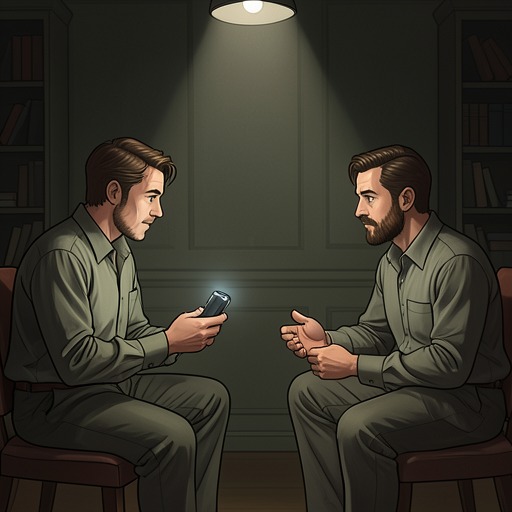
When Mickey7 returns to his rack, he finds Mickey8 in his chair at his desk, reading on a tablet. Mickey8 shuts the screen when he hears him enter and has removed the pressure wrap from his un-sprained wrist. The domestic familiarity of the scene sits beside the awkwardness of sharing quarters and possessions: Mickey8 occupies Mickey7’s place, yet the two can speak with the shorthand of people who have inherited the same past.
Their common body does not mean their immediate circumstances are identical. Mickey7 has been working while Mickey8 has recently come out of the regeneration tank, and both are hungry. Mickey7 says that he has used one hundred kilocalories, leaving Mickey8 only two hundred. Mickey8 objects that he has just emerged from the tank and has had nothing but cycler paste. Their exchange turns an abstract problem of duplicated identity into a material one: food, energy, and the colony’s limited supplies must now be divided between two people who each have a claim on them.
The same practical negotiation shapes their work. When Mickey7 is assigned to Security for a perimeter patrol at Lock Two, he thinks the duty is better suited to Mickey8 and prepares to ask him to take it. Mickey8 contacts him first. He refuses to treat the request as a simple favor, recalling that he won their rock-paper-scissors death match and chose not to shove Mickey7 into the corpse hole afterward. In his accounting, that restraint gives Mickey7 a debt to repay. He also points out that he has not had breakfast and agrees to take the assignment while offering to accept whatever duty comes the following day. Their bargain joins a deadly history to an ordinary rotation of labor: survival has become a debt they can invoke, negotiate, and defer.
Care, resentment, and intimacy
The exchange over work is not evidence of unbroken harmony. Mickey7 has taken two days of hazard duty while Mickey8 slept after his regeneration, and Mickey7 says he has offered three-quarters of their rations for the next two days. He is also hungry and has nearly been killed that day. When he erupts at Mickey8, these details give the anger its immediate circumstances: the two are sharing hardship, but Mickey7 feels that the burden has not been shared evenly. His outburst also rejects the idea that coming out of the tank makes Mickey8’s needs automatically more important than his own.
The argument exposes a further difference between them. Mickey7 invokes the fact that both are hungry and rejects the suggestion that tank recovery makes them unusually horny. Mickey8 is surprised that Mickey7 thought the dispute was about sex. The misunderstanding briefly makes their closeness difficult to categorize, but Marshall later treats it as more than a misunderstanding: he angrily cites their having had relations with one another as part of the case against them. His accusation makes their intimacy one of the charges surrounding their existence as simultaneous copies, alongside the resources they have consumed and the rule that one should have returned to the cycler.
Marshall’s response turns a private relationship into a matter of colonial judgment. He calls the pair an abomination and says that both will be put into the cycler; he also raises whether there will be a ninth iteration and whether Nasha should die with them. Mickey8 tries to argue that their duplication was unintentional and that two workers could be useful to a colony barely at viability. The plea frames the relationship in practical terms, but Marshall’s fury makes clear that usefulness will not by itself protect either of them. Their bond is therefore both personal and politically vulnerable: their shared life is precisely what the authorities regard as intolerable.
Two accounts of identity
The threat of being recycled forces Mickey7 and Mickey8 to confront what their resemblance can and cannot establish. Mickey7 tells Mickey8 that he is not him. For Mickey7, the life of each iteration is finite: the preceding six weeks are the only life he has, and the few days since Mickey8 emerged from the tank are the only life Mickey8 has. A future ninth iteration might carry the memories, but it would not be the person now facing Marshall. On this account, continuity of information cannot undo the loss of the living individual.
Mickey8 rejects that conclusion. Recalling the Ship of Theseus Thought Experiment and Kant, he argues that if a later iteration believes himself to be Mickey8 and everyone around him accepts that identity, there is no way to prove otherwise. To him, Mickey7’s insistence on separation is not a neutral observation; it is the very sort of division that the prohibition on multiples is meant to prevent. Their disagreement is unusually intimate because neither speaks as an outside theorist. Each is making a claim about the other’s survival and about whether his own present self can be replaced.
Mickey7 answers that the ban exists because Alan Manikova tried to take over the universe. The reply grounds the prohibition in a historical danger rather than in proof that copies are metaphysically one person. Their exchange thus leaves two problems in tension: society has reason to fear multiple instances, while the existence of that rule does not resolve what Mickey8 is to Mickey7—or what either is to a future iteration.
The relationship’s stakes
The relationship moves from the small transactions of shared food and assigned work to an argument over life and death. Mickey7 and Mickey8 can invoke a previous death match, repay favors, complain about unequal labor, and contest who gets to define their common history. Their exchanges make them neither simple duplicates acting in unison nor strangers without obligations. Shared memories supply the ground of their familiarity, while separate hunger, work, and fear keep their present experiences distinct.
That distinction becomes urgent under Marshall’s order. Mickey8 argues that the colony needs them; Mickey7 argues that a future copy would not preserve either of them. Their disagreement is not resolved by the evidence of resemblance or by the usefulness of having two workers. Instead, the relationship reveals the human cost hidden inside the colony’s administrative language of iterations and recycling: choosing between the two would mean deciding whether their connection makes them one person, two people, or two lives that cannot be saved together.