Mickey Barnes–Nasha relationship
Mickey7Mickey Barnes and Nasha’s relationship joins intimate comfort to consequential acts of protection. In the aftermath of Mickey’s return, Nasha welcomes him, asks about Mickey8, and listens as he explains his uncertain understanding of the creepers’ terms. Later, as the colony begins cautiously to reclaim the thawing landscape, the two walk hand in hand. Their closeness is not separate from the crisis surrounding them: Nasha has refused Marshall’s order to bomb the creepers, while Mickey has hidden a weapon partly because he could not risk harm coming to her.
Reunion and physical intimacy
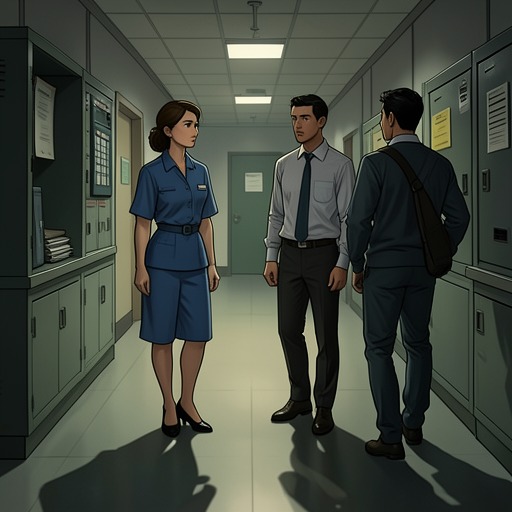
Nasha’s reunion with Mickey begins quietly. Finding him winding down in his room, she closes the door behind her and welcomes him back. Mickey makes room for her on the bed, and she sits beside him, apologizing that she has come alone this time. Her question about what happened to Mickey8 places grief and uncertainty within the intimacy of the encounter: she wants to know whether the events that brought Mickey back were bad, even as neither of them yet has a settled way to feel about them.
The scene’s physical gestures carry what the characters cannot immediately resolve in words. Nasha laughs and sniffles, then leans into Mickey as he puts an arm around her waist. She pushes him down onto the bed and rests her head on his chest. Later she strokes his cheek, raises his head enough to kiss him, and settles against him again. The tenderness is reciprocal, but not effortless: the conversation moves between affection, the danger facing their friends, and questions whose answers remain incomplete.
Shared danger and Nasha’s decision
While they lie together, Nasha tells Mickey that Marshall had tried to order her to make a bombing run against the creepers. She refused. Her reason is practical as well as strategic: if Mickey’s account is true, the creepers are buried beneath at least a hundred meters of bedrock, and the colony’s weapons cannot meaningfully reach them. At best, an attack would irritate them, making a dangerous situation worse without achieving its intended purpose.
That decision gives Nasha an independent role in the fragile possibility of coexistence. She does not claim certainty about Mickey’s negotiations; instead, she asks whether the creepers will really leave the colonists alone. Mickey can offer only a qualified belief. He explains that the stated terms concerned staying away from their tunnels and not building in the foothills south of the dome, while acknowledging that he cannot know how much either side understood. In particular, he is unsure whether the creepers understand the dome as the colonists do, or whether the agreement rules out their killing an occasional human. Nasha’s response recognizes the limits of his success without treating the uncertainty as resolved. Their intimacy therefore coexists with an unresolved question of survival, rather than serving as proof that the danger has passed.
A walk beyond the dome
The relationship appears again when the weather changes and the colony begins to imagine a future outside its shelter. After a few months of more moderate conditions, Agriculture establishes an experimental plot beyond the dome. Colonists begin spending time outdoors and discuss decanting the first embryos; most seem to have put the creepers out of mind. Mickey, who has not, asks Nasha to go for a walk. They still need rebreathers: oxygen levels have risen only slowly as green growth returns, and no one knows whether the season will last for years or end tomorrow.
The walk moves them away from the dome and into a landscape only beginning to stir. Mickey compares the thaw to the sudden renewal of a dry region on Midgard after rare heavy rain: life had been waiting for its chance to emerge. On Niflheim, lichen has given way to something like grass, woody-looking shrubs are appearing, and small crawling animals resemble the creepers. About a kilometer from the dome, he spots what looks like an eight-legged reptile on a sun-warmed rock shelf. Against this setting, Nasha takes his hand and they continue together. The gesture is small, but its circumstances matter: they are walking into a world whose recovery offers hope while leaving the duration of its hospitable season unknown.
Protection, secrecy, and uncertainty
During the walk, Nasha asks Mickey why he left a doomsday weapon buried outside instead of returning it. He explains that leaving it with the creepers could eventually have led them to use it. Although he had ceased to care about most people in the dome, he could not accept the risk of anything happening to Nasha. His admission makes personal attachment a direct factor in his handling of the weapon, not merely a private feeling alongside the larger conflict.
Mickey also explains why he did not bring the bomb back to Marshall. If he had returned both bombs, he believes Marshall would have killed him and sent Nine into the tunnels to continue the genocide. Mickey says that he remains alive, and the creepers remain alive, because Marshall thinks Mickey is the only thing preventing them from detonating the weapon beneath the dome. His concealment thus functions as leverage, but it also leaves him with no secure resolution: he has protected Nasha and helped prevent an immediate attack while relying on Marshall’s belief about the threat.
Nasha asks whether Mickey has a backup plan if Marshall does not die. He does not. She cups his cheek, kisses him, calls him no genius, and remarks that it is fortunate he is cute before turning back up the gully. Mickey looks toward the hiding place, which appears to be only one jumble of rocks among countless others on the planet. The scene ends without reassurance that the plan is sufficient. Nasha’s affection remains clear, but so does the precariousness of the position Mickey has chosen: their bond is a reason for his choices, not a guarantee that those choices will keep either of them safe.