Mickey Barnes–Mickey8 relationship
Mickey7Mickey Barnes and Mickey8 are two instances of the same person whose relationship turns the abstract problem of duplicated identity into a lived bond: they recognize one another as both another person and a version of the self. Under threat of permanent erasure, they make a plan together, then are separated in the creeper tunnels. Mickey8’s death leaves Mickey Barnes grieving a loss he cannot resolve by telling himself that the dead duplicate was, in some sense, still him.
Shared Identity and Uneasy Familiarity
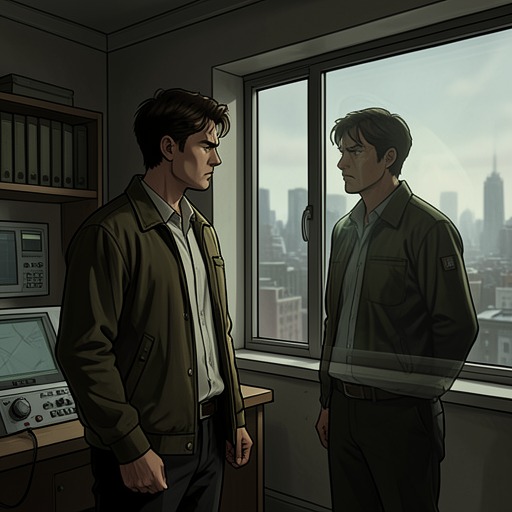
The relationship rests on an unsettling intimacy. Mickey Barnes understands Mickey8 not as an unrelated copy but as someone whose memories and identity are continuous with his own. After Mickey8 dies, Mickey Barnes tries to account for his reaction by reminding himself that he had known him for only a few days and that Mickey8 could be annoying. Yet the same reflection turns the other way: Mickey Barnes thinks of Mickey8 as himself, and himself as Mickey8. Their resemblance therefore offers neither simple companionship nor a clean division between two independent lives. It makes the loss harder to classify.
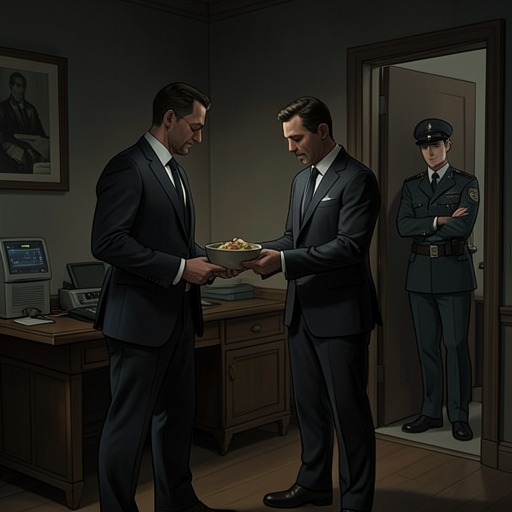
Their brief time together is set against a much longer shared history implied by their common memories. Facing Marshall, Mickey8 says that he has been getting himself killed for him for nine years. He also insists that Marshall is, for the most part, decent, even while criticizing his habitual rigidity and his present attempt to act like a villain. This familiarity belongs to both Mickeys’ shared identity, but in the immediate crisis it is Mickey8 who invokes it. His appeal makes their predicament personal: Marshall is not merely deciding the fate of two bodies, but threatening a person who has served him repeatedly.
A Choice Made Under Threat
Marshall clarifies that the danger is not another ordinary death followed by restoration. If both Mickeys are killed, he says, their personality will be wiped from the server and their body template destroyed; for Mickey Barnes, this would mean a death sentence rather than a return to the tank. Mickey8 rejects the idea that the colony can afford this outcome. With only 176 people left and the colony moving to a war footing, he argues, it needs every available body—and cannot discard its only Expendable.
Mickey8’s response to the threat is blunt rather than sentimental. He tells Marshall to kill one of them and dispose of the body, or kill both and make another, if that is what Marshall intends; what he refuses is the drawn-out uncertainty. His challenge shows how the shared identity operates under pressure: Mickey8 can speak of either instance as expendable while also defending their collective value to the colony. The practical question of which body survives cannot settle the deeper question of whether the person survives.
Separation and the Joint Plan
When the two set out, Mickey8 proposes splitting up and getting as far from one another as possible before pulling their triggers simultaneously. The distance, he reasons, should maximize the spread and keep one weapon’s blast from disturbing the other’s dispersal pattern. The plan is coordinated down to its timing, but it requires them to act alone. Mickey8 tells Mickey Barnes to keep a voice channel open and notify him when he is ready. If Mickey Barnes encounters the friend they had met earlier, Mickey8 says, he should tell him they are sorry.
The farewell is practical, but it carries the strain of a separation they cannot control. Mickey8 refuses to hear Mickey Barnes begin to object and orders him to start walking. His instructions preserve a line of communication between them, yet the plan depends on distance and simultaneous action rather than rescue or reunion. Their last undertaking together thus combines cooperation with the possibility that neither will be able to confirm what happened to the other.
Death, Uncertainty, and Grief
Mickey Barnes receives a final, badly blurred image in his cache. He can make out the maw and feeding arms of a giant creeper only because he recognizes them; the image shows the creature from a few meters away. When Mickey8 does not answer, Mickey Barnes realizes he is dead. He does not know where Mickey8 was, how far away the crèche might be, or whether Mickey8 had time to pull the trigger. The evidence establishes the death but not the precise final choice: the simultaneous plan has become impossible to verify from the surviving instance’s perspective.
The emotional consequence arrives later, when Mickey Barnes is back in his rack with his eyes closed and his hands folded behind his head. He tries to reason around the loss: Mickey8 had to die if he was to stay; Mickey8 could be annoying; they had known each other only a few days; and, because they were the same person, perhaps Mickey8 was not really gone. None of these arguments prevents grief. Within seconds, Mickey Barnes breaks into intense, uncontrolled crying, unsure whether he is mourning Mickey8, himself, or everything that has accumulated since he fell into the hole.
When Nasha asks whether what happened to Mickey8 was bad, Mickey Barnes recounts their separation and the images Mickey8 sent of thousands of creepers crawling over one another in a huge domed cavern before his signal cut out. He supposes the death must have been quick, because Mickey8 had intended to pull the trigger and whatever happened came too suddenly for him to do so. But Mickey Barnes immediately recognizes that he cannot know this. Mickey8 may have changed his mind at the last moment, or had the chance to pull the trigger and chosen not to. The uncertainty keeps their final act from resolving into a neat sacrifice or a confirmed last decision. Their relationship ends with a death Mickey Barnes can identify, a choice he cannot know, and grief that disproves his attempt to treat shared identity as a substitute for loss.