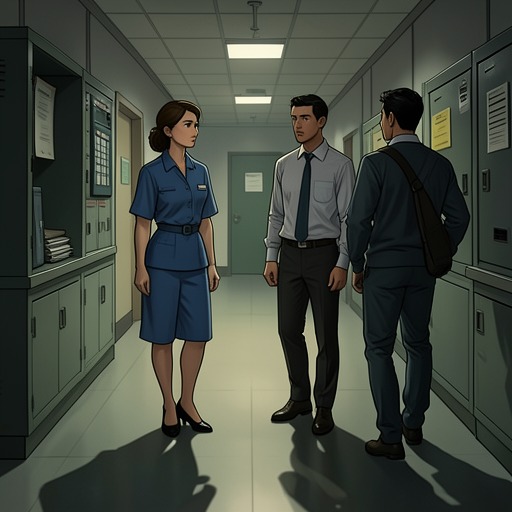
Mickey Barnes Seven and Nasha Adjaya's Romantic Relationship
Mickey7Mickey Barnes and Nasha Adjaya’s romantic relationship turns the isolation of the Drakkar’s voyage into a sustained intimacy, and gives concrete form to the emotional cost of Mickey’s repeated deaths. It begins in the ship’s bored, weightless coast and becomes most clearly defined when Nasha refuses to leave him alone as he dies: years into their relationship, they finally name their love and make companionship part of the ordeal to come.
Formation aboard the Drakkar
Mickey had noticed Nasha going back to Himmel Station, where fewer than two hundred people shared the same confined vessel, but he had not spoken to her. His estrangement from other passengers was partly reciprocal: many wanted nothing to do with him, and he answered by withdrawing from them as well. Their eventual meeting therefore marks a break from a pattern of mutual avoidance, rather than an instant connection between strangers with no prior awareness of one another.
They met for real about a year after the collision that killed Mickey’s first two incarnations. By then, the Drakkar was in its coast phase, traveling just under point-nine times the speed of light. The crew were weightless, on short rations, and profoundly bored. Command required at least two hours in the carousel during each duty cycle, officially to preserve the crew’s bones before landing and, in Mickey’s wry assessment, to reduce the chance that monotony would drive them to violence. Their relationship takes shape inside this suspended routine: a private attachment formed amid shared confinement, deprivation, and the long wait for arrival.
Intimacy and the meaning of “ghost chaser”
Their early intimacy is sexual, but Nasha’s candor quickly makes it more than a private affair. In bed, she tells Mickey she is not a “ghost chaser”—a term he has not heard before. She explains that, to a Natalist, a person like Mickey is forbidden fruit, and that she has heard women talk about him. She then distinguishes herself from those women. The distinction matters: Nasha recognizes the attention Mickey attracts after going through the tank, but presents her own desire as separate from that fascination with an expendable who has returned from death.
She tests whether Mickey understands the pattern, asking how many women he has been with on the trip and whether they were all after the collision, after he went through the tank. He does not answer; to him, her knowledge is already plain. Their exchange brings the social meaning of his survival directly into their intimacy. Nasha does not conceal that others find his status alluring, nor does she let that attention stand in for what is happening between them. Her denial that she is a ghost chaser draws a boundary around their relationship even as she acknowledges the taboo and curiosity surrounding him.
Nasha’s past and the destination ahead
Nasha shares relatively little about her childhood, though Mickey gathers that it was difficult. She is more direct about why she learned to fly: she had known since childhood that the mission was coming and wanted to take part. An academic route toward a doctorate in exobiology was closed to her, and she lacked the connections needed for Security or Command. Becoming a combat-skimmer pilot was a path she could pursue. Her account ties the relationship to a life shaped by restricted options and deliberate preparation, rather than presenting her merely as Mickey’s companion.
In an intimate conversation, Nasha tells Mickey that Midgard had never been home and never would be. The place they are traveling toward, by contrast, seems to offer a possible future. Mickey answers with a playful picture of warm breezes, white sand beaches, and a world without anything trying to eat them. The exchange holds both their hope and its vulnerability: for Nasha, the mission points away from a place she does not belong; for Mickey, the imagined destination is an occasion for teasing optimism. His narration retrospectively undercuts that confidence, but the conversation preserves the hope they could share before they knew what the new world would demand.
Care, death, and the promise to return
After eight years together, Nasha faces the prospect of watching Mickey die from an illness in the test chamber. She stays outside its window for four hours, talking about what the planet looks like on the viewscreens, Arkady’s behavior, and a drama about a wealthy family on Midgard. She also talks about things the two of them might do together after Mickey comes out of the tank. The ordinary subjects and imagined future are her way of maintaining their connection while his condition worsens; as his fever rises, he coughs blood, and she remains at the window with a hand pressed to the glass.
At the four-hour mark, Mickey manages to tell her to go away because he does not want her to see what comes next. Nasha refuses. When it becomes clear that he is dying, she persuades Arkady to strap her into a biohazard suit so she can enter the chamber. As Mickey coughs hard enough to crack a rib and brings up tissue, she holds his hand, cradles his head against her belly, and talks him through the pain. The scene shifts their intimacy from shared desire and conversation to physical care under the most extreme conditions. Mickey initially did not want her there, but remembers her presence with lasting gratitude.
After he wakes from the tank, Mickey tells Nasha that she should not have to watch someone she loves die more than once. She supplies the word he cannot finish, and the two acknowledge that, despite their eight years together, neither has said it before. Nasha answers that she will be there: even temporary death should not have to be faced without company, and she wants to make sure he does not slip away. Her promise does not erase the danger or the repeated separation built into Mickey’s existence. Instead, it defines their bond as a decision to accompany one another through it. Their love becomes explicit not in a conventional declaration of safety, but in Nasha’s resolve to stay present when Mickey must die again.