Mickey Barnes and Berto Gomez's Friendship
Mickey7Mickey Barnes and Berto Gomez’s friendship is both a source of care and a fault line in Mickey’s trust: Berto calls Mickey his best friend and stands up for him, yet he also leaves Mickey alive in a crevasse and repeatedly changes his account of what happened. Their bond is not undone in a single confrontation. Instead, it persists in gestures of generosity and protection while the concealed abandonment keeps altering what those gestures can mean.
Friendship, Apology, and the Meal
Berto’s attempt to make amends takes the form of an unusually generous offer at the ration counter. He tells Mickey to choose what he wants, then qualifies the offer with a limit: the meal must stay under a thousand kilocalories. Mickey orders potatoes, fried crickets, lettuce and tomatoes, then adds a mug of paste. Berto orders a rabbit. Their combined meal comes to 2,400 kilocalories, and Berto presents his ocular to the scanner, which accepts the charge. The rabbit and the shared excess make the scene feel like a deliberate departure from ordinary rationing, not merely a routine meal.
Berto explains the offer as an apology, saying that Mickey is his best friend and that he should not have lied. But the apology arrives already compromised: Mickey knows Berto is still lying, even as he decides that he does not care at that moment. The meal therefore holds two truths together. Berto is trying to repair the friendship, and Mickey is willing, briefly, to accept the care without requiring full honesty. Their connection remains strong enough to make reconciliation imaginable, but not strong enough to erase the deception.
The rabbit also carries the story of Berto’s earlier risk. When Mickey recognizes the connection to the flitter outing, Berto reveals that he collected 3,000 kilocalories. Mickey immediately objects that Berto could have died, and that he risked his life for only two days’ rations. Berto first treats the danger lightly. Mickey’s anger makes the underlying comparison explicit: Berto undertook a potentially fatal risk for food, when Mickey believes Berto would not have taken a comparable risk to rescue him. The exchange turns a friendly meal into an accounting of what each man has been willing to risk for the other.
The Abandonment Beneath the Anger
Mickey’s accusation exposes more than resentment about the stunt. He realizes that he has said something he may not be supposed to know: that Berto left him in the crevasse. His own uncertainty about whether he has revealed too much reflects the lies and gaps surrounding his supposed death. At the table, he considers telling Berto plainly that he survived and was abandoned, then repeatedly changes his mind. He imagines asking whether a few days’ rations might have persuaded Berto to come back for him, but does not get as far as saying it.
That withheld confession gives the meal its tension. Mickey is eating his first solid food in more than two days, yet he cannot enjoy it as much as he thinks he should. The ordinary act of chewing a potato unfolds beside the possibility of a direct reckoning. Berto watches him with narrowed eyes, and Mickey struggles to decide whether to disclose the truth. The interruption comes when Darren approaches their table and challenges them for eating the colony’s rations. Mickey does not trust himself to answer. Berto does: he tells Darren to back off because Mickey has had a difficult couple of days.
Public Loyalty and Private Injury
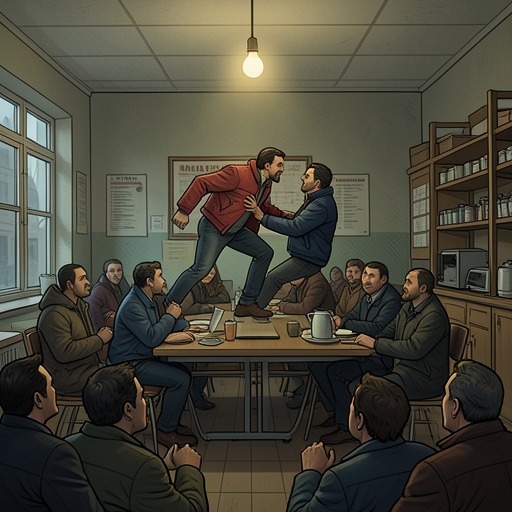
Berto’s defense of Mickey is significant because Darren’s attack is specific and damaging. Darren says that Mickey got two colonists killed the previous day and had left a fight, forcing Cat Chen to rescue him for the second time in twenty-four hours. Berto sets down the rabbit bone he has been gnawing and puts both hands flat on the table. The change in his manner, from a grin to a direct, serious posture, makes his intervention a visible act of loyalty rather than an extension of the earlier joking.
That loyalty does not settle the private dispute. Berto protects Mickey from Darren’s contempt while Mickey still knows that Berto’s account of his abandonment is false. The contrast prevents the friendship from being reduced either to betrayal or to uncomplicated devotion. Berto can defend Mickey in public and offer him food, while remaining the person who did not return for him when he was trapped. Mickey, for his part, is angry enough to name the unequal risk but hesitant to make the full accusation. Affection survives; confidence does not recover so easily.
Conflicting Accounts and Unfinished Trust
The fracture becomes explicit when Hieronymus Marshall questions Mickey about the tunnels. Marshall recounts how Berto’s reports changed: first Mickey was said to have been killed by creepers; later Berto said he had died in a fall; in a further amendment, Berto acknowledged that Mickey fell through the ice into a tunnel system and was alive and conscious when Berto left him. The sequence gives official form to the personal fact Mickey had nearly confronted Berto with at dinner. It also shows that Berto did not simply make one mistaken report: his account was revised as the truth emerged.
Later, while held in a cell, Mickey considers another uncertainty tied to Berto. He knows that he does not remember every death of his earlier incarnations, and that he learned about some of them from surveillance footage. He had believed Berto’s account that an earlier incarnation was torn apart by creepers. Given what Berto said about Mickey’s own supposed death, he now wonders whether that incarnation, too, was abandoned in the tunnels and never found a way out. This remains a suspicion, not a confirmed revelation, but it deepens the significance of Berto’s unreliable reports: Mickey can no longer treat a story about one of his deaths as settled merely because Berto told it.
Mickey’s resolution to get the truth from Berto if they meet again keeps the relationship open rather than reconciled. The friendship still contains the remembered generosity of the shared meal and the concrete loyalty of Berto’s defense at the table. It also contains an abandonment confirmed by Berto’s amended report, and a second possible abandonment that Mickey cannot verify. Their bond therefore remains emotionally consequential but unsettled: the desire to preserve it exists alongside the need to know what Berto did, and what he has concealed.