Mickey and Berto's Relationship
Mickey7Mickey Barnes and Berto Gomez’s relationship is a long friendship shaped by genuine affection, unequal talents, and repeated tests of what either man is willing to sacrifice for the other. Berto can be generous and remorseful, but his loyalty has limits: when Mickey’s life as an Expendable makes him seem replaceable, Berto chooses not to risk himself. Their eventual apology does not erase that breach; it makes their friendship more honest about its imperfections.
School friends and unequal talents
Mickey Barnes and Berto Gomez met at school, long before either signed on to the Drakkar. Berto was tall, smart, athletic, and unusually good-looking; Mickey describes himself as much the same person he is later, only smaller. They bonded over a flight simulator and a shared dislike of school administrators. Berto mastered the simulator in about an hour, while Mickey was still crashing it when they graduated. Their differences were already visible: administrators disliked Mickey for obsessing over history instead of studying something they considered useful, but treated Berto like the son they had never had.
That contrast did not prevent closeness. When Berto’s calculus instructor told him in form ten to spend less time with Mickey if he wanted to reach his full potential, Mickey understood Berto’s response as taking the criticism for another challenge. Their friendship was not built on similar strengths so much as on their willingness to remain companions despite the judgment of people around them.
Berto’s talent also shaped the scale of his ambitions. At fifteen, after his mother bought him a pog-ball racket, he taught himself by hitting balls against the administration building rather than taking lessons or joining a recreational league. After one season on the school team, he entered a pro-am tournament as an unknown and won his first match decisively, finishing second in his age bracket by the end of the week. The following year he won the amateur division; after graduation he began playing for money, and by the time he left the sport for serious flight training two years later, he was ranked tenth in the world. Mickey’s account presents Berto’s competitive brilliance as both a source of admiration and a force that could overrun friendship: when a match mattered to Berto, loyalty did not mean asking him to lose.
A win, a debt, and the Drakkar
Berto’s victory in the tournament cost Mickey money and left him owing Darius Blank. Mickey later regretted not asking Berto to throw the match, but Berto made clear that he would not have done so: he considered the tournament his last chance to make an impression before leaving the planet, and winning was nonnegotiable. Mickey’s conclusion is that friendship with Berto only went so far. The limit was not an absence of feeling; Berto did feel bad about the cost to Mickey. Rather, his own ambition took precedence when the two came into direct conflict.
Berto tried to make amends by proposing that Mickey sign on to the Drakkar. He imagined that his own fame would help secure Mickey a berth in Security, as though he could obtain whatever he wanted. In practice, the eighteen Security places were sought after and generally went to applicants with relevant qualifications and political connections. Mickey had neither; his extensive reading about the Battle of Midway did not count as military experience, and Berto had less influence than he assumed. Berto’s attempt to repair the damage therefore helped direct Mickey toward the expedition without delivering the particular protection or position he had hoped to arrange.
The abandoned rescue and the rupture of trust
The sharpest test comes after Mickey falls deep underground into creeper territory. Berto, hovering above the place where Mickey went down, says the signal is weak and that extracting him would require substantial effort and personal risk. He cannot justify taking that risk for an Expendable. When Mickey asks whether Berto would take the risk for a friend, Berto answers that Mickey is not really dying: he expects to file a loss report, have Marshall approve regeneration, and see Mickey back in his bed the next day. His reassurance makes the distinction between Mickey’s physical danger and his status as a replaceable colony asset feel especially stark. Mickey still has to die alone in the hole before the regeneration process can return him.
After Mickey gets back to the dome, Berto’s earlier inaction remains consequential. Mickey reflects that Berto’s laziness may have spared him trouble at the entrance, because it may mean nobody has registered Mickey8 with Security, but that the same laziness could have left him stranded: Mickey believes Berto could have gathered equipment and tried to extract him. He would not have wanted Nasha to take that risk, but thinks he would have accepted the gamble from Berto. The double judgment captures the intimacy and resentment together: Mickey still measures Berto as a best friend, and therefore expects more from him than he does from someone else.
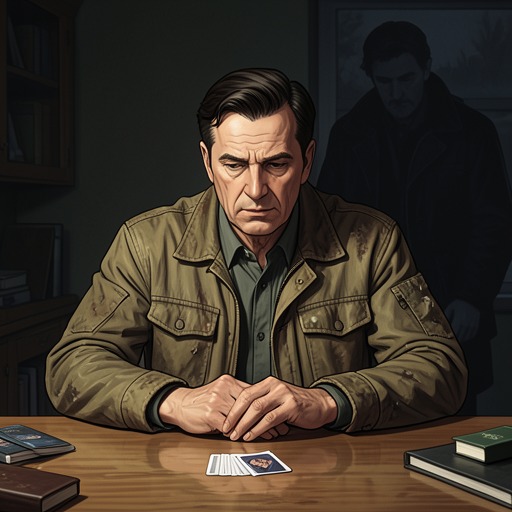
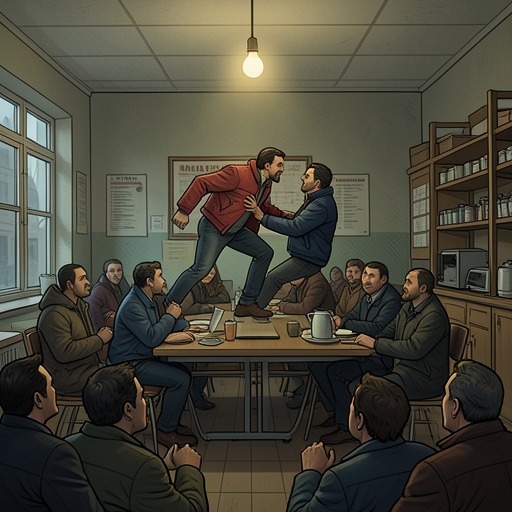
The conflict becomes explicit when Berto tells Mickey that he was already dead by the time he hit bottom and insists that he would have tried to rescue him if there had been any chance of bringing him out alive. Mickey knows that Nasha had said she was in contact with him after the fall, and that Berto was present when she said it. To Mickey, this makes Berto’s explanation a lie rather than a simple mistake. The dispute is not merely about whether an extraction was practical; it is about whether Mickey can trust Berto to tell him what happened while Mickey himself has no memory of the event.
Apology, friendship, and its limits
Mickey explains that his repeated deaths leave him waking in bed, hungover and covered in goo, without remembering what happened or how to prevent it from happening again. He has to rely on Berto and Nasha to reconstruct those lost experiences. Berto’s lie therefore threatens more than one account of a failed rescue: it makes Mickey wonder how many other times the people he depends on may have distorted his past. Berto eventually recognizes the problem, admits he had not thought about it that way, and apologizes. He says he will not lie to Mickey again, then pulls him into a bear hug. Mickey accepts the gesture with skepticism rather than instant absolution.
Mickey’s later reflection refuses to reduce Berto to his worst choices. He argues that no friend is perfect and that treating every failing as grounds for rejection would mean missing the good that people bring to one another’s lives. This does not cancel the earlier verdict that Berto’s friendship has boundaries, nor does it prove those boundaries have disappeared. Instead, the relationship holds both facts at once: Berto has repeatedly cared enough to try to make amends, and his care has not always outweighed ambition, convenience, or self-preservation. For Mickey, their history makes that contradiction bearable without making it harmless.