Mickey and Hieronymus Marshall's Relationship
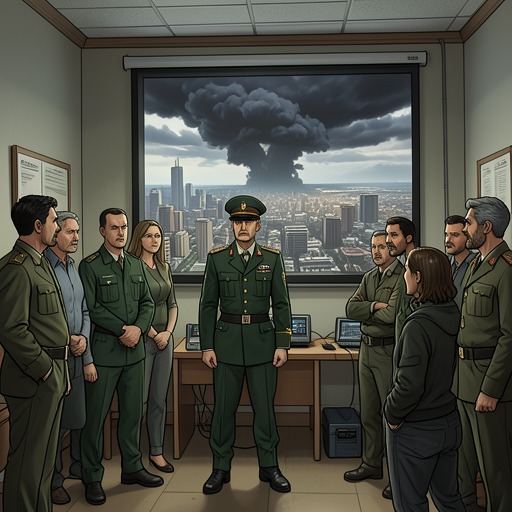
Mickey7Mickey Barnes and Hieronymus Marshall’s relationship is a struggle over authority, personhood, and the value of survival. Marshall commands the expedition and expects Mickey, the Expendable, to accept danger without complaint; Mickey’s survival and repeated existence instead make him a target of suspicion, punishment, and contempt. Their exchanges expose a sharp contradiction: Marshall can dismiss Mickey as a mere construct when it suits him, then demand that he answer for surviving when others do not.
Authority and First Impressions
Marshall first encounters Mickey at Himmel Station, where he waits for the would-be colonists after their shuttle journey. Mickey arrives visibly shaken by the trip, drenched in sweat and trembling. That vulnerable appearance becomes Marshall’s first impression of him. The commander’s own presentation is almost aggressively controlled: a tight, jet-black haircut, a clenched jaw, and a rigid bearing even in free fall. Mickey later interprets this severity as a mixture of genuine priggishness, insecurity, and overcompensation for the fact that Marshall had been designated ground commander but had no command authority during the transit.
When Marshall asks Mickey to identify his function, Mickey answers that he is the expedition’s Expendable. Marshall does not return his grin; his face twists in disgust. The exchange establishes the imbalance between them before their later disputes: Mickey names a role that makes him available for lethal work, while Marshall responds not with simple acceptance of that function but with visible revulsion toward the person occupying it.
Suspicion, Belief, and Command
Marshall’s hostility has more than one source. About a week after the Drakkar leaves orbit around Midgard, he learns of Mickey’s earlier run-in with Darius Blank and reads it as evidence that a criminal element has entered the colony. His religious tradition also regards even the ordinary practice of restoring a person from the tank as an abomination. The combination turns Mickey’s existence into a threat to Marshall’s sense of order: Mickey is not only associated with criminal trouble but is also living proof of a practice Marshall rejects.
The conflict nearly becomes immediate expulsion. Marshall comes close to throwing Mickey out of an air lock, but Mara Singh, then captain of the Drakkar and later head of Engineering, reminds him that he is not actually in command of the mission until it reaches Niflheim. The intervention makes the limits of Marshall’s power part of their relationship from the outset. He regards Mickey with deep hostility, but cannot act on that hostility whenever he wishes; his authority is real and consequential, yet bounded by the mission’s chain of command.
The Iteration and the Price of Survival
Marshall’s scrutiny becomes more pointed when he asks which iteration of Mickey he is. Mickey answers uncertainly that he is Eight, and Marshall notices the hesitation. The question treats Mickey’s successive incarnations as an administrative and disciplinary problem, rather than as a personal continuity that might deserve recognition. Later, when Marshall asks the newly restored Mickey to comment on a dispute, Mickey explains that he has only just come out of the tank and knows nothing of what preceded his restoration. Marshall accepts that he cannot be responsible for events he did not witness, but describes him as simply a construct. Mickey would ordinarily challenge that judgment, but chooses not to in the moment.
Marshall’s willingness to recognize the limits of Mickey’s knowledge does not soften his treatment. He says that the activities of the preceding weeks have permanently removed nearly 300,000 kilocalories from the colony’s energy budget, at a time when the Agricultural Section cannot reliably grow food and the colony has little calorie margin. He proposes that Mickey and Berto Gomez bear the brunt of the resulting reduction, then permanently docks both men’s ration cards by 20 percent. The ruling turns a dispute about the cost of their actions into a material penalty that will continue into the future. When Berto tries to object, Marshall cuts him off and insists that he will not hear further argument.
Survival as an Offense
The deepest expression of the relationship comes after a mission in which several people have been lost. Marshall confronts Mickey over how three people could be lost in two hours, or four if Gallaher is included, and five if Torricelli is included, while Mickey remains alive. Mickey answers with bitter sarcasm, apologizing for surviving and promising to do better next time. Marshall rises in anger and reminds him that an Expendable is not supposed to worry about survival. As he sits again, Mickey wipes Marshall’s spittle from his forehead; the physical detail makes the hierarchy of the encounter unmistakable.
Marshall then demands an account of why Mickey saved himself rather than helping Dugan, and threatens to shove him down the corpse hole if the explanation is not convincing. Cat Chen attempts to speak, but Marshall orders her to be quiet until he has finished with Mickey. His questioning therefore goes beyond an inquiry into a specific decision: it enforces an expectation that Mickey’s life should be risked for others, while denying him the ordinary presumption that survival is a legitimate concern. The threat also shows how readily Marshall’s command turns into personal intimidation when Mickey’s conduct challenges the role assigned to him.
The Relationship’s Central Contradiction
Marshall alternates between treating Mickey as less than a full moral subject and demanding that he answer as a responsible agent. Calling him a construct excuses the commander from recognizing the personhood claimed by successive incarnations; blaming him for a costly loss or demanding an explanation for choosing survival assumes that his choices and obligations matter. Mickey’s sardonic replies do not remove the imbalance, but they make its logic visible: he is ordered to be expendable, then condemned when he behaves as though remaining alive matters.
The relationship is consequently more than a personal dislike between a commander and a subordinate. It dramatizes the way the colony’s practical dependence on an Expendable coexists with religious and institutional contempt for the means by which he returns. Marshall’s authority makes that contempt concrete in ration penalties, threats, and demands for obedience. Mickey’s survival, rather than resolving their conflict, repeatedly brings the contradiction back into view.