Camden Farebrother's feelings for Mary Garth
MiddlemarchCamden Farebrother’s feelings for Mary Garth become visible in a conversation ostensibly about Fred Vincy’s future: Farebrother asks Mary to be direct about whether Fred may hope to win her, and she recognizes that the question may concern Farebrother himself. Mary chooses Fred, while refusing to promise marriage before he has earned her respect; Farebrother accepts the answer and rides back to Middlemarch, making his affection legible through the pain he suppresses and the assistance he continues to offer.
The Commission and the Question
Farebrother approaches Mary with a practical purpose. Fred has asked whether, if he braves the difficulties of earning his bread another way, Mary will give him hope. Mary’s position has not changed: Fred should already know that she will not encourage him to ask for marriage before he has done something worthy, rather than merely claiming he could do it. Her answer protects her independence of judgment and makes the future of the relationship depend on Fred’s conduct.
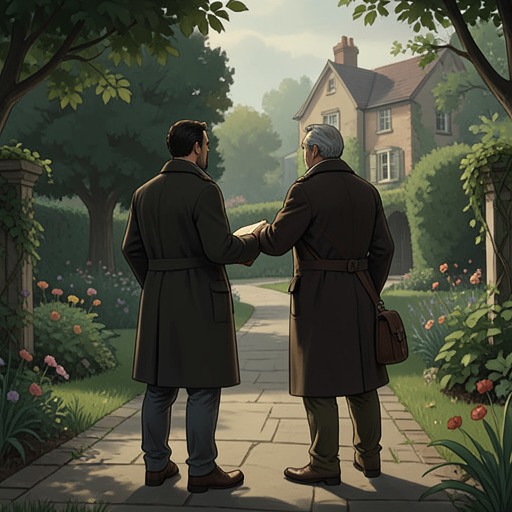
Farebrother presses the issue beyond Fred’s immediate question. Under the shadow of a maple at the end of a grassy walk, he tells Mary that she must decide whether her feeling for Fred rules out another attachment. If Fred can count on her remaining single until he earns her hand, that is one prospect; if not, he may be disappointed regardless. Because a woman’s affections can affect the happiness of more than one life, Farebrother argues, the nobler course is for her to speak openly. His appeal is framed as a matter of fairness to Fred, but its gravity carries a more personal implication.
Mary Recognizes the Personal Stakes
Mary is surprised less by Farebrother’s manner than by his tone, which contains restrained emotion. The possibility flashes through her mind that he is speaking about his own attachment to her. She is incredulous and ashamed even to consider it: she has never imagined that any man could love her except Fred, who had chosen her when they were children, when she wore socks and little strapped shoes. She has still less imagined that she could matter in this way to Farebrother, the cleverest man in her narrow circle.
The recognition remains hazy to Mary, and she allows that it might be illusory. But uncertainty about Farebrother’s meaning does not make her uncertain about what to say. She tells him that her feeling for Fred is too strong for her to give him up for anyone else, and that she could not be happy knowing Fred was unhappy because he had lost her. Her attachment rests not only on a present prospect of marriage but on a long history: gratitude for Fred’s enduring love and childhood care, including his concern when she hurt herself.
A Choice Without a Promise
Mary’s loyalty is not an unconditional pledge to marry Fred. She wants to see him become worthy of everyone’s respect, and she will not promise her hand until he has done so. To marry him before that change would shame and grieve her parents; she also tells Farebrother that Fred remains free to choose someone else. Her answer therefore holds affection and judgment together: she will not replace Fred with another attachment, but neither will she treat love as a substitute for his independence and earned worth.
This distinction gives Farebrother the clarity he has requested while denying him any prospect of being chosen. He says he has fulfilled his commission thoroughly and extends his hand to Mary. Rather than withdrawing from Fred’s affairs because of his own disappointment, he turns back toward his purpose: with Mary’s answer as a prospect for Fred, he hopes they can get him into the right niche and that he may live to join their hands. His feeling thus appears alongside an active effort to help the person Mary loves.
Farewell and Self-Renunciation
Mary asks Farebrother to stay for tea. Her eyes fill with tears because something indefinable in his manner—like the resolute suppression of pain—suddenly makes her miserable. The scene does not have her name his love or describe a formal declaration. Instead, the emotion is registered through what Mary observes, and through her sudden comparison with an earlier moment when she saw her father’s hands trembling in trouble. Her response suggests that Farebrother’s restraint communicates more than his words disclose.
Farebrother refuses the tea and says he must return. Within minutes he is on horseback, having carried out a duty the narrator describes as magnanimous and harder than giving up whist or writing penitential meditations. That comparison places his sacrifice among private moral trials rather than public gestures: the difficult thing is not simply to accept Mary’s answer but to act honorably after discovering what it costs him. His departure closes the conversation without erasing the practical support he has offered Fred.
Narrative Significance
The relationship is defined by an asymmetry of knowledge and feeling. Mary has not previously understood that Farebrother might love her; she discovers the possibility only when he requires her to state plainly what Fred may expect. Farebrother, by contrast, understands that the question could touch his own happiness, yet presents it as a responsibility owed to Fred. His self-effacement is not indifference: Mary’s tears register the pain she senses precisely because he does not make it her burden through an explicit appeal.
The scene also distinguishes emotional constancy from entitlement. Mary’s long attachment to Fred does not compel her to promise marriage before he becomes worthy, while Farebrother’s affection does not lead him to press for a claim on her. He seeks an honest answer, accepts it, and returns to helping Fred find a suitable place in life. The result is a restrained triangle in which care is shown less through possession than through the willingness to protect another person’s freedom and happiness, even when that choice entails renunciation.