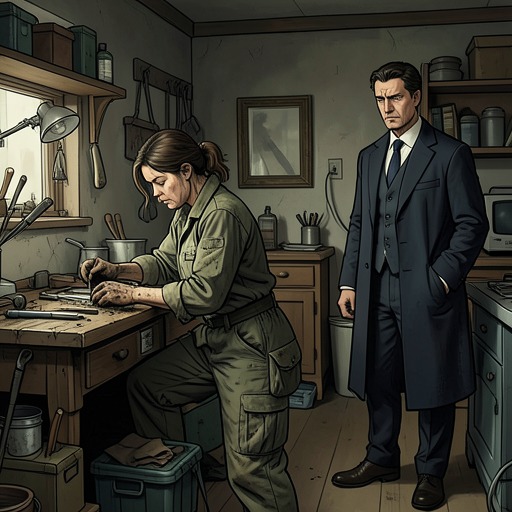
Fred Vincy and Mary Garth relationship
MiddlemarchFred Vincy and Mary Garth share a bond rooted in childhood familiarity, but their future depends on more than affection. Their relationship is tested by Fred’s debt to the Garth family and his lack of direction; Mary’s candid judgment and Caleb’s willingness to offer work together turn the prospect of a marriage from a youthful wish into a question of responsibility and useful employment.
Childhood Affection and Unequal Circumstances
The connection between the families began through Peter Featherstone’s two marriages, which linked the Garths to the Vincy family. When the children were young, the adults’ acquaintance had largely faded, but Fred and Mary’s friendship continued. They drank tea from toy cups and played together for whole days. At six, Fred made Mary his wife with a brass ring cut from an umbrella, an early token of a feeling that would persist through the changes in their circumstances.
Fred kept visiting the Garth home as a second home throughout his education, even after contact between the two families’ elders had dwindled. His affection belonged to a relationship formed in childhood, not to the distinctions of status that later shaped local opinion. The Garths had fallen into narrow circumstances after Caleb’s building business failed, and their financial recovery did not erase the social distance that the Vincys observed between their households. The Vincys’ regard for the Garths was qualified by rank and material display, while Fred’s attachment to them endured.
Mary’s place in the Garth household also made her a source of concern to Fred’s mother. Mrs. Vincy disliked the Garths and feared that Fred might attach himself to Mary, whom she regarded as plain and from a family that lived modestly. Fred knew of this disapproval and did not speak at home about visits that had become increasingly important to him. The contrast between his private closeness to Mary and his family’s social expectations establishes an obstacle before the pair have openly settled their future.
Debt and Mary’s Judgment
When Fred needed help with his debts, he hesitated to approach his friends, shrinking from the discomfort of asking for money and from the prospect of being regarded as short of funds. The person he did approach was Caleb Garth, at once the poorest and kindest of his friends. Fred’s appeal placed his childhood attachment to the Garths under a more demanding test: his actions now affected the household whose welcome he had long taken for granted.
After Fred had been away, he confided in the Vicar of St. Botolph's, Camden Farebrother. Farebrother went to the Garths as Fred’s envoy and explained that Fred felt miserable about his debt and his inability to repay it; he could not bear to come himself even to say goodbye. Caleb answered that the debt did not matter, since the family had endured the pinch and recovered. His reassurance did not erase the injury Fred believed he had caused, but it showed that the Garths’ affection was not reducible to money.
Mary’s response is more conditional than Caleb’s forgiveness. Farebrother reports that Fred was especially troubled by the thought that Mrs. Garth might never think well of him again. Mrs. Garth says she has been disappointed in him, but will be ready to think well of him again when he gives her good reason. Mary leaves the room during that exchange. The distinction matters: sympathy can soften the consequences of Fred’s failure, but renewed respect must be earned through what he does next.
Vocation as a Test of the Future
Farebrother tells the Garths that Fred intends to return to college and try again for his degree. He has advised Fred to study before the next term, but does not urge him to enter the Church. Fred has frankly acknowledged that he is not fit to be a clergyman, and Farebrother regards his willingness to work toward a degree as evidence that he may yet show energy and resolve. He also hopes to reconcile Walter Vincy to his son’s choosing another line of life.
Mary’s earlier judgment of Fred’s clerical prospects is remembered in the conversation. She had told him that he would become one of the ridiculous clergymen who make the whole clergy ridiculous. When Farebrother recalls the remark, Mary calls it one of many impertinent things she has said to Fred as an old playfellow. Yet she does not withdraw its substance: she says that if she claimed he would not be ridiculous as a clergyman, she would have to say he would be something worse. What pleases her is not the prospect of his taking orders, but that he is going away to work.
Mary’s severity is not simple hostility. The narrator contrasts her advance condemnation of Fred’s possible clerical shortcomings with her relative tolerance of Farebrother’s actual imperfections. She admires the Vicar, though she knows he sometimes acts unwisely, and her judgment of Fred is sharper because his choice of a profession seems to her consequential. Her affection does not require her to approve a path she considers unsuitable; instead, she wants Fred to become capable of a life built on work rather than on expectations he has not met.
A Practical Opening
Caleb considers whether Fred might learn estate work under him. With some of his existing assistants soon to leave and his younger son not ready to take up business for several years, he expects to need help. He believes Fred has enough sense and quickness to learn, likes being on the land, and could become a useful man if he gives his mind to the work. The offer connects Fred’s future to a form of employment that may fit him better than the clergy and gives substance to the change Farebrother has reported.
Mrs. Garth warns that Fred is set to return to college and suggests waiting to see what he chooses afterward. She also notes that Caleb is not entirely sure of his own position or future needs. Caleb accepts that it may be better to wait, but resists allowing the family’s pride or the opinions of others to prevent a good action. His willingness to consider Fred for work is an expression of affection, but it is also an opportunity that requires Fred to make a choice and follow through.
For Mary and Fred, then, the possibility of a shared future remains tied to a change in Fred’s conduct and prospects. Caleb’s offer does not itself settle their relationship, and Mary does not promise that it will. It creates a credible alternative to an unsuitable clerical career and gives Fred a chance to demonstrate the industry and independence on which his standing with Mary depends. Their childhood bond supplies the attachment; work, accountability, and Mary’s continuing judgment determine whether it can mature.