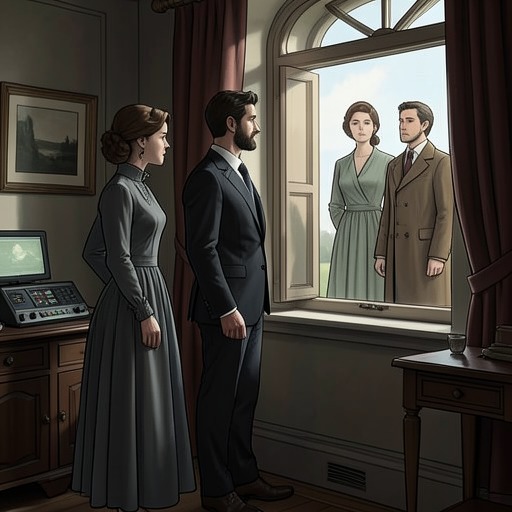
Gender norms governing women
MiddlemarchGender norms governing women in Middlemarch make feminine modesty and domestic usefulness seem like natural limits, while treating marriage as the principal path through which a woman’s future is secured. The novel tests those assumptions against women whose purposes do not fit them: Dorothea Brooke seeks intellectual and practical agency, while Rosamond Vincy’s household expectations become entangled with her husband’s professional finances. Its irony lies in showing that the conventional ideal of the submissive, supportive wife is neither a neutral description of women nor a harmless private preference; it allocates authority, work, and economic risk within marriage.
Social Expectations and the Limits of Female Opinion
The norms are stated most bluntly as a principle of social order: women are expected to have weak opinions, and society’s safeguard is that opinions should not be acted upon. What is presented as sanity is conformity—people do what their neighbors do, leaving those who depart from convention marked as unreasonable. The rule therefore governs action as much as belief. A woman may possess conviction, but the surrounding culture expects her to keep it from becoming a claim on money, property, or public life.
Dorothea’s religious intensity and unconventional habits make that restriction visible. Her desire to use money for generous schemes, impatience with her uncle’s reluctance to reform his estate, and wish for a life directed by serious purposes set her apart from the feminine mildness provincial opinion finds reassuring. Even her enthusiasm for riding is shadowed by conscientious doubts: she enjoys it but anticipates renouncing it. The contrast shows how readily women’s ordinary pleasures and larger ambitions are both subjected to moral self-surveillance.
Sir James Chettam’s courtship reveals how these assumptions can be affectionate in manner and paternalistic in structure. He admires Dorothea’s intelligence and imagines a wife who can help him reason through practical decisions, yet he assumes her religious excess will disappear after marriage and believes a husband can restrain a wife’s predominance if he chooses. His confidence is supported by a wider tradition that treats masculine judgment as inherently superior, even when the man’s own abilities are modest. Dorothea’s disagreement about riding does not overturn that assumption; instead, it exposes the distance between his idea of a suitable wife and her own convictions.
Learning, Work, and Marriage as an Arrangement
The limits on women’s intellectual life also appear in Mr. Brooke’s opinion that classics and mathematics are too taxing for a woman. He accepts Dorothea learning to read Greek characters only insofar as she is helping Mr. Casaubon by saving his eyes; he does not treat her study as an independent scholarly ambition. For women more generally, he allows music and the fine arts only to a certain point and in a supposedly light form. His comments turn unequal access to knowledge into a distinction of feminine nature, while Dorothea’s gratitude that Casaubon does not expect her to perform domestic music shows how narrow the available alternatives can feel.
Before the marriage, the settlement arrangements proceed to Mr. Brooke’s satisfaction, and Dorothea is invited to see her future home and dictate changes she wants made. The narrator’s pointed observation that a woman dictates before marriage so that she may acquire an appetite for submission afterward catches the bargain’s built-in contradiction: a brief period of choice is made to prepare for enduring deference. The visit to Lowick gives that prospective domestic role a physical setting. The manor’s neglected flowers, dark trees close to the windows, and melancholy aspect do not promise the bright, open home that might have made conventional marriage seem an uncomplicated fulfillment.
Mr. Casaubon’s expectations reveal another face of the same arrangement. He chooses a young wife whom he considers educable and submissive, expects her to admire his mind, and imagines her assistance might spare him the need for a paid secretary. Dorothea’s intellectual labor is thus welcomed when it supports his project, but not recognized as a scholarly vocation in its own right. His assumption that Providence has supplied the wife he needs leaves unexamined whether the marriage will meet her needs. The imbalance is not merely a difference in temperament: it is built into the expectation that a wife’s abilities should serve her husband’s work and domestic happiness.
Domestic Service and Economic Consequences
Rosamond’s engagement to Lydgate shows how idealized expectations about a wife can shape a marriage before it begins. Lydgate imagines an accomplished, docile partner who will honor his intellectual work, bring order to the household and accounts, and make domestic life beautiful without obstructing his ambitions. Rosamond believes herself deeply in love, but his picture of her is also a prescribed role: domestic competence and admiration are expected to sustain his career, while her own wishes remain largely outside his calculation. The narrator’s irony exposes how a language of ideal womanhood can turn a person into a support system for a man’s plans.
The couple’s finances later give that ideal a material cost. Rosamond, accustomed to an extravagant household, equates good housekeeping with ordering the best of everything; Lydgate likewise assumes that if something is to be done, it must be done properly. Their initial expenses exceed his available capital by four or five hundred pounds. A year later, household expenses, horses, and related costs approach a thousand pounds, while the practice that had seemed worth eight hundred a year brings in scarcely five hundred, much of it unpaid. These figures reveal that domestic expectations do not remain matters of taste: they help turn the household into a source of debt and constrain Lydgate’s professional independence.
The novel sets that domestic economy beside other forms of gendered expectation. Rosamond dismisses Fred’s uncertain prospects as unrelated to her own marriage and turns her attention to ordering fine work for the household, including cambric frilling. Her choices are presented within a world where women’s futures are closely tied to marriage and household position, while paid work and professional alternatives are much less available to them. The contrast does not make the sisters’ circumstances identical: it shows how conventional domestic life can narrow the frame within which a woman’s interests and responsibilities are understood.
Gender, Vocation, and the Novel’s Wider Critique
The account of Lydgate’s professional ideals supplies a revealing contrast. He hopes to unite scientific inquiry with social benefit, enters medicine with the intention of reform, and plans to begin with changes within his reach, including prescribing without dispensing drugs. The narrative treats such professional purpose as a legitimate field for ambitious work, even as it notes the resistance of established practitioners. Dorothea’s desire for meaningful work and reform, by contrast, must find expression through money, marriage, and the estate she hopes to influence. The difference makes gender visible as a distribution of recognized vocations: men may imagine a public professional calling, while women’s capacity to act is more readily contained within a husband’s household or family property.
That contrast should not be mistaken for a simple division between a progressive man and a powerless woman. Lydgate’s reforming ambition exists alongside a conventional expectation that his wife will organize the home around his work, and his household’s unsustainable expenses show how little his professional ideals protect him from domestic assumptions. Dorothea, meanwhile, is not without initiative: she thinks critically about property, pursues learning, and resists ideas she regards as limiting. The norm’s force lies partly in the gap between such capacities and the social forms through which women are permitted to exercise them.
Across courtship, education, marriage settlements, and household spending, the novel portrays gender convention as both spoken rule and everyday practice. It defines whose opinions count, which studies are suitable, whose labor supports another’s ambitions, and how far a wife may direct a shared life. By placing Dorothea’s intellectual and practical aspirations beside Rosamond’s domestic expectations—and by tracing the costs of the latter—the novel makes the private household a consequential site of social power rather than a refuge from it.