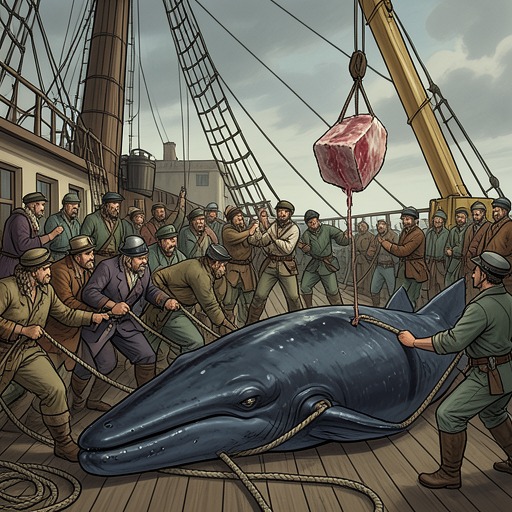
A dead whale or a stove boat!
Moby-Dick“A dead whale or a stove boat!” is the Pequod crew’s shouted formula for the immediate work of the hunt. It names the two stark outcomes that govern the sailors’ action after a whale is sighted: either the whale is killed, or the boat is smashed in the attempt. In the novel, the expression is therefore more than nautical slang. It is a compressed statement of whaling’s economy of risk, a command disguised as a refrain, and a piece of communal language through which danger becomes actionable.
Definition and Hunting Sequence
The phrase appears within a rapid sequence of questions posed by Captain Ahab after he summons the entire ship’s company aft. He asks what the men do when they see a whale; they answer that they must “Sing out for him!” He then asks what comes next, and they reply, “Lower away, and after him!” When he asks what tune accompanies their pulling, the answer is “A dead whale or a stove boat!” The order of the exchange is crucial: sighting produces a cry, the cry produces pursuit, and pursuit accepts the possibility of destruction. The expression consequently functions as the verbal endpoint of a complete operational sequence rather than as an isolated boast.
The two nouns in the formula are deliberately balanced. A dead whale represents the material object of the voyage and the reward toward which the crew’s labor is directed; a stove boat represents the immediate physical cost that may result from that labor. The expression refuses to separate achievement from peril. The whale cannot be treated as a passive commodity, because obtaining it requires the crew to enter a contest in which the animal’s strength may overturn the boat, scatter the men, or end the hunt in disaster. The refrain keeps both possibilities audible at once.
Ahab’s Speech and Collective Mobilization
Ahab’s questioning changes the ordinary relation between command and obedience. Rather than simply ordering the men to prepare the boats, he draws the expected answers from them, allowing the crew to supply the language of action in a chorus. Their responses are initially impulsive, but Ahab’s approval intensifies their animation. The sailors begin to wonder why apparently purposeless questions have made them so excited, yet they are soon eager again. The refrain thus shows speech becoming an instrument of mobilization: the men hear their own customary procedure returned to them with heightened force.
The phrase also helps Ahab convert a general whaling routine into a charged communal performance. “Sing out,” “lower away,” and “after him” belong to the practical vocabulary of the ship, but Ahab arranges them as escalating beats. By asking for the tune to which the men pull, he turns coordinated labor into something resembling a battle song. The sailors’ collective voice gives the hunt a shared tempo, while Ahab’s fierce approval invests that tempo with his own intensity. The ordinary language of seamanship becomes the audible surface of a larger pursuit.
Repetition in the Sailors’ Song
The expression returns in the forecastle song, where the sailors sing of the captain standing on the deck with a spy-glass and of a “bold harpooner” striking the whale. The song presents the hunt as cheerful, rhythmic, and socially infectious. Its exhortation that the sailors should be cheery and that their hearts should never fail places emotional steadiness beside physical danger. The men are not merely told to endure risk; they are invited to sing through it.
This recurrence gives the expression a different emphasis from its appearance in Ahab’s speech. In the earlier exchange, it is the crew’s answer to a captain who is testing and exciting them. In the song, it circulates among the sailors as part of shipboard culture. The refrain binds individual labor to the movements of the group: oars pull together, voices follow together, and the harpooner’s strike becomes the climactic action toward which the chorus is directed. Yet the song’s cheerfulness does not erase the danger encoded in “stove boat.” Its buoyant form carries a grim alternative inside it.
The song is interrupted by the call for eight bells and the summons of the next watch. That interruption places the refrain within the ship’s regulated time. The excitement of pursuit must coexist with bells, watches, orders, and the rotation of labor. The phrase therefore belongs both to the imaginative world of heroic whaling and to the repetitive discipline of a working vessel.
Risk, Labor, and the Whale Hunt
The expression’s force depends on the physical conditions of whaling. The Pequod’s boats are lowered from the ship and sent after a whale whose movements cannot be fully controlled. A successful chase may lead to a dead whale, but an unsuccessful encounter may leave the boat stove, meaning damaged or smashed, and the men exposed in the sea. The phrase makes the value of the catch inseparable from the vulnerability of the human craft pursuing it.
That tension broadens through the novel’s depictions of the oceanic environment. The Pequod passes through brit, the minute substance on which the Right Whale feeds, and the seemingly peaceful sea can conceal predatory life, including sharks and the mysterious Giant squid. Whales themselves gather in immense caravans, sometimes appearing after long periods without a sighting as a vast semicircle of jets across the horizon. The hunt takes place within a living system whose scale exceeds the crew’s plans. “A dead whale or a stove boat!” reduces that system to a stark practical alternative, but the surrounding narrative continually reveals how much uncontrollable life lies behind the formula.
The phrase also belongs to the book’s larger defense of whaling as arduous and dangerous labor. The narrator argues that the world’s candles and lamps burn to the glory of whalemen, and points to the fleet’s enormous commercial scale: hundreds of vessels, thousands of men, vast expenditure, and millions of dollars in annual imports. He further credits whale-ships with exploration, colonial contact, and the opening of routes toward Australia, Polynesia, and the Pacific coast of Spanish America. Within that expansive account, the refrain supplies the bodily reality beneath the industry’s wealth and historical claims: every profitable whale begins with men pulling toward an animal while accepting that their own boat may be destroyed.
Irony and Narrative Significance
The expression is energetic, but it is not simply triumphant. Its grammar places death and destruction on opposite sides of the same “or,” as though the result of the hunt were a matter of two equally intelligible outcomes. That blunt structure creates an irony at the center of the whaling enterprise. The crew’s livelihood, the ship’s commercial purpose, and the heroic language of the hunt all depend upon treating extreme danger as a normal working condition.
At the same time, the refrain shows how collective language can make peril feel manageable. A boat crew pulls more effectively when its effort is synchronized by rhythm; fear is transformed into timing, and uncertainty into a shared decision to continue. The line is memorable because it does not deny catastrophe. It incorporates catastrophe into the song before the boat leaves the ship. In that sense, it is both morale-building and fatalistic.
The expression also illuminates the contrast between the narrator’s broad reflections on the dignity and global power of whaling and the immediate violence of its scenes. Whaling can be presented as a peaceful influence that opened seas and connected peoples, yet its working vocabulary remains anchored in the dead whale and the stove boat. The refrain holds those perspectives together: imperial commerce and communal song on one side, animal death and human wreck on the other.
As a recurring verbal emblem, “A dead whale or a stove boat!” condenses the Pequod’s world into a single beat of decision. The men see, call, lower, pull, and strike; the outcome is either the carcass that sustains the voyage or the broken craft that exposes its cost. Its lasting significance lies in that fusion of procedure, music, solidarity, and danger: the phrase makes the whaling adventure audible while refusing to let its risks disappear beneath its heroic surface.