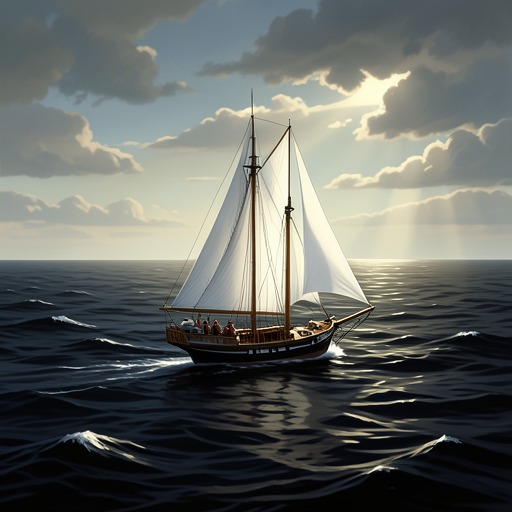
the ungraspable phantom of life
Moby-DickThe ungraspable phantom of life is the central metaphysical image through which Ishmael explains the sea’s power over the human imagination. It names the elusive likeness that people pursue in water, in travel, in religion, and in the natural world, yet can never finally grasp. The phrase turns the sea from a setting into a medium of desire, self-recognition, and inexhaustible mystery.
Origin in Water and Reflection
Ishmael develops the expression while asking why human beings are repeatedly drawn toward water. In a landscape of lakes, even an absent-minded traveler seems instinctively to find a stream or pool; in romantic painting, trees, meadows, mountains, and cottages remain incomplete until the eye is fixed upon the water; and the vast beauty of the prairie lacks its defining charm when it contains no water. These examples make water more than a scenic detail. It becomes the element that gathers scattered impressions into a meaningful whole and awakens an impulse that ordinary explanations cannot exhaust.
The same attraction appears in the desire to go to sea. Ishmael connects the urge to sail with the mystical vibration felt when a ship passes beyond the sight of land, with the ancient Persian reverence for the sea, and with the Greek decision to give the sea its own divine power. His examples move from private restlessness to historical religion, suggesting that maritime longing is not merely a sailor’s occupational habit. It is a recurring human response to a reality that seems at once visible, immeasurable, and addressed to the self.
Narcissus and the Failure to Possess
The expression receives its decisive formulation through the story of Narcissus. Narcissus sees a mild, tormenting image in a fountain, but because he cannot grasp it, he plunges into the water and is drowned. Ishmael then expands the myth beyond the individual figure: the same image appears in all rivers and oceans. The reflected surface offers recognition without possession, intimacy without mastery, and knowledge that disappears whenever the observer tries to seize it.
The image is therefore not simply a reflection of a face. It is the ungraspable phantom of life itself. The phrase preserves the tension between appearance and reality: the world presents forms that invite interpretation, but the ultimate meaning behind them remains beyond capture. The sea is powerful because it shows the seeker an image of existence while withholding the stable object that would resolve the search.
The Sea as Metaphor
The phrase gives philosophical shape to Ishmael’s decision to go to sea whenever his thoughts become hazy and his awareness of his own body becomes oppressive. He does not sail as a passenger, Commodore, Captain, or Cook; he rejects the prestige and responsibility associated with those offices and presents himself instead as someone seeking relief through movement toward the sea. His voyage is consequently both practical and inward. The ocean becomes a counterforce to mental stagnation, but it does not provide a final answer. It intensifies the very mystery that draws him toward it.
This structure recurs throughout the voyage. Father Mapple’s prayer in the pulpit makes the congregation feel as though it were praying at the bottom of the sea, and the hymn and sermon on Jonah turn drowning, disobedience, punishment, repentance, and deliverance into a religious drama of descent and return. At the Pequod’s capstan, Captain Ahab converts drinking, weapons, crossed lances, and the assembled crew into a ritual of collective purpose. His appeal to the white flame likewise transforms fire into a power against which his individual personality defiantly measures itself. These scenes do not dispel the phantom; they show communities and individuals trying to give its pressure a form through worship, ceremony, oath, and resistance.
Knowledge, Violence, and the Living Ocean
The expression also illuminates the book’s shifting treatment of marine life. In the chapter on brit, the Pequod moves through immense yellow meadows that sustain Right Whales, while the whales feed by filtering the minute substance through the fringed structures of their mouths. In the chapter on the squid, the sea appears beautiful, dangerous, and largely hidden: its creatures glide beneath lovely colors, and its food chain conducts an unending war. The ocean thus contains both nourishment and predation, serenity and violence, concealment and revelation.
The sperm whales’ immense aggregations deepen this uncertainty. After extensive hunting, they are described as forming vast caravans, sometimes appearing in numbers so great that they resemble nations joined for mutual protection. Yet within the surrounding circles of alarm, the whales continue their peaceful social life, while wounded animals and pursuing boats create sudden eruptions of violence at the margins. Ishmael recognizes a corresponding calm at the center of his own being, surrounded by grief and disturbance. The phantom is therefore not only an object outside the self; it is also the inaccessible inner stillness that persists beneath conscious turmoil.
The book’s natural history repeatedly resists the fantasy that human beings possess complete knowledge. The whale-bone whales may be driven from familiar coasts without being near extinction, retreating instead toward Polar citadels beyond ordinary pursuit; the sperm whale may disappear for weeks and then emerge in immense herds. Such observations undermine fixed human conclusions about absence, scarcity, and mastery. The sea withholds its creatures, rearranges its patterns, and exposes the limits of the observer’s map.
Human Bonds and the Limits of Mastery
The phantom’s logic extends into human relationships. When Ishmael and Queequeg exchange smoke, they become bosom friends; Queequeg divides his silver equally with Ishmael and draws him into a shared act of worship despite their different religious forms. Ishmael’s reasoning accepts that worship may consist in doing the will of God through mutual obligation, and the two men participate in each other’s ritual without resolving the theological difference between them. Their friendship does not conquer mystery. Instead, it creates a form of fellowship capable of living beside it.
Queequeg’s coffin later gives the same principle a material form. He equips it with his harpoon iron, a boat paddle, biscuits, fresh water, woody earth, sail-cloth, and Yojo, then lies inside it to test its comfort. The coffin is at once an anticipation of death, a personal object shaped by his beliefs, and an embodiment of the boundary between life and disappearance. Its later transformation into a life-buoy makes the boundary still more unstable: what seems to be a vessel for the dead becomes an instrument by which life may continue.
The ungraspable phantom of life therefore names the condition that joins the book’s largest and smallest experiences. It is present in the traveler’s instinctive search for water, in the sailor’s longing beyond the horizon, in Narcissus’s fatal reflection, in religious descent, in Ahab’s defiance of impersonal power, in the uncertain movements of whales, and in the coffin that turns death’s emblem toward survival. The phrase does not solve these contradictions. Its force lies in preserving them: life remains most compelling where it can be seen, pursued, and interpreted, but never finally possessed.