All visible objects are but pasteboard masks
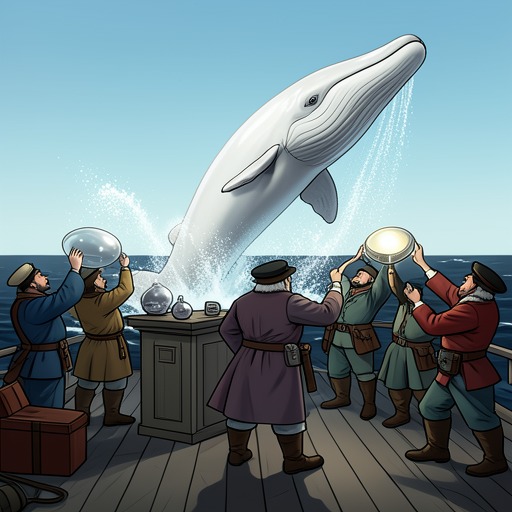
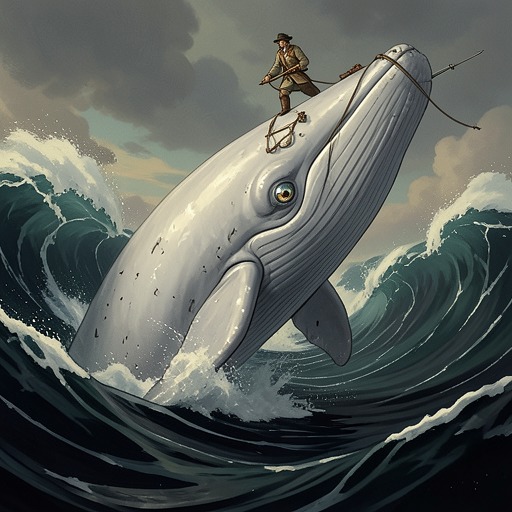
Moby-Dick“All visible objects are but pasteboard masks” is the governing expression of Captain Ahab’s metaphysical interpretation of the world. It presents visible things as thin surfaces rather than final truths: behind every event and deed, Ahab imagines some hidden, reasoning power shaping what appears. The phrase therefore explains why Moby Dick becomes more than a whale for him. The White Whale is the mask, wall, and accessible target through which Ahab attempts to strike at an unknown force behind existence itself.
Origin in Ahab’s Confrontation with Starbuck
The expression occurs when Starbuck condemns Ahab’s vengeance as madness and blasphemy because the whale struck him through blind instinct. Ahab rejects Starbuck’s distinction between a merely physical animal and a morally meaningful antagonist. He argues that an “unknown but still reasoning thing” reveals the mouldings of its features through the “unreasoning mask” of each living deed. His reasoning converts the whale’s attack from an accident of animal behavior into an event charged with hidden agency.
Ahab’s reply also makes the expression a direct answer to Starbuck’s Christian and practical objections. Starbuck sees vengeance against a “dumb brute” as a violation of moral order; Ahab sees the apparent brute as the nearest visible form of an inscrutable malice. He says that the White Whale is the wall pushed close to him and that, although he sometimes thinks there is nothing beyond it, the wall is still enough. The phrase thus contains both metaphysical uncertainty and practical certainty: Ahab cannot know what lies behind the mask, but he can still attack the mask.
The Mask, the Wall, and the White Whale
The expression gives Moby Dick a double status. The whale remains a material creature capable of striking Ahab, yet Ahab treats that material body as the surface of a larger hostile principle. He attributes to it “outrageous strength” joined with “inscrutable malice,” while leaving open whether the whale is the agent or merely the principal’s instrument. This uncertainty is crucial. Ahab’s hatred does not depend on proving the whale’s intention; the absence of proof becomes part of the object of hatred.
The wall image intensifies the mask image. A wall blocks access to what lies beyond it, but it also gives the imprisoned person something tangible to strike. Ahab’s violence is therefore directed at the limit of knowledge itself. His proposed blow through the wall is an attempt to force the hidden world to answer through physical action. In that sense, the expression does not make the White Whale transparent; it makes the whale the most concentrated and intolerable form of opacity.
From Metaphysical Suspicion to Methodical Pursuit
Ahab’s belief in hidden forces does not produce random behavior. In his cabin he repeatedly spreads charts of the four oceans, studies old log-books, and marks new courses over earlier routes. He calculates tides, currents, the drift of the sperm whale’s food, and the regular seasons in which whales appear at particular latitudes. The visible chart becomes another kind of mask: a surface of lines that Ahab uses to approach an animal whose movements remain only partly knowable.
His method depends on recurring patterns. Sperm whales are described as traveling along remarkably precise oceanic “veins,” and their seasonal routes make particular feeding grounds and passages promising places of encounter. The Season-on-the-Line offers Ahab his strongest expectation because Moby Dick has repeatedly been seen there and because earlier deadly encounters occurred in those waters. Yet the chart cannot guarantee the whale’s presence. Moby Dick’s appearances at the Seychelle ground or Volcano Bay are treated as temporary stopping-places rather than permanent habitation, so Ahab’s calculations remain “surmises” approaching certainty without becoming certainty.
This tension between map and mystery gives the expression its practical force. Ahab uses knowledge to pursue what knowledge cannot secure. The Pequod’s early departure leaves a full year before the next Season-on-the-Line, but he fills that interval with a generalized hunt through distant waters, allowing winds, monsoons, and the ship’s circumnavigating wake to become instruments in his search. The mask is not simply an illusion to be discarded; it is the only surface through which the hidden object can be tracked.
Instruments That Promise Knowledge and Fail
Ahab’s distrust of appearances extends to the instruments meant to make the world measurable. While taking the sun’s meridian with his quadrant in the Japanese sea, he can determine where he is but not where Moby Dick is, nor where any other living thing will be at the next noon. The quadrant reveals position while concealing movement, contingency, and relation. Ahab therefore denounces it as a toy that cannot predict the future and smashes it on the deck.
After destroying the quadrant, Ahab turns toward the level compass, dead reckoning, log, and line. Yet the later condition of the Pequod’s log and line exposes another irony: these instruments have long been neglected, left beneath the after-bulwark railing to suffer rain, spray, sun, and wind until they are warped and rotted. The tools of navigation are materially vulnerable even as Ahab invests them with renewed authority. His rejection of one instrument and reliance on others does not remove uncertainty; it merely rearranges the visible surfaces through which he tries to master it.
Wider Recurrences and Significance
The mask principle recurs throughout the book’s descriptions of the sea and its creatures. The Right Whale feeds in apparently peaceful meadows of brit, while sharks gather around a captured Sperm Whale in such numbers that the sea seems transformed into a living field of voracity. A squid appears as a strange spectre beneath an unnaturally quiet surface. Vast herds of Sperm Whales rise like the chimneys of a metropolis, turning animal migration into an image of organized civilization. In each case, beauty, order, and danger coexist, and the visible scene refuses to settle into one final meaning.
The expression also governs the book’s treatment of whale knowledge. Changes in the distribution of whales may look like extinction, yet the narrative proposes that some have gathered into immense caravans or retreated toward Polar citadels beyond ordinary pursuit. Numbers, routes, and appearances provide evidence but not complete possession. Even the apparent stability of migration conceals variation, separation, and the possibility that the sought creature will not be where the chart expects it.
At its most powerful, “All visible objects are but pasteboard masks” names the unstable boundary between perception and interpretation. It explains Ahab’s grandeur and his madness at once. Because he refuses to accept the whale as only an animal, every physical encounter becomes a confrontation with fate, malice, or an unknown order; because he cannot identify what lies behind the whale, his vengeance can never reach a demonstrable end. The phrase is therefore both a philosophy of appearances and the engine of Ahab’s destructive pursuit: the world’s surfaces are inadequate, but they are the only places where his war can be waged.