Catholic Church
Moby-DickThe Catholic Church is presented not primarily as a separate institution but as Ishmael's name for the universal religious community that can contain doctrinal difference. In the inn, his attempt to explain why he can worship with Queequeg turns denominational identity into an argument for shared humanity: beneath Presbyterian, pagan, and other competing forms stands what he calls the ancient Catholic Church to which everyone belongs.
Universal Belonging
Ishmael introduces the Catholic Church while Captain Bildad presses him to identify Queequeg's religious affiliation. Rather than give a narrowly accurate denominational answer, Ishmael broadens the category until it includes himself, Queequeg, Captain Bildad, Captain Peleg, and every other worshipper. He describes it as the great and everlasting first congregation of the whole worshipping world, while allowing that individuals may preserve strange private opinions that do not touch the common belief. The Church therefore functions as an image of religious universality rather than as a merely bureaucratic label.
This formulation also makes religious difference compatible with fellowship. Ishmael does not deny that Queequeg worships an idol or that his own upbringing belongs to the Presbyterian Church; instead, he treats these practices as varied expressions within a larger human relation to the divine. The language of joining hands shifts the emphasis from doctrinal uniformity to mutual recognition, and Captain Peleg responds by calling Ishmael's explanation a sermon and urging both men aboard the Pequod.
Worship and Ethical Reciprocity
The idea receives its most practical test when Queequeg prepares his evening worship before the two men sleep together. Ishmael initially hesitates because he considers himself a Christian raised in the Presbyterian Church and sees Queequeg's wooden idol as an object he should not worship. He then reasons that worship consists in doing the will of God, and that the will of God is to do to one's fellow man what one would have that fellow man do in return. Since Queequeg is his fellow man, Ishmael concludes that he should join Queequeg in Queequeg's form of worship just as he would wish Queequeg to join his.
Ishmael consequently lights the shavings, helps support the idol, offers it burnt biscuit, salutes it, and kisses its nose. The scene does not erase the difference between Presbyterian Christianity and Queequeg's practice; it dramatizes a decision to let ethical reciprocity govern the encounter. The Catholic Church, in this enlarged sense, names the fellowship produced when a religious principle is measured by conduct toward another person rather than by exclusion from a rival rite.
Biblical Imagination and the Sea
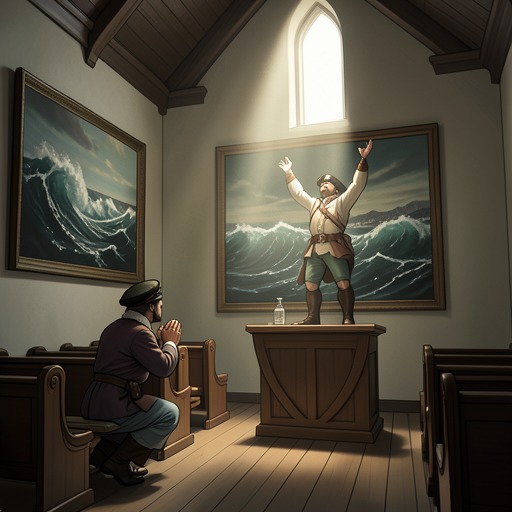
The Catholic Church's universalizing potential contrasts with Father Mapple's more explicitly Christian sermon in the Whaleman's Chapel. Father Mapple kneels in the pulpit and prays with such intensity that he seems to be praying at the bottom of the sea, then directs the congregation to the first chapter of Jonah and interprets Jonah's disobedience, fear, punishment, repentance, prayer, deliverance, and joy as a lesson for sinful human beings. The sermon places the sea, the whale, and religious instruction within a biblical framework that the sailors can inhabit collectively.
Yet the book's religious imagination is not confined to one tradition. In its meditation on the honor and antiquity of whaling, the narrative brings together Perseus, Saint George, Hercules, Jonah, and Vishnoo, treating figures from Greek, Christian, Hebrew, and Hindu traditions as members of a vast symbolic fraternity of whalemen. The Catholic Church's appearance in Ishmael's speech anticipates this wider habit of religious translation: traditions remain distinct, but the narrative repeatedly searches for the human and mythic structures that connect them.
Ritual, Authority, and Difference
Religious forms also organize collective action aboard the Pequod. Father Mapple's prayer gathers a scattered congregation into silence, while the singing of the hymn rises above the storm. Captain Ahab later stages his own ceremony around the capstan, ordering the crew to drink and arranging the mates' lances and the harpooneers' weapons into a charged communal display. He appoints the mates as cupbearers to the pagan harpooneers and presents the gesture as a reversal of hierarchy, invoking the image of a great pope washing the feet of beggars.
These scenes show both the power and the instability of religious ritual. Prayer can produce common attention and moral instruction; a captain's ceremony can transform weapons, alcohol, and obedience into instruments of collective devotion to pursuit. Ahab's flame-lit declaration that the white fire lights the way to the White Whale turns religious language toward defiance, while the crew's varied responses to the cries of seals near the Equator reveal competing Christian, pagan, and superstitious explanations. Against this background, Ishmael's Catholic Church is less a settled authority than a hopeful model of coexistence among incompatible forms of belief.
Narrative Significance
The Catholic Church matters because it supplies Ishmael with a vocabulary for resisting the easy opposition between Christian civilization and pagan otherness. His fellowship with Queequeg is sealed not by conversion but by reciprocal participation, shared smoking, gift-giving, and willingness to inhabit each other's practices. The universal Church he imagines is thus embodied in friendship before it is defined as theology.
At the same time, the narrative keeps that ideal under pressure. The Pequod contains solemn Christian preaching, Quaker ownership and speech, pagan harpooneers, individual idols, inherited legends, maritime superstition, and Ahab's quasi-religious pursuit of the White Whale. The Catholic Church becomes significant precisely within this crowded field: it names an aspiration toward common belonging, while the ship's rituals repeatedly show how easily religious symbols can unite people, authorize authority, or be redirected into violence.