Presbyterian Church
Moby-DickThe Presbyterian Church is Ishmael's inherited religious institution and the starting point for his reflections on worship, obedience, charity, and the limits of religious certainty. It gives him a vocabulary of Christian doctrine, but the narrative does not leave that vocabulary untouched: through encounters at sea and in lodging houses, Presbyterian identity becomes one tradition among many within a crowded religious world.
Identity and Religious Formation
Ishmael describes himself as born and bred within the Presbyterian Church, presenting it as the unquestioned Christian setting of his upbringing. That inheritance initially creates a conflict when Queequeg performs his evening worship before Yojo, his small wooden idol. Ishmael asks how he, as a Presbyterian Christian, could join a “wild idolator” in worshipping a piece of wood, but his reasoning turns the apparent opposition between the two religions into a test of Christian conduct. He concludes that worship means doing God's will, that God's will means treating one's fellow human being as one would wish to be treated, and that Queequeg is his fellow man. On that basis, he joins Queequeg's ritual, kindles the shavings, helps support Yojo, offers burnt biscuit, salutes and kisses the idol, and goes to bed with his conscience at peace.
This episode does not erase the Presbyterian Church from Ishmael's identity; it makes that identity interpretive rather than merely institutional. Presbyterian Christianity supplies the moral principle by which Ishmael justifies an act that his inherited doctrine might otherwise condemn. The scene therefore presents religious charity as a practice that can exceed rigid confessional boundaries, while also showing that Ishmael continues to understand his religious experiment through the categories formed by the Presbyterian Church.
Charity, Difference, and Religious Practice
Ishmael applies the same principle of charity to Queequeg's Ramadan, described as a day of fasting and humiliation. He refuses to disturb Queequeg while the observance continues and insists that Presbyterian Christians should not imagine themselves vastly superior to pagans or other believers. His judgment is deliberately self-critical: Presbyterians and pagans alike are portrayed as somehow “cracked about the head” and in need of mending. The Presbyterian Church is thus associated not only with doctrinal confidence but also with the possibility of humility before unfamiliar religious obligations.
The contrast between the Presbyterian Church and Queequeg's religion is enacted in concrete domestic practice rather than abstract theological debate. Queequeg's Ramadan involves privacy, fasting, ritual performance, and devotion to Yojo; Ishmael responds by granting the practice space and dignity even while calling its notions absurd. His position is neither simple conversion nor simple rejection. Instead, the Presbyterian moral inheritance becomes a reason to suspend religious superiority and to recognize fellowship across a boundary of belief.
Biblical Imagination at Sea
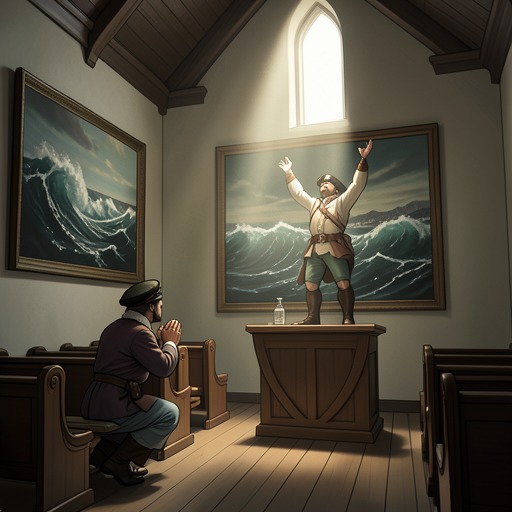
The Presbyterian world also enters the maritime community through the preaching of Father Mapple. In the Whaleman's Chapel, Father Mapple kneels in the pulpit, prays with such intensity that he seems to be praying at the bottom of the sea, and leads the congregation in a hymn whose sound rises above the storm. He then turns to the first chapter of Jonah and announces the lesson of the great fish that swallowed the prophet. The scene converts the chapel into a symbolic ship and the sermon into a meditation on sin, disobedience, fear, punishment, repentance, prayer, deliverance, and joy.
Jonah's story gives Presbyterian Christianity a language suited to sailors: divine command becomes a hard course, disobedience becomes a dangerous deviation, and the sea becomes both judgment and the setting of possible deliverance. Father Mapple's preaching also places individual conduct within a communal ritual. The scattered congregation is ordered into formation, becomes silent, prays together, and sings together before receiving the biblical lesson. The church therefore functions as a body that gathers maritime experience into a moral and theological pattern.
Christianity Among Competing Sacred Traditions
The book expands the religious field far beyond the Presbyterian Church. Whaling is presented as an ancient and honorable fraternity whose legendary members include Perseus, St. George, Hercules, Jonah, and Vishnoo. Perseus attacks a sea monster to rescue Andromeda; St. George's dragon is reinterpreted as a whale; Hercules is claimed as an involuntary whaleman because a whale swallows and disgorges him; Jonah is admitted through the biblical tradition; and Vishnoo becomes incarnate as a whale to recover sacred books from the waters. These stories do not simply confirm Presbyterian doctrine. They place the Christian Bible within a comparative mythology in which the whale repeatedly mediates danger, rescue, sacred knowledge, and divine power.
The Presbyterian Church's biblical inheritance consequently becomes one strand in a broader network of maritime myth. Jonah remains central, especially in Father Mapple's sermon, but the narrative refuses to isolate him from pagan, classical, and Hindu traditions. Religious meaning is produced through juxtaposition: the same ocean can carry a Presbyterian sermon, Queequeg's ritual, ancient legends, and the superstitions of sailors.
Ritual, Material Objects, and Limits of Authority
Religious practice in the narrative repeatedly takes material form. Queequeg divides his silver with Ishmael, worships Yojo, and later places the idol within his coffin alongside provisions, water, earth, a paddle, and the iron of his harpoon. Ahab, meanwhile, gathers the crew around the capstan, orders drink to circulate, crosses the mates' lances, and attempts to charge the assembled men with his own fiery emotion. His ritual is not Presbyterian worship, but it borrows the structure of communal ceremony and turns a shipboard gathering into an instrument of collective purpose.
At the height of the voyage, Ahab confronts a white flame and addresses it as a spirit he once worshipped as a Persian. He recognizes its impersonal power but declares that a personal self still stands against it and will dispute its mastery. The scene places individual defiance, pagan religious memory, and maritime danger in opposition to the more humble moral framework represented by the Presbyterian Church. Where Presbyterian Christianity emphasizes obedience, repentance, and charity, Ahab's ritual seeks to sanctify resistance and bind the crew to his private war.
The narrative also exposes the instability of religious interpretation. The crew hears cries near rocky islets and divides between Christian or civilized sailors, who fear mermaids, pagan harpooneers, who remain unafraid, and the old Manxman, who identifies the sounds as voices of the drowned. Ahab later explains that the sounds came from seals, though their human-seeming faces and cries preserve the superstition. The Presbyterian Church can provide one interpretive order, but the sea continually generates phenomena that exceed any single system of explanation.
Narrative Significance
The Presbyterian Church matters less as a fully described institution than as a measure of Ishmael's developing religious intelligence. It begins as his inherited standard of Christian orthodoxy, yet his conduct with Queequeg transforms that inheritance into a principle of mutual recognition. His respect for Ramadan, his participation in an unfamiliar ritual, and his attention to Father Mapple's Jonah all show a movement from denominational certainty toward comparative and experiential understanding.
In the wider narrative, Presbyterian Christianity occupies a productive middle ground between formal doctrine and the unstable sacred world of the sea. It offers scripture, communal worship, and moral language, but it shares the book with Yojo, whale legends, fire worship, maritime omens, and Ahab's improvised ceremonies. Its most persuasive value is therefore ethical rather than triumphalist: it survives in Ishmael's willingness to treat another person's religious practice with charity, even when that practice conflicts with his own inherited beliefs.